
BOOK REVIEW "A LETTER TO THE UNBORN CHILD "
FOR THOSE WHO HAVE BEEN, ARE, AND WILL BE MOTHERS

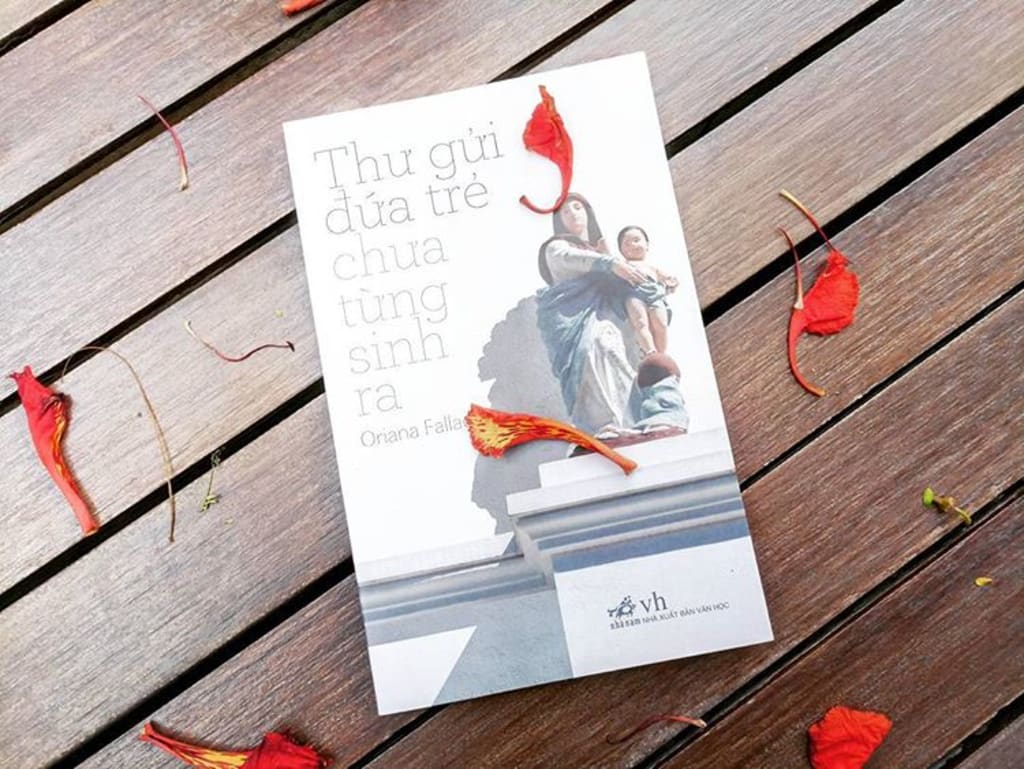
This book, dedicated to all women, is a profound message and a poignant reflection on gender equality, love, marriage, family, and life… things that have kept us trapped in a hopeless cycle for generations.
Oriana Fallaci (1929 – 2006) was an Italian journalist, writer, author, and political interviewer. Her life and career spanned most of the most significant events of the 20th and early 21st centuries, occurring worldwide, primarily as a witness in her role as a journalist, but also as a literary figure. In addition, she was a social activist for the feminist movement.
Who was Oriana Fallaci to Vietnam?
As a member of the editorial board of Europea, O. Fallaci became a special correspondent in Vietnam around the time before and after the Tet Offensive of 1968. She was present at most of the hotspots of the Vietnam War. What she witnessed and felt there was vividly reflected in her collection of essays "Life, War, and Then…" (translated by Le Minh Duc from the French edition, Ho Chi Minh City Publishing House, 1991).
Besides works depicting everyday life in the war atmosphere and intense battlefield reports, O. Fallaci was the only female journalist to interview the main actors in the Vietnam War, from Nguyen Cao Ky, Nguyen Van Thieu, Vo Nguyen Giap, to Henry Kissinger (former US Secretary of State, negotiator of the Paris Agreement in January 1973).
In particular, thanks to her intelligent and sharp interviewing style, posing provocative questions and trapping her opponent in a pincer movement, the extraordinary O. Fallaci succeeded in forcing Henry Kissinger to admit that the Vietnam War was a “useless war – unless war” (from the American perspective), and compared him to a “cowboy” leading a freight train by riding ahead alone on horseback. Kissinger later described the interview with O. Fallaci as “the most terrible conversation I’ve ever had with a reporter.”
A page from the author’s own diary
“Letter to a Child Never Born” is not simply a product of imagination; it is a part of the author’s memory. As a young woman, she met and fell in love with someone and later suffered a miscarriage. Overwhelmed by grief at the loss of her child, she even considered suicide.
“Letters to an Unborn Child,” published in 1975, sold 4.5 million copies worldwide. Originally intended as an investigative report on abortion, after seven months of work, the Italian journalist presented the manuscript, in the form of a woman's monologue during pregnancy—a responsible choice marked by internal struggle—to her editor-in-chief for publication. The book was published in collaboration with the Italian Embassy.
“One of the most beautiful writings by a woman on pregnancy, abortion, and inner turmoil.”
Throughout the work is the heartfelt confession of a single woman on the threshold of motherhood, from the moment she realizes that a life has emerged from nothingness and is present within her body. The woman had no name, no details to describe her face or age, but the sincerity in O. Fallaci's words touched the hearts of many readers, both men and women.
A mother's intuition told her that the baby was there, a drop of life existing, even without any scientific examination. Shocked, distraught, and questioning herself terribly, she wondered what would happen if one day the baby cried out to her: "Why did you bring me into this world, why?"
The world constantly talks about gender equality, about a new era and things that are no longer old, yet a woman pregnant before marriage is often perceived as immoral and irresponsible, and no one remembers the man who caused the problem and then fled. Perhaps it was this haunting thought that led her to consider abandoning her child.
Like her mother – who had once not wanted her, the child conceived by a mistake, from a moment of carelessness with someone else. But maternal instinct dispelled all fear, making her understand that pregnancy is a miracle and that being born, "rolling radiantly in the sunlight," whether happy or sad, is still better than nothing at all.
Naturally, after sensing the child's existence, she called her lover – the child's father: "How much will it cost?" I didn't quite understand him, so I cheerfully replied: "Nine months, I guess. But now it's not even eight months yet." Then his hoarse voice turned cold: "I'm talking about money." "What money?" I asked. "Money to get rid of it, of course." Yes, he said "get rid of it," as if the child were a package.
So, that man had asked her to have an abortion. He subtly shirked his responsibility like that.
After the second check-up, confirming the pregnancy, she had to endure the doctor's rudeness, the nurse's disapproving shake of the head, the pharmacist's raised eyebrows and stunned stare, the tailor's jaw drop, and her boss's speechless reaction. All because she was a pregnant woman out of wedlock. The worst part is that while the world changes, "gender equality" remains the same in this particular case, seemingly just a flowery phrase.
The decision to keep the baby brought her many difficulties. She was pregnant but couldn't rest, had no one to care for her, and still had to complete long business trips as scheduled. Her boss wouldn't accept an "unexpected incident" involving a female employee. If she didn't complete her work, she could be fired, which meant losing her job. She lost her source of income and couldn't provide for her child when it was born.
The psychological pressure and the long business trip caused her to miscarry. She tormented herself and felt as if the whole world was condemning her for murder. Even more painful, the woman suffered complications and died.
“My child is dead. Now I'm dead too. But that doesn't matter. Because life doesn't die.”
Without dramatic plot twists or complex characters, "Letter to an Unborn Child" is the proud cry of a woman wanting to break free from convention, a wild yet loving cry. She is a strong woman who has experienced much misfortune since childhood, a harsh life that has shaped her understanding of love differently. At times she plays the role of an extremely strict mother, at other times she acts like a grown-up child. Her emotions are rich yet contradictory.
This delicate book, like a lengthy letter, though brief, is enough for the woman to tell her life story, fairy tales, confide in and teach the child many things: to live bravely and never be cowardly, to learn about injustice and violence, and that "Equality, like freedom, exists only in you now. In the egg sac, we are all equal."
The Italian way of addressing others is quite similar to that of the British and Western countries in general, meaning that personal pronouns are not as diverse and rich as in Vietnamese. Therefore, the Vietnamese translation by Le Thuy Hien truly has its own unique charm. The pronouns "I - child" express a calm acceptance of the child as a continuation of life from one generation to the next, but a reluctance to acknowledge and embrace the sacred role of motherhood, until… Until the child is no longer developing… At the trial of right and wrong, the child appears in the mother's mind, for the first time a loving "mother" is sent, and also for the first time a "mother" is responded to, belatedly and with great pain.
"Motherhood is not a job. It's not even an obligation. It's just one right among many rights."
The work extols maternal love; While recounting the bitterness of being born weak, the author does not despise the fate of women, for it is an adventure that requires courage, a challenge that is never boring; at the same time, it reflects hope for life, for tomorrow. Tomorrow will come. Because life does not die.
About the Creator
HieuDinh
- Loves nature, likes to grow ornamental plants such as succulents, lotus (participates in volunteer activities to plant forests, protect forests in the locality)
- Loves dogs and cats (participates in local wildlife rescue activities)
The Planned Obsolescence of the Jedi Order
“Bound by temples and codes, the Force grows thin, for flow it must, not sit in stone. When orders cling to their names, blind they become to the living light. Only when the old walls fall does the Force remember how to breathe.”
By Peter Ayolov2 days ago in BookClub


Comments
There are no comments for this story
Be the first to respond and start the conversation.