
The Planned Obsolescence of the Jedi Order
From Sacred Guardians to Relics of Empire

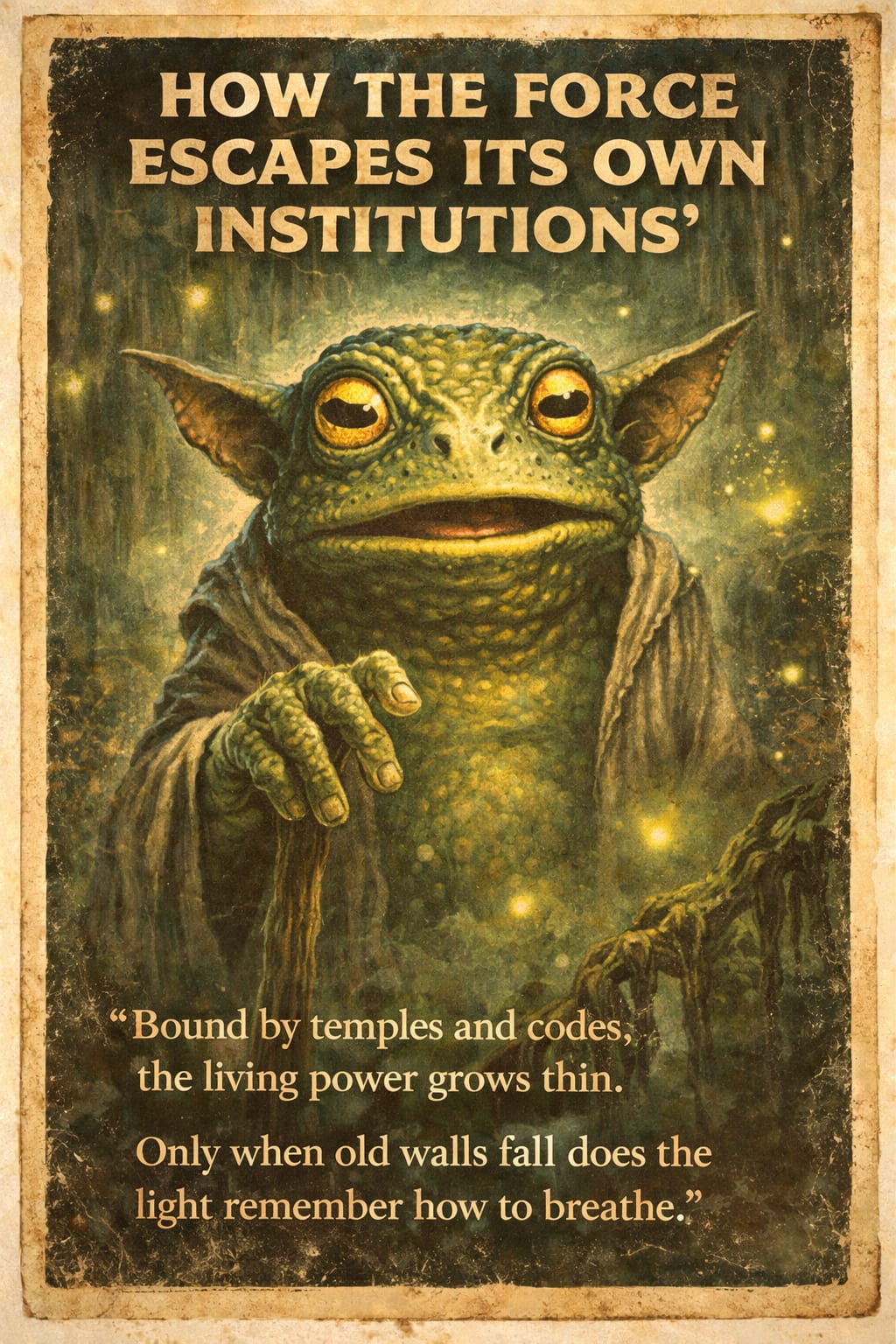
“Bound by temples and codes, the Force grows thin, for flow it must, not sit in stone. When orders cling to their names, blind they become to the living light. Only when the old walls fall does the Force remember how to breathe.”
-Grand Master Yoda of the Jedi Order, (Dagobah, in the mist-cycle of the long rains, 3 ABY, spoken to Luke Skywalker as the swamp temple sank back into the roots of the dead tree.)
Abstract
The Jedi Order occupies a unique position in the political mythology of Star Wars, presented as both the moral spine and the institutional Achilles’ heel of galactic civilisation. This article reconstructs the approximately 25,000-year history of the Jedi within the shifting structures of the Republic, tracing the transformation from the militant Old Republic to the demilitarised Galactic Republic after the Ruusan Reformations. By analysing the Order’s changing political authority, military role, and territorial scope, the text argues that the Jedi did not cause the fall of the Republic through corruption or malice, but through a fatal rigidity: an inability to recognise when the institutional framework that had sustained them for millennia had already become obsolete. Their destruction was not a sudden betrayal but the logical end point of a long historical process. Is the future of the Force destined to repeat the failures of the Jedi Order, or can Rey’s generation finally break the cycle of institutional decay that has haunted the galaxy for twenty-five millennia?
Keywords
Jedi Order, Old Republic, Galactic Republic, Ruusan Reformations, High Republic, Clone Wars, Palpatine, Star Wars political history
Introduction: A Myth of Longevity and Collapse
In both Star Wars Canon and Legends, the Jedi Order is said to have existed for approximately 25,000 years. This astonishing longevity is not merely decorative world-building; it frames the Jedi as an institution that outlived entire civilisations. Obi-Wan Kenobi’s remark in A New Hope that the Jedi were guardians of peace and justice for ‘over a thousand generations’ situates them as a quasi-timeless moral authority. Yet the saga also insists that this same institution collapsed within a few decades, annihilated almost overnight. Understanding this paradox requires looking beyond individual heroes and villains and instead examining the deep structural shifts that transformed the Republic itself. In this context, the forthcoming 2027 film Rey Skywalker: A New Order signals not a nostalgic return to Jedi glory, but a narrative experiment in institutional rebirth. The question posed from the very outset is whether Rey can found an order that resists the planned obsolescence that destroyed the Jedi, or whether every tradition of the Force is doomed to expire under the weight of its own history.
Chronological Existence of the Jedi Order
The founding of the Jedi Order is usually placed around 25,000 BBY, with Legends occasionally citing more precise dates such as 25,783 BBY. This marks the beginning of what is often called the Dawn of the Jedi, associated with early Force traditions on worlds such as Ahch-To or Tython. The broader Old Republic era spans roughly from 25,000 BBY to 1,000 BBY, a period defined by near-continuous warfare against Sith empires, Mandalorian crusades, and innumerable regional conflicts.
The oft-cited ‘thousand years’ of the Republic mentioned by Palpatine in Attack of the Clones has generated persistent confusion. This refers not to the full lifespan of either the Republic or the Jedi, but to the millennium following the Ruusan Reformations, around 1,000 BBY. That reform marked the transition from the militarised Old Republic to the modern Galactic Republic, and it is this final millennium that ended with the Clone Wars and the rise of the Empire.
Key Eras in Jedi History
The Dawn of the Jedi around 25,000 BBY represents the formative stage, when Force-sensitive traditions crystallised into an organised Order. This early period is shrouded in myth and religious experimentation, with no sharp boundary between spiritual practice and political authority.
From 25,000 to 1,000 BBY, the Old Republic period dominates the timeline. Here the Jedi function as warrior-monks deeply embedded in galactic power struggles, often leading armies and directly governing territories. This era is characterised by open confrontation with the Sith and Mandalorians, and by a Republic that is as much a military alliance as a political entity.
The High Republic, roughly 500 to 100 BBY, is retrospectively mythologised as a golden age. The Jedi are at the height of their prestige, the Republic appears stable, and the galaxy enjoys relative peace. Yet this serenity is built upon the post-Ruusan demilitarised framework that will later prove fatally brittle.
The final century, from 100 to 19 BBY, charts the fall of the Jedi. This is the age of political stagnation, bureaucratic corruption, and increasing dependence on emergency powers, culminating in the Great Jedi Purge and the establishment of the Galactic Empire.
From Old Republic to Galactic Republic
The decisive rupture between the Old Republic and the Galactic Republic is the Ruusan Reformations. After the apparent defeat of the Sith around 1,000 BBY, the galaxy attempted to inoculate itself against endless war by radically restructuring its institutions.
In governance, power was stripped from the Supreme Chancellor and redistributed to the Galactic Senate to prevent the emergence of new autocrats. Millions of star systems were reorganised into 1,024 sectors, each represented by a single Senator, creating an unprecedentedly vast but also unwieldy legislature. The inclusion of corporate and cultural entities such as the Trade Federation as Senate members introduced economic interests directly into political decision-making, sowing the seeds of later corruption.
In military affairs, the Old Republic’s massive standing forces were disbanded. The Galactic Republic maintained only the Republic Judicial Forces, a symbolic remnant rather than a true defence apparatus. Security was outsourced to local planetary militias and, crucially, to the Jedi Order itself. This demilitarisation fostered peace for centuries but left the Republic defenceless when confronted with a large-scale threat such as the Separatist movement.
The Jedi were also transformed. They were legally barred from holding political office, a sharp break from earlier centuries in which Jedi could become Supreme Chancellor. Their military titles were revoked, private armies and starfighter corps dismantled, and the Order was centralised in a single temple on Coruscant. What had once been a decentralised, semi-autonomous power became a tightly regulated religious-bureaucratic institution subordinate to the Senate.
Territorially, the shift is equally stark. The Old Republic had been a relatively compact polity focused on the Core Worlds and Mid Rim. The Galactic Republic expanded to encompass nearly all known inhabited systems, including the volatile Outer Rim, becoming galactic in fact as well as in name.
The Long Suicide of an Institution
The Jedi Order did not bring an end to the Old Republic through deliberate betrayal. Its destruction was the outcome of a slow historical narrowing of function and authority. Once warrior-statesmen, the Jedi became ceremonial peacekeepers in a demilitarised bureaucracy that mistook procedural stability for moral clarity. Their rigid adherence to the post-Ruusan system blinded them to the structural decay of the Republic and to the emergence of a new kind of enemy who did not fight openly but legislated, manipulated, and insinuated.
Palpatine did not defeat the Jedi with superior power alone; he exploited the contradictions of an institution that had survived too long in a world that no longer needed what it truly was. The fall of the Jedi is therefore not a tragedy of hubris or corruption, but a lesson in historical obsolescence: when an order forgets the conditions of its own birth, it may persist for a thousand years, yet still be perfectly prepared for extinction.
Conclusion: Birth of a Post-Jedi Galaxy
The planned obsolescence of the Jedi Order is not a historical accident but the structural destiny of every institution that confuses endurance with truth. For almost twenty-five millennia the Jedi preserved their authority by attaching themselves to successive political regimes, until adaptation hardened into captivity and spiritual guardianship degenerated into bureaucratic paralysis. When the Republic finally disintegrated, the Order had already stopped being a living tradition and had turned into an archive of its own past, loyal to a system that no longer existed in any meaningful sense.
The forthcoming 2027 film centred on Rey Skywalker places this collapse at the narrative core of the saga. Rey does not inherit a functioning Order but its ruins, and the problem confronting her is no longer how to revive the Jedi, but whether revival is even possible. If Kylo Ren revealed that the Dark Side could be stripped of Sith orthodoxy and transformed into a new grammar of power, Rey now confronts the inverse challenge: to liberate the Light Side from Jedi dogma and create a practice able to endure in a post-Republic galaxy.
The destiny of the Force will thus not be settled by bloodlines or prophecy, but by institutional imagination. Either Rey will embalm the Jedi in reverence and repeat the ancient cycle, or she will recognise that every order, even a sacred one, is subject to planned obsolescence — and that the Force may only be used for good once the very name ‘Jedi’ is finally left behind.
“Bound by temples and codes, the Force grows thin, for flow it must, not sit in stone.
When orders cling to their names, blind they become to the living light.
Only when the old walls fall does the Force remember how to breathe.”
-Grand Master Yoda of the Jedi Order, (Dagobah, in the mist-cycle of the long rains, 3 ABY, spoken to Luke Skywalker as the swamp temple sank back into the roots of the dead tree.)
About the Creator
Peter Ayolov
Peter Ayolov’s key contribution to media theory is the development of the "Propaganda 2.0" or the "manufacture of dissent" model, which he details in his 2024 book, The Economic Policy of Online Media: Manufacture of Dissent.
Keep reading
More stories from Peter Ayolov and writers in BookClub and other communities.
The Perverse Language
When Words Turn Against Meaning: A Review of The Perverse Language The Perverse Language, the fourth and concluding part of Volume I in THE MISCOMMUNICATION TRILOGY, represents the most uncompromising stage of Peter Ayolov’s inquiry into the condition of contemporary communication. If the earlier parts of the volume explore the planned obsolescence of language, the conspiratorial nature of speech, and the emergence of anti-languages, this book confronts a more disturbing development: the inversion of language itself. Here, speech does not merely decay or fragment; it becomes structurally perverse — detached from shared reference, sincerity, and ethical accountability.
By Peter Ayolov10 days ago in BookClub
Rachel Reviews: Lakefront Wolves by Joseph Deegan
Meet Finn. He's an 18 year old kid who has potential. He's bright with great school scores and he's also an athlete, a footballer of some prowess. He has it all going for him, it would seem, and yet, he's determined to send what could be a well-planned, stable existence firmly off the rails. He drinks, he smokes, he takes drugs, he has violent tendencies and he's in danger of losing not only his mind but all that he holds dear.
By Rachel Deeming15 days ago in BookClub
8 Western Novels You Must Read In 2026
Few genres capture the rugged spirit, moral complexity, and sweeping landscapes of human history like the Western novel. These stories transport us to the untamed frontiers of 19th-century America, where lawmen, outlaws, pioneers, and cowboys navigated a world defined by survival, honor, and ambition. Yet, Westerns are more than tales of horseback chases and gunfights—they explore timeless themes of courage, justice, friendship, and the consequences of human ambition.
By Diana Meresc6 days ago in BookClub


Comments
There are no comments for this story
Be the first to respond and start the conversation.