

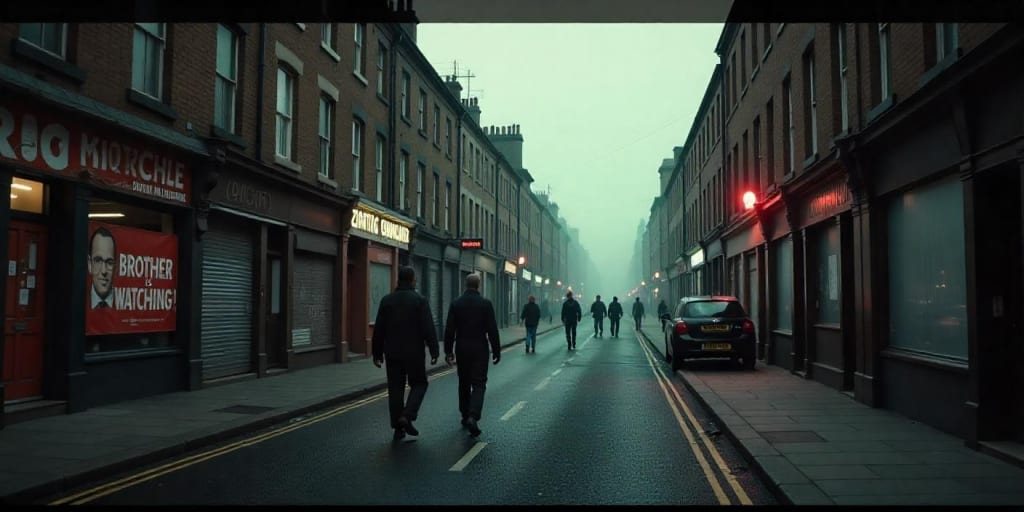
George Orwell's 1984 is more than a mere novel; it serves as a haunting prophecy, a cautionary tale inscribed in ink, and a reflection of the most sinister aspects of human society. Released in 1949, this dystopian work has endured through the decades, maintaining a disturbing relevance in the 21st century. Its exploration of surveillance, propaganda, and the degradation of truth strikes a profound chord in an era where technology and authority converge in ways that Orwell could hardly have foreseen.
The narrative takes place in Airstrip One, a territory within the superstate of Oceania, where the Party, under the watchful eye of Big Brother, maintains total dominance over all facets of existence. The main character, Winston Smith, is employed at the Ministry of Truth, tasked with modifying historical documents to align with the Party's shifting storyline. Winston inhabits a reality marked by perpetual observation, where even the slightest hint of rebellion can result in severe repercussions. The telescreens, which monitor and eavesdrop on every action, epitomize the Party's unwavering control over the truth.
The profound unease of 1984 stems from its examination of truth and the art of manipulation. The Party’s slogan, “War is peace. Freedom is slavery. Ignorance is strength,” succinctly captures the reality inversion that characterizes Oceania. Orwell presents the idea of “doublethink,” which allows individuals to accept two opposing beliefs at once, serving as a mechanism of control. In a society where facts are flexible, truth is defined solely by the Party’s declarations. This distortion of reality transcends fiction, serving as a poignant reminder of the ease with which truth can be warped in our own society.
Winston's defiance against the Party initiates with a seemingly innocuous action: he begins to keep a diary. In a world where independent thought is punishable, this act is profoundly subversive. His connection with Julia, another member of the Party, evolves into a beacon of hope and defiance. However, their romance is fated to fail, as the Party's influence is omnipresent. The harrowing climax, in which Winston is shattered in Room 101, starkly illustrates the obliteration of individuality. His final betrayal of Julia signifies the Party's ultimate victory over the essence of the human spirit.
Orwell's depiction of surveillance stands out as one of the most insightful elements of 1984. The telescreens, which observe every action and utterance, anticipate the contemporary landscape of digital monitoring. In today's world, our activities are constantly recorded by smartphones, social media platforms, and a myriad of other technologies. Although these innovations provide ease of use, they simultaneously provoke concerns regarding privacy and individual freedom. As Orwell cautioned, the distinction between safety and tyranny is alarmingly fragile.
The novel explores the influence of language as a means of control. Newspeak, the official language of the Party, is crafted to eradicate the potential for rebellious thoughts by narrowing the spectrum of expressible ideas. By constraining language, the Party aims to restrict thought itself. This idea serves as a powerful reminder of how language influences our perception of reality. In an era characterized by misinformation and “fake news,” Orwell’s caution regarding the manipulation of language resonates with heightened urgency.
1984 is not an easy read, nor is it intended to be. It presents a stark and unyielding examination of the perils of unchecked authority and the vulnerability of truth. Orwell’s depiction of a totalitarian future serves as a clarion call for vigilance, encouraging us to challenge authority and safeguard our liberties. As we navigate the intricacies of contemporary society, 1984 remains a chilling reminder of what is at stake.
Winston's ultimate defeat serves as a warning for all of humanity, not merely a personal loss. The Party's triumph is rooted not in the domination of physical beings, but in the manipulation of thoughts. Orwell conveys a powerful message: the struggle for truth and liberty is an ongoing endeavor. It is a fight we must engage in daily to avoid descending into the dystopia depicted in 1984.
About the Creator
A História
"Hi. My name is Wellington and I'm a passion for general history. Here, I publish articles on different periods and themes in history, from prehistory to the present day.
Keep reading
More stories from A História and writers in BookClub and other communities.
Dune Messiah
Frank Herbert's Dune Messiah, released in 1969, serves as the second book in the influential Dune series. While the first book, Dune (1965), is widely regarded as a seminal work in science fiction, Dune Messiah ventures into new territory, examining the ramifications of power, prophecy, and the essence of humanity. This sequel presents readers with a more somber atmosphere, intricate themes, and ethically complex characters, further establishing Herbert's status as a pioneering author willing to navigate the complexities of his narrative world.
By A Históriaabout a year ago in BookClub
Rachel Reviews: Lakefront Wolves by Joseph Deegan
Meet Finn. He's an 18 year old kid who has potential. He's bright with great school scores and he's also an athlete, a footballer of some prowess. He has it all going for him, it would seem, and yet, he's determined to send what could be a well-planned, stable existence firmly off the rails. He drinks, he smokes, he takes drugs, he has violent tendencies and he's in danger of losing not only his mind but all that he holds dear.
By Rachel Deeming9 days ago in BookClub
8 Best Books That Introverts Will Love
In a world that often celebrates the loudest voices, introverts may feel overlooked, undervalued, or misunderstood. Yet, the power of quiet reflection, deep thinking, and meaningful connection is profound—and literature has a unique way of speaking directly to the introverted soul. Whether you thrive in solitude, savor thoughtful conversation, or crave stories that resonate with inner reflection, there are books that feel like they were written just for you.
By Diana Meresc6 days ago in BookClub


Comments
There are no comments for this story
Be the first to respond and start the conversation.