Muhammad Hussain
Bio
I have been through very tough time, life is not safe for everyone, some people may have gifted the things they want, and some struggling to get things, don't lose hope no matter how upset you are, be a role model for someone
Stories (17)
Filter by community
Why We Talk to Ourselves. AI-Generated.
Have you ever caught yourself whispering under your breath while working on something? Or maybe you have replayed a conversation in your head, imagining what you could have said differently. At first, it may seem strange, but talking to ourselves is one of the most natural things we do as humans. Far from being a sign of madness, self-talk is a powerful tool that shapes the way we think, act, and even succeed.
By Muhammad Hussain6 months ago in Psyche
Dreams as Emotional Therapy. AI-Generated.
Every night when we close our eyes, our minds enter a mysterious world of dreams. Some dreams make us laugh, others frighten us, and some leave us puzzled for days. While many people dismiss dreams as random images, science shows they serve a deeper purpose. Dreams are not meaningless; they are one of the brain’s most powerful tools for emotional healing.
By Muhammad Hussain6 months ago in Psyche
The Spotlight Effect: Why We Think Everyone Is Watching Us. AI-Generated.
Introduction Have you ever walked into a room and felt like everyone was looking at you? Maybe you spilled coffee on your shirt, gave the wrong answer in class, or wore something unusual to work. In that moment it feels as if a bright spotlight has been turned on you and all eyes are staring. This is what psychologists call the spotlight effect.
By Muhammad Hussain6 months ago in Psyche
The First Impression: Why We Judge in 7 Seconds. AI-Generated.
Introduction Have you ever met someone and within seconds decided whether you liked them or not? It happens so quickly that we often do not even realize it. Science shows that humans form strong opinions about others in as little as seven seconds. This process is called a first impression and it can have a lasting impact on how we view people in the future.
By Muhammad Hussain6 months ago in Psyche
The Science of Loneliness: Why We Feel Alone Even in a Crowd. AI-Generated.
Introduction You’ve probably experienced this before: standing in the middle of a party, surrounded by laughter, conversations, and music yet feeling an emptiness inside, as if you don’t belong. This is loneliness in its rawest form. It isn’t just about being physically alone. It’s a psychological state that can strike even when we are surrounded by people.
By Muhammad Hussain6 months ago in Psyche
The Paradox of Choice: Why Having More Options Makes Us Unhappier. AI-Generated.
Introduction: Imagine standing in a supermarket aisle with hundreds of cereal boxes lined up in front of you. Different flavors, sizes, health claims, and price tags scream for your attention. At first glance, it feels empowering you have the freedom to choose. But as you reach for a box, a strange feeling creeps in: What if I’m making the wrong choice? What if the one I didn’t pick was better?
By Muhammad Hussain6 months ago in Psyche
The Old Notebook. AI-Generated.
Life has a mysterious way of guiding us toward the things we need, even when we don’t realize it. For some, it may be a person, for others, a moment but for one struggling student, it was something as ordinary as an old, second-hand notebook. What seemed like a simple purchase turned into a turning point in his life, reminding him that wisdom can come from the most unexpected places.
By Muhammad Hussain6 months ago in Education
The Empty Chair. AI-Generated.
In every classroom, there are memories that never fade moments, faces, and stories that remain etched in the heart of a teacher forever. For one teacher in a small town school, that memory was symbolized by something unusual: an empty chair. To his students, it was just an ordinary chair, but to him, it carried the weight of a promise, a loss, and an unspoken hope.
By Muhammad Hussain6 months ago in Motivation
The Silent Helper. AI-Generated.
In the narrow lanes of an old neighborhood, where life moved slowly and neighbors knew each other’s stories, there lived a widow named Shabana. She was in her late forties, with lines of worry etched across her face and eyes that often carried a distant sadness. After losing her husband to illness, Shabana found herself alone with two children to raise. Life had never been easy, but widowhood turned survival into a daily struggle.
By Muhammad Hussain7 months ago in Fiction
The Street Musician. AI-Generated.
In the heart of a crowded city, where honking horns and restless footsteps fill the air, a man sat every evening on the same street corner with an old guitar. His name was Kareem. His clothes were worn, his beard untrimmed, and his eyes heavy with tiredness. To passersby, he looked like just another man trying to earn a few coins. But for Kareem, that street corner was not just a place to make money it was the last stage left in his dream of being a musician.
By Muhammad Hussain7 months ago in Motivation
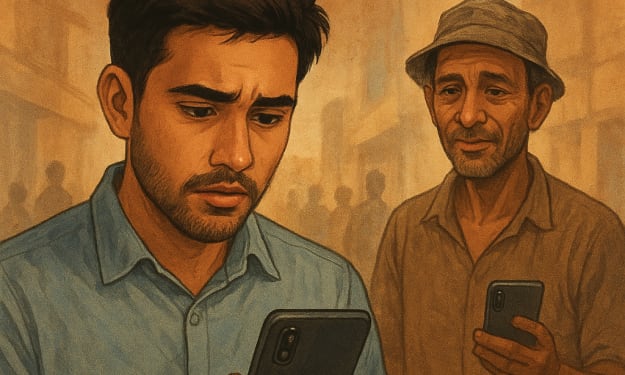
The Lost Phone. AI-Generated.
It was an ordinary day, one of those busy afternoons when the streets of the city are overflowing with noise, vendors calling out, and people rushing to get somewhere. A young man named Adnan was returning home from work, his mind preoccupied with deadlines and bills, when he suddenly realized his phone was missing. His pocket was empty. Panic rushed through him in today’s world, losing a phone feels like losing a part of your life.
By Muhammad Hussain7 months ago in Fiction
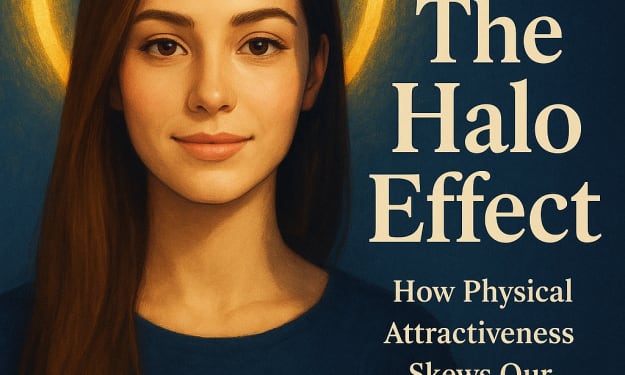
The Halo Effect: How Physical Attractiveness Skews Our Judgment. AI-Generated.
The Halo Effect: How Physical Attractiveness Skews Our Judgment Have you ever met someone and instantly assumed they were kind, intelligent, or trustworthy simply because they were physically attractive? That instant, almost unconscious leap in judgment is no accident it’s called the Halo Effect, one of the most powerful psychological biases influencing our perceptions every day. This phenomenon occurs when one positive trait, such as beauty, creates a “halo” that leads us to assume other unrelated positive traits. In other words, our brains are quick to believe that “good-looking” equals “good person.”
By Muhammad Hussain7 months ago in Psyche