Mohammed Shahidullah-Bin-Anwar
Bio
Mohammed Shahidullah-Bin-Anwar is a geopolitical analyst and historical writer (MA, University of Dhaka) who contributes to Wikipedia, Wikimedia Commons and ResearchGate while maintaining TIME PRINTER, his political history website.
Stories (19)
Filter by community
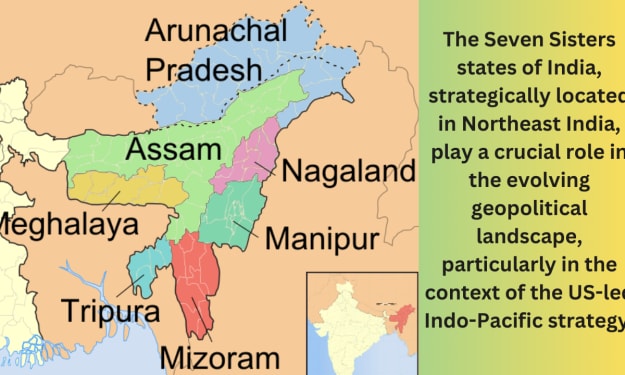
The Geopolitical Landscape of India’s Seven Sisters: A Strategic Northeastern Frontier
India’s northeastern region, known as the Seven Sisters, consists of seven states—Assam, Meghalaya, Arunachal Pradesh, Nagaland, Manipur, Mizoram, and Tripura—nestled between the borders of Bangladesh, Bhutan, and Myanmar. These states, due to their unique geographical positioning, ethnic diversity, and turbulent histories, have always held a vital yet delicate position within India's geopolitical framework.
By Mohammed Shahidullah-Bin-Anwar about a year ago in Education
Factors Hindering Ottoman Conquest of Persia
The Ottoman Empire, renowned for its impressive conquests and expansion across three continents, never succeeded in conquering Persia, despite numerous attempts. Several key factors contributed to this outcome, encompassing geographical challenges, logistical issues, and staunch Persian resistance. If the Ottoman Empire had successfully conquered Persia, the historical, cultural, political, and economic landscapes of the region and beyond would have been significantly altered.
By Mohammed Shahidullah-Bin-Anwar 2 years ago in Education
The Seven Years' War: A Clash of Empires Reshaping the World Order. Content Warning.
The Seven Years' War, often dubbed as the world's first global conflict, stands as a watershed moment in history, altering the geopolitical landscape and setting the stage for subsequent power struggles and revolutions. Emerging from a complex web of colonial rivalries, territorial ambitions, and diplomatic realignments, this conflict pitted major European powers against each other across multiple continents. This article seeks to delve into the roots, dynamics, and consequences of the Seven Years' War, highlighting its profound impact on the balance of power, colonialism, and the course of history.
By Mohammed Shahidullah-Bin-Anwar 2 years ago in Education
The Battle of Diu 1509: Portuguese Naval Power in the Indian Ocean. Content Warning.
The Battle of Diu, fought on February 3, 1509, stands as a pivotal event in the history of naval warfare, symbolizing the dawn of European dominance in the Indian Ocean. Led by Admiral Dom Lourenço de Almeida, the Portuguese fleet engaged in a fierce struggle with a formidable coalition comprising the Sultanate of Gujarat, the Mamluk Sultanate, the Ottoman Empire, and other regional powers. This historic clash not only showcased the technological superiority of the Portuguese but also marked a turning point in the geopolitical landscape of the early modern period.
By Mohammed Shahidullah-Bin-Anwar 2 years ago in Education
Breaking the Chains: The First Portuguese Republican Revolution. Content Warning.
The 31 January 1891 revolt in Portugal was the first attempt by republicans to overthrow the monarchy. It was triggered by the British Ultimatum, which demanded Portugal's withdrawal from southern African territories it claimed. The revolt was fueled by national humiliation and inspired by the proclamation of a Republic in Brazil. Led by sergeants and lacking high-ranking officers' support, the revolt became known as the "revolt of the sergeants."
By Mohammed Shahidullah-Bin-Anwar 2 years ago in Education
Charles Curtis: Pioneering Path of Perseverance and Achievement. Content Warning.
In a moment that would leave an indelible mark on American politics, Charles Curtis embarked on a transformative journey in 1907, solidifying his place as a trailblazer by becoming the first Native American US Senator. His remarkable story unfolded against a backdrop of cultural diversity and a rapidly evolving political landscape, forever shaping the course of history.
By Mohammed Shahidullah-Bin-Anwar 2 years ago in Education
The Russian Exploration Legacy: Concluding the Age of Discovery
The Age of Discovery, spanning the 15th to the 17th century, witnessed European sailors embarking on daring expeditions to explore, colonize, and conquer new territories globally. Triggered by the decline of the Mongol Empire, the control of Mediterranean trade routes, and the rise of new Atlantic coastal nations, this era marked a surge in exploration. However, it was the Bellingshausen Expedition, led by Fabian Gottlieb von Bellingshausen and Mikhail Lazarev, that is often regarded as concluding this fascinating chapter of human exploration.
By Mohammed Shahidullah-Bin-Anwar 2 years ago in History
Jefferson's Legacy: Shaping Minds at the University of Virginia
On January 25, 1819, the General Assembly officially sanctions Central College in Charlottesville as the chosen location for the esteemed University of Virginia. This momentous occasion marks the inaugural meeting of the Board of Visitors of the University of Virginia. The University of Virginia stands as a testament to the rich history and educational legacy of the United States. Established by visionaries such as Thomas Jefferson, the university has evolved over the centuries, adapting to the changing educational landscape while preserving its founding principles.
By Mohammed Shahidullah-Bin-Anwar 2 years ago in Education
The Russo-Persian War of 1827: Shaping Armenia's Geopolitical Landscape for Centuries
The year 1827 marked a momentous turning point in Armenian history, as the Russo-Persian War triggered significant geopolitical shifts in the region. Armenia had endured over a thousand years of Muslim rule, but the capture of Yerevan by General Ivan Paskevich's Russian army signified the end of this era. In this article, we will delve into the enduring geopolitical consequences of this pivotal event, which continue to influence contemporary Armenia.
By Mohammed Shahidullah-Bin-Anwar 2 years ago in History
Ostpolitik: Germany's Diplomatic Masterstroke
The story of Germany's division and subsequent reunification is a complex and compelling narrative that spans the 20th century. This article will explore the key events that led to the division of Germany, the consequences of this division, and the remarkable reunification process that brought East and West Germany back together as one nation.
By Mohammed Shahidullah-Bin-Anwar 2 years ago in History
Victory of Arab Forces: Alexandria Conquered by Amr ibn al-'As
Alexandria, also known as Al-Iskandariyyah, is a significant city in Egypt. It was once a great city of the Mediterranean world, known for its Greek learning and science. Founded by Alexander the Great in 332 BCE, it served as Egypt's capital until it surrendered to Arab forces led by ʿAmr ibn al-ʿĀṣ in 642 CE.
By Mohammed Shahidullah-Bin-Anwar 2 years ago in History
Evolution of Diplomacy: From Benjamin Franklin to Modern State Department
The United States Department of State, also known as the State Department, is the oldest executive department in the United States government. Established in 1789, it is responsible for the country's foreign policy and international relations. Over the years, the State Department has played a crucial role in shaping the course of history and promoting American values around the world.
By Mohammed Shahidullah-Bin-Anwar 2 years ago in History