
The Geopolitical Landscape of India’s Seven Sisters: A Strategic Northeastern Frontier
Navigating Geopolitical Complexities and Strategic Opportunities in India's Northeastern Frontier

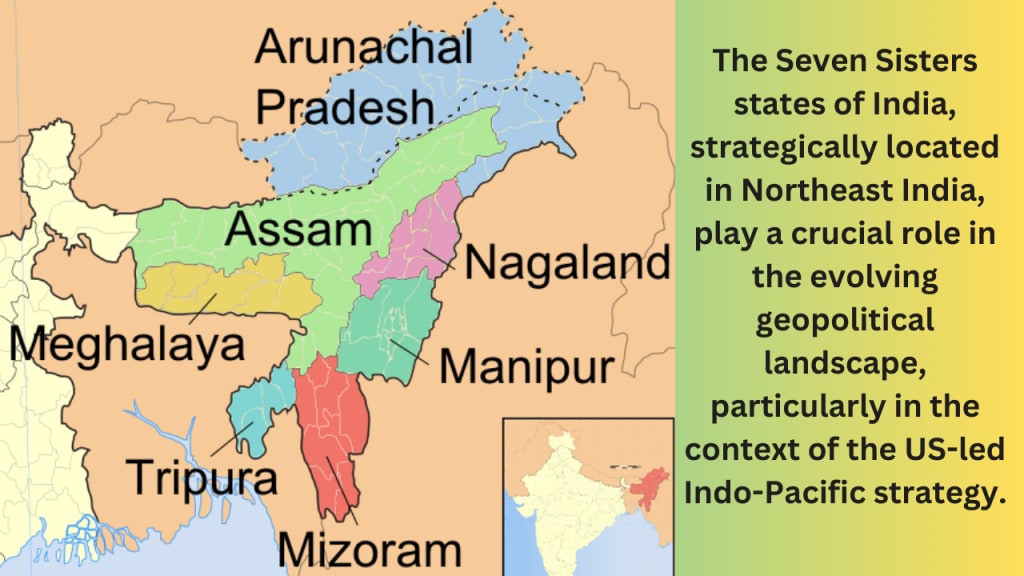
India’s northeastern region, known as the Seven Sisters, consists of seven states—Assam, Meghalaya, Arunachal Pradesh, Nagaland, Manipur, Mizoram, and Tripura—nestled between the borders of Bangladesh, Bhutan, and Myanmar. These states, due to their unique geographical positioning, ethnic diversity, and turbulent histories, have always held a vital yet delicate position within India's geopolitical framework.
Historical Context: From Colonial Legacy to Modern Challenges:
The history of the Seven Sisters is steeped in colonial legacies. When India gained independence in 1947, the region became integral to the new nation’s territorial integrity, despite its geographic isolation and the existence of multiple indigenous and ethnic communities. Much of the contemporary political and social challenges in this region can be traced back to the colonial period when British administrators either neglected or exploited its resources and people.
After India’s independence, the region was quickly recognized for its geopolitical importance, not only because it formed the northeastern frontier but also because it connected South Asia to Southeast Asia. The narrow Siliguri Corridor, also referred to as the “Chicken's Neck,” is a lifeline that connects this region to mainland India. This bottleneck underscores the vulnerability of the northeastern states, as they are geographically isolated and share porous borders with countries like China, Myanmar, and Bangladesh, making them susceptible to external and internal influences.
The Strategic Significance of Assam:
Among the Seven Sisters, Assam holds a prominent place geopolitically due to its natural resources, population, and central location. Assam is the most populous state in the region, with a significant proportion of its population adhering to Hinduism and Islam. It is also home to key rivers like the Brahmaputra, which is not only vital for agriculture and water resources but also has strategic implications given the transboundary nature of water disputes between India, China, and Bangladesh.
Assam’s border with Bhutan and Bangladesh, along with its close proximity to China, makes it an important state in India's external security calculus. The presence of the Kaziranga and Manas National Parks has given Assam an international profile for conservation, but more crucially, the state is a site of increasing military infrastructure and security efforts to counter both external and internal threats.
Arunachal Pradesh and the Sino-Indian Tensions:
The geopolitics of Arunachal Pradesh is defined by the persistent tension between India and China over the McMahon Line, which separates the state from Chinese-controlled Tibet. This territorial dispute, rooted in historical ambiguities from the British colonial era, has sparked multiple skirmishes and border standoffs, the most famous being the Sino-Indian War of 1962. China’s continued claims over Arunachal Pradesh, which it refers to as "South Tibet," remain a critical point of contention in Sino-Indian relations.
Due to its proximity to China, Arunachal Pradesh has become a hub for Indian military presence, with an extensive buildup of infrastructure and troops to counter possible Chinese incursions. The state's vast forests and remote terrain provide both strategic advantages and challenges for India, making Arunachal Pradesh a keystone in India’s defense strategy.
Meghalaya and Bangladesh Relations:
Meghalaya shares its borders with Bangladesh and, since its formation in 1972, has been important in the context of India-Bangladesh relations. With the increasing strategic importance of the Bay of Bengal Initiative for Multi-Sectoral Technical and Economic Cooperation (BIMSTEC) and the Act East Policy, Meghalaya has found itself playing a role in facilitating cross-border trade and people-to-people exchanges with Bangladesh.
The region's rich resources, particularly in minerals, have attracted attention from both India and Bangladesh, but it is also subject to challenges related to illegal immigration, which has stoked ethnic and political tensions. The strategic geography of Meghalaya allows for overland trade routes, yet it is a space where cooperation and conflict coexist, making it a geopolitically sensitive zone.
Nagaland, Manipur, and the Border Dynamics with Myanmar:
Nagaland and Manipur are two of India’s northeastern states that share borders with Myanmar. Both states have a history of insurgency and political unrest, often rooted in ethnic aspirations and demands for greater autonomy. Nagaland, in particular, has been home to one of India’s longest-running insurgencies, with the Naga people seeking independence or greater self-determination. Similarly, Manipur has experienced decades of internal strife due to separatist movements and ethnic conflicts, such as the ongoing Meitei vs. Kuki conflict.
The geopolitical importance of Nagaland and Manipur lies in their proximity to Myanmar, a nation undergoing significant political turmoil. The porous border allows for the easy movement of insurgents, arms, and narcotics, complicating India's efforts to maintain security. India's partnership with Myanmar's military junta has been driven by the necessity to curb insurgency and promote stability in the northeastern states, even as the region remains a potential hotspot for external intervention and cross-border militancy.
You May Also Read:
- 450 Years of Portuguese Rule in Goa: A Colonial Legacy Explored
- Teesta Water Sharing: A New Political Drive for Bangladesh
- India's Geopolitical Ascendancy: Sittwe Port, Kaladan Project, and Beyond
- Nepal as a Buffer State: Historical and Geostrategic Insights
Mizoram and Tripura: Geopolitical Marginality and Ethnic Identity
Mizoram and Tripura, the two smaller northeastern states, are often overshadowed by their larger neighbors, but they play vital roles in India’s border security and ethnic politics. Mizoram, located at the southeastern tip of India, shares a border with both Myanmar and Bangladesh. It is one of India’s most ethnically homogeneous states, with a high percentage of its population belonging to scheduled tribes.
While Mizoram has remained relatively peaceful compared to other northeastern states, its proximity to Myanmar makes it vulnerable to the spillover effects of political instability, such as the refugee crisis caused by the ongoing military crackdown in Myanmar. This has geopolitical consequences, as India must manage both humanitarian and security concerns while maintaining diplomatic relations with Myanmar.
Tripura, which borders Bangladesh, has experienced its own history of conflict, particularly due to the migration of refugees during and after Bangladesh's War of Independence in 1971. The demographic shifts led to ethnic tensions between the indigenous Tripuri population and Bengali settlers. Despite its small size, Tripura's high literacy rate and strategic location between multiple nations have made it a focal point for India’s efforts to integrate the northeastern region into its larger geopolitical strategy.
The Geopolitical Future of the Seven Sisters:
India's northeastern frontier continues to be an area of significant geopolitical interest. The Act East Policy, aimed at strengthening economic and strategic ties with Southeast Asia, places the Seven Sisters at the center of India’s outreach. With its proximity to Bangladesh, Bhutan, Myanmar, and China, the region serves as India’s gateway to Southeast Asia, offering opportunities for economic growth, trade, and regional connectivity.
However, the region's geopolitical challenges—ranging from insurgency and ethnic conflict to the complexities of cross-border relations with China and Myanmar—are far from resolved. The ongoing infrastructure projects, such as highways and railroads, are intended to enhance connectivity, yet the rugged terrain and difficult political landscape present formidable barriers.
The Seven Sisters will continue to be a region of both strategic opportunity and vulnerability for India. The state's relationships with its neighbors, particularly China and Myanmar, will shape the geopolitical landscape for years to come, and India's ability to manage internal diversity and external threats in this region will determine the future stability of its northeastern frontier.
About the Creator
Mohammed Shahidullah-Bin-Anwar
Mohammed Shahidullah-Bin-Anwar is a geopolitical analyst and historical writer (MA, University of Dhaka) who contributes to Wikipedia, Wikimedia Commons and ResearchGate while maintaining TIME PRINTER, his political history website.
Keep reading
More stories from Mohammed Shahidullah-Bin-Anwar and writers in Education and other communities.
Factors Hindering Ottoman Conquest of Persia
The Ottoman Empire, renowned for its impressive conquests and expansion across three continents, never succeeded in conquering Persia, despite numerous attempts. Several key factors contributed to this outcome, encompassing geographical challenges, logistical issues, and staunch Persian resistance. If the Ottoman Empire had successfully conquered Persia, the historical, cultural, political, and economic landscapes of the region and beyond would have been significantly altered.
By Mohammed Shahidullah-Bin-Anwar 2 years ago in Education
Speak and Be Heard: A Beginner’s Guide to Becoming a Podcast Host and Growing Your Audience
Becoming a podcast host is an exciting way to share your ideas, inspire others, and build a strong community. Whether you want to teach, entertain, or have great conversations, podcasting gives you a voice that can reach people around the world. But starting a podcast and growing an audience takes more than just a microphone. It requires planning, patience, and a real connection with your listeners. In this guide, you'll learn how to become a podcast host and grow your audience step by step.
By Spencer Hakimian4 days ago in Education
Beyond Deals: Building Alliances That Truly Scale
Strategic partnerships for growth help companies expand faster and smarter. They enable two or more businesses to work together to create shared value. Each partner brings skills, reach, or resources that the other lacks. When done right, strategic partnerships create long-term growth that feels natural and steady.
By Rushi Manche7 days ago in Education


Comments
There are no comments for this story
Be the first to respond and start the conversation.