
What is your escape plan?
If your home caught fire, what would you do?

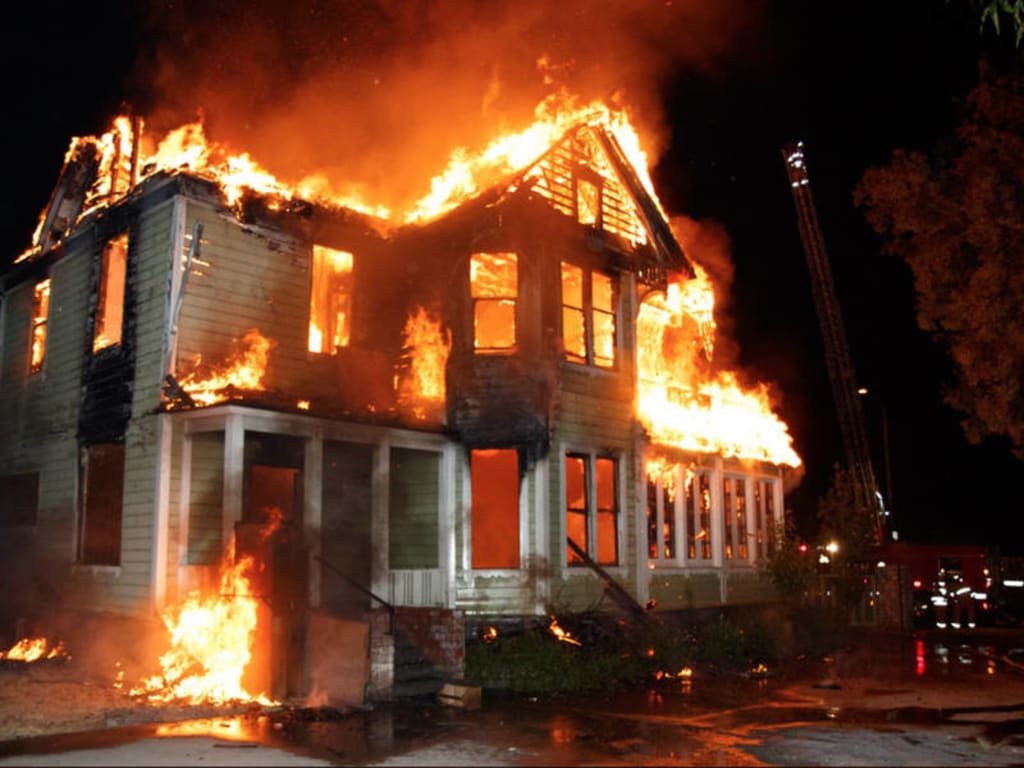
It is very important to know how you and your family would get out of your house in case of an emergency, such as a fire. Many lives have been lost because the inhabitants had not thought this through and therefore panicked when disaster struck.
Most fatal house fires take place at night when everyone is upstairs and asleep. An ignored cigarette end or an overheating electrical appliance can be the cause, and the fire can have taken good hold before anyone is aware of it.
It goes without saying that having a working smoke alarm is essential, because smoke kills more people than flames do, and you need to be woken in good time in order to make good your escape.
However, you still need an escape plan for the moment when the alarm sounds.
When I was a teenager my parents installed double glazing for the first time. My bedroom was given a large picture window that only had a top section that opened for ventilation. This consisted of a set of small louvres that were no more than a couple of inches wide – clearly nobody could escape through these. Had there been a fire I would have had no way of getting out except via the door, and if the fire was at the foot of the stairs that might have been impossible.
Breaking a double-glazed window is far from easy – throw a chair at one and all that is likely to happen is that the chair will bounce back and send you flying! There is a trick for breaking such a window and that is to hit it with a sharp object in one corner. Part of one’s escape plan might therefore be to keep a hammer and chisel close by in case they are needed in an emergency.
Having windows that open wide enough to allow you to get out of them is therefore a good idea, and should be a consideration if you are having new windows installed. If the windows lock, you should either leave them unlocked at night or, if you are worried about security, make sure that the key is ready to hand – even better, leave the key in the lock when you go to bed.
Having an alternative escape plan is also a good idea, because you don’t know where the emergency will arise and you don’t want to be stymied by having your only escape route put out of action. My family’s escape plan bears this in mind because, although we lock the front door at night, we always leave the key in the lock on the inside so that we wouldn’t have to fetch the key from elsewhere should the need arise. The front door is right at the foot of the stairs, so even if this area was full of smoke it would be feasible to take a deep breath at the top of the stairs, rush down and open the door in a matter of seconds.
Another consideration is what you would land on if you had to escape via an upstairs window. There would be little point in escaping a fire only to impale yourself on a set of sharp spikes on the fence just outside the house! Flower beds, either bare or growing “soft” plants, are much less injurious to land on than solid concrete.
I once stayed in an Oxford college room, several floors up, which had what looked like a somewhat primitive but hopefully effective escape route. Above the window, inside the room, was a large hook firmly fixed to the wall. Next to the window was a glass case in which there was a coil of rope with a loop in one end. To escape you smashed the glass case, opened the window, hooked the rope to the hook and let yourself down. I did not test this, but I have to assume that the rope was long enough!
Whatever the plan, the important thing is to have one – preferably two.
About the Creator
John Welford
John was a retired librarian, having spent most of his career in academic and industrial libraries.
He wrote on a number of subjects and also wrote stories as a member of the "Hinckley Scribblers".
Unfortunately John died in early July.
Keep reading
More stories from John Welford and writers in Lifehack and other communities.
5 Simple Lifehacks to Keep Your Teeth Healthy Every Day
Healthy teeth aren’t just about occasional dental visits—they’re shaped by the little choices you make every day. Simple habits, when done consistently, can prevent cavities, gum issues, sensitivity, and other oral concerns while keeping your smile bright and comfortable. These lifehacks are easy to integrate into your routine and don’t require drastic lifestyle changes.
By Smile Sydney2 days ago in Lifehack
Review of 'Man on the Run'
My wife and I saw Man on the Run, a nearly 2-hour documentary on Amazon Prime, about Wings, Paul McCartney's group that flew around the world from shortly after The Beatles broke up in early 1970 to shortly after John Lennon was murdered at the end of 1980, making a Beatles reunion forever impossible.
By Paul Levinson5 days ago in Beat


Comments
There are no comments for this story
Be the first to respond and start the conversation.