
"Zama Nang, Zama Wafa"
A Tale of Honor, Loyalty, and the Echoes of the Tribal Hills

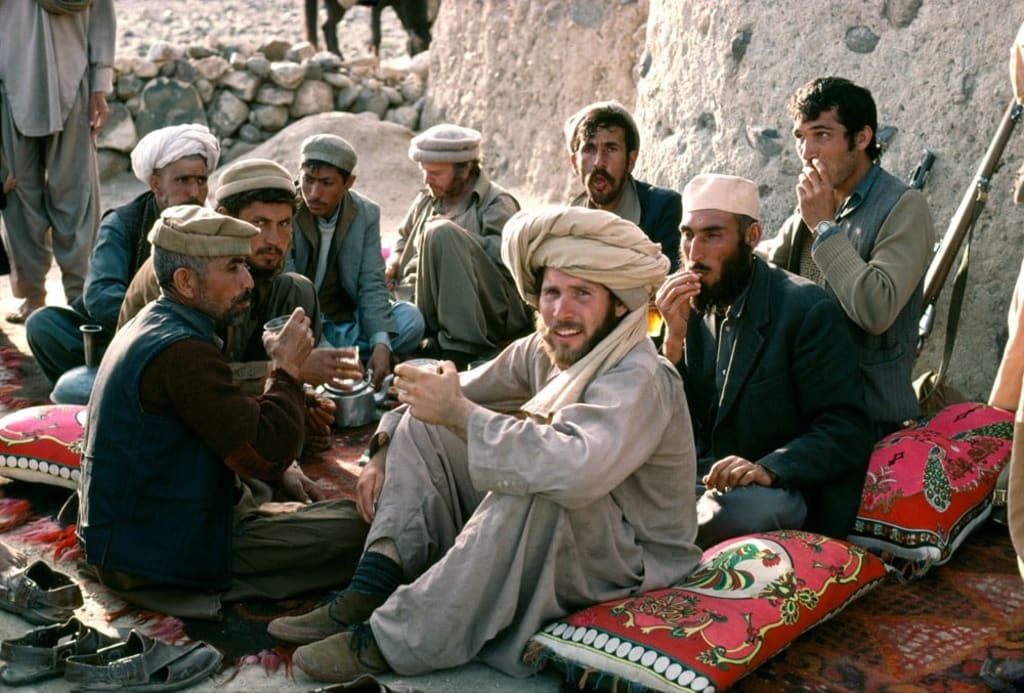
In the heart of the Spin Ghar mountains, where the snow caps sparkle under the golden Afghan sun, a young Pashtun named Tariq Gul was born into the proud Mohmand tribe. From his earliest days, Tariq was raised under the towering shadows of tradition—he was taught the values of nang (honor), wafa (loyalty), sabr (patience), and melmastia (hospitality).
His father, Haji Nawab Khan, was a respected elder known throughout the valley for his unwavering adherence to Pashtunwali, the ancient code of the Pashtuns. People from distant villages came to him for jirgas (tribal councils) and for guidance. His words were final, his presence dignified, and his decisions always just.
Tariq, unlike many boys his age, did not crave war or rebellion. He craved greatness—not through bloodshed, but through wafa, devotion to his people. He was a brilliant horseman, a poet of fierce spirit, and a master of the rabab—his melodies could make even the harshest warriors weep.
One spring, when the pomegranates began to bloom and the air carried the scent of chamak flowers, a tragic incident shook the valley. A caravan belonging to the neighboring Afridi tribe was ambushed in Mohmand territory. Blood was shed, and the fragile peace between the two powerful tribes was shattered like cracked pottery.
Tariq was present during the jirga that followed. While the elders demanded revenge and badal (retribution), Tariq stood up, his heart pounding.
“Da badal tol okhpal dai, kho da sulh barakhtaar dai.”
("Revenge is our right, but peace is more powerful.")
There was silence. No one dared interrupt the son of Haji Nawab Khan, yet not all agreed. Some called him weak. Others saw wisdom in his restraint. Nawab Khan looked at his son, eyes filled with pride and worry.
“You must be ready,” he whispered that night, “for peace often demands more courage than war.”
Days later, Tariq took it upon himself to cross the tribal border—alone. A dangerous act, considered near-suicidal. But he went to the Afridi village with nanawatey—a plea for peace and forgiveness, a sacred tradition no Pashtun could deny.
He entered the courtyard of the Afridi Malik, his hands raised in surrender. “I bring my heart, not my sword,” he said. “Let our sons grow in gardens, not graves.”
The elders were moved. The Malik, though wounded in pride, honored the nanawatey, as was his duty.
A feast was held. Dates, lamb, kabuli pulao, and green tea flowed as if it were Eid. Songs of Khushal Khan Khattak were sung, and the two tribes pledged to preserve peace—for their ancestors, and their children.
But not everyone was pleased.
Back in the Mohmand valley, a group of tribal hotheads—led by Wasiq, a jealous cousin of Tariq—plotted to rekindle the fire of war. They believed Tariq’s actions had dishonored the tribe. On a moonless night, they ambushed Tariq as he returned from the Afridi hills.
But the arrows of betrayal cannot pierce the shield of truth.
Though wounded, Tariq survived. When he awoke, his first words were:
“Zama nang sta da toor na loye dai.”
("My honor is greater than your sword.")
The jirga was called once again, and this time, it was Wasiq who stood trial. The tribe, now awakened to Tariq’s vision, exiled Wasiq and his men. Peace, for the first time in decades, took root in the rocky soil of Mohmand.
Tariq healed slowly. His name became legend, not for killing, but for healing. Bards composed tappay (traditional folk couplets) about his bravery:
"Pa har sangar kai tariq ghazi she,
Da nang gul pa stargo khar she."
(In every battle, Tariq becomes a hero,
The flower of honor shines in his eyes.)
Soon, news of his deeds reached far and wide. A respected tribal leader from the Kunar valley offered the hand of his daughter, Bano Gul, a poetess and scholar. Their marriage was a union of minds and spirits, a celebration that united poets, warriors, and villagers alike.
Under a full moon, they performed attan, spinning with rifles raised, drums echoing in the night. It was not a dance of war—but a dance of joy, of unity, of a future written not in blood, but in verse.
Years passed. Tariq Gul became an elder, much like his father. His house stood open to all—rich or poor, friend or traveler. Children sat by his feet, learning da pukhto torah (the way of the Pashtun), and listening to his tale:
“Nang na da tol jwand warta wee.
Melmastia da da qalb sha'an dai.
Wafa da safa sara zindagi dai.”
(Honor is the meaning of life.
Hospitality is the grace of the heart.
Loyalty is life lived with purity.)
"Zama Nang, Zama Wafa" was not just a story—it was a song sung by the wind through the hills of Mohmand, a legacy passed down in every verse, every act of hospitality, and every decision made with honor.
About the Creator
DreamFold
Built from struggle, fueled by purpose.
🛠 Growth mindset | 📚 Life learner
Reader insights
Nice work
Very well written. Keep up the good work!
Top insight
Heartfelt and relatable
The story invoked strong personal emotions
'Till Death We Do Art
There would be nothing divine in this world without art. Nature may surpass the divine to all intents and purposes, but like everything it absorbs and is absorbed by, it remains here, stuck on the surface of this world, ever-present, physically bound to the universe.
By Avocado Nunzella BSc (Psych) -- M.A.P 19 days ago in Art
The BAFTA Awards
By now, in a stunning departure from recent years, most of the world is aware of what happened at the BAFTA film awards. Social Media Headlines will tell you the bare bones: that John Davidson, a Tourette's Syndrome advocate, shouted a racial slur at two Actors of Colour, Michael B Jordan and Delroy Lindo.
By Natasja Rose4 days ago in Psyche




Comments
There are no comments for this story
Be the first to respond and start the conversation.