
Wool Combs: Why They're Not For Me
Examining the Advantages and Disadvantages of Wool Hand Combs


Fiber artists — like many artists — aren’t exactly rolling in dough. And yet, much of the equipment is not cheap. If you’re processing fiber or weaving a shawl, you can easily spend thousands of dollars before you even know you hit “add to cart”.
But there are cheap(er) options out there, they just require a little more time and a little more work. So when I had the scant spare funds to buy a little something for myself and the time came that I needed something to process raw fiber, I decided to try an unconventional tool; wool hand combs.
I got them in the mail, and I was soooooo jazzed when they arrived. My Valkyrie hand combs were of a truly beautiful and sturdy make (which is partly why fiber equipment can cost so much: when taken care of, they can last forever and look good doing it). I couldn’t wait to try them out!
But when I did… I was less than enthused. I tried to convince myself it was just a learning curve and it would get easier to use them. But when the time came to try them again, I just became frustrated. Ultimately, I determined they are not for me.
Here’s a little more insight into it all….
Why I Wanted Wool Combs in the First Place
The Birdy Goes “Cheap, Cheap!” — Ok, wool hand combs are not exactly cheap. Mine were still over $100. But that’s nothing compared to a drum carder, with the cheapest being easily over $300. For someone on a tight budget, a set of hand combs can last a long time and do the job without eating up your whole wallet in one gulp.
I Wanted Roving — If you know much about wool processing, you might think, “Why not a pair of hand carders?” Well, I’ve used hand cards and I like them, but I really do prefer to spin yarn from roving. When you use hand cards, you get a rolag, and you spin from the bend in the fiber, making a woolen yarn rather than a worsted one. While woolen is all well and good (who doesn’t love a fluffy yarn?), at this stage in my spinning career, I like to aim for something with a bit more uniformity — I’m still working on consistency. That is easier to achieve when spinning worsted, with the fibers all lined up in one direction, like in roving. And you can get a roving from a wool comb by using a diz to group the fibers and pull them off the steel teeth.

It Seemed Less Stressful for the Fiber — While I know it isn’t really true, I always got the feeling I was ripping the fiber when I used hand cards. It was probably the sound that made me feel that way, though it was really only the tines rubbing against one another rather than the wool ripping. Nonetheless, it gave me pause when I considered using hand cards to process angora rabbit fiber, which is so fine and delicate that true angora enthusiasts don’t even recommend brushing the fiber off the bunny with a metal grooming comb. You’re not even supposed to process it and just spin “from the cloud”… but I suck at spinning from the cloud. I’ve tried it. With angora. Not a pleasant experience. Frustration. So much frustration. Never going back. ANYWAYS, I figured the large, smooth teeth of a wool hand comb was much gentler on the fiber, even though it was still pulling. And it worked perfectly fine… for the most part….
Finally… They’re Just Different and That’s Cool! — If you know me, you know I like to wander off the beaten path. Ever since I started knitting at 8 years old using my own goddamn patterns instead of someone else’s, I’ve charted my own course, aiming for the unconventional, the unique, the unknown. So when I found this fiber tool I had never used and that was kind of hard to find (regular wool combs, sure, but extra fine combs?), I jumped on them. Plus they fulfilled so many of my other desires.
Or so I thought….
Why I No Longer Like My Wool Combs
Dizzing is Hard — Okay, this is probably mostly my own fault. User error, whatever you like to call it. But it does make wool combs kind of a non-beginner-friendly tool. If you get the diz too deep in the fiber, you end up having to pull with the might of Hercules. But if you get too far away, your roving falls apart. It’s a very delicate balance, and very rewarding when you get it right, but there comes a point where you’re trying to get the fiber off and you’re down to those last little bits and they’ve all clumped up and for some reason are super short and super dense and they Just. Won’t. Come. Off. It’s extremely frustrating, and leads me to my next point —
There’s a Lot of Waste — Oof. This is a big one for me. I hate waste. If you follow me on Instagram ( @theolivetreefiberarts , just leaving that there if anyone’s interested…) you’ve seen my scrap blankets… and shawls… and sweaters… et cetera…. I hate waste. And that includes fiber. And sure, I can pull the remaining fiber clean off the combs and spin “from the cloud”, but as I’ve said, I’m not good at that and it kinda wrecks the end of the yarn. And anyways, I just don’t like that waste is a given with these at all. It’s like it's is in their nature. And of course there’s some kind of waste with any fiber processing… but not this much….
Yah’ Kinda Need a Clamp — This is also related to dizzing the fiber off the combs. I don’t have a table I can clamp to without leaving a horrible mark, so I didn’t get any kind of clamping mechanism for my combs. So I’ve been holding one comb between my knees while I diz off a roving. This… is not easy. If the dizzing’s going well, it’s not too big of a deal, but sometimes I pull the comb right out of my knees even when it is going well. It takes so much force, it’s not even really safe. Those tines are sharp.
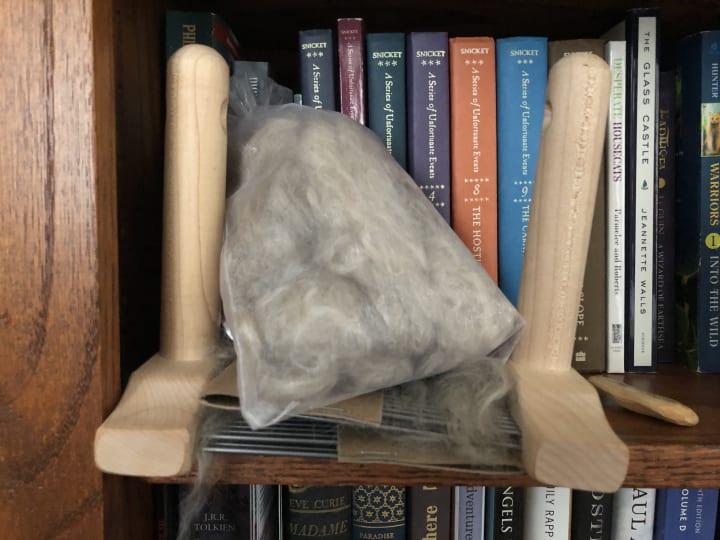
Wool Combs are a Bit Dangerous — I’ll say it again; those tines are sharp. And long. It would be very easy to murder someone with these things. Which makes using them a little nerve-wracking. You can’t swipe too enthusiastically, or tug too hard, because you could easily hit yourself in the body, face, leg, or even someone next to you. Hopefully the dog isn’t interested in what you’re up to, because they could easily wind up in harm’s way while you’re swinging these things. Caution is always used, of course, but it’s a little upsetting to have to try not to injure yourself and others to make some roving. It also makes storing them a little persnickety. I still have the cardboard tine covers that came with my combs, so I always put these on when storing. Additionally I place them on their heads, so the tines are horizontal against the shelf. It’s just a little disconcerting to have to take such care in putting something away so that no one dies.
It’s a Lot of Work For Not A Lot of Fiber — Well, you could say the same for hand cards. But even so, I would say hand cards are still more efficient than wool combs. You still have to load, and do the combing/carding process a few times through, but with combs you still have to diz off the fiber, which can be a lot trickier than rolling up a rolag. It also requires a tool — a diz — that doesn’t come with the combs. Additionally, I would say the actual combing part of wool combs requires a lot more effort than hand cards. And, carding is faster. Hand cards transfer pretty much all of the wool from one to the other in just a few swipes, whereas it can take twenty, thirty, forty swipes of a wool comb to get most (not all) of the fiber transferred. And by the end, you really only get a small amount of roving, so there’s not much spinning time to rest your dizzing-weary hands.

In Conclusion…
Wool combs do serve a purpose. While they mostly did what I wanted them to, it wasn't a very fun process. They just aren’t the best tool out there. They’re still a neat fiber processing duo, and really pretty, and I will probably keep them for a while in case I need to process any more fine fibers. But I think I’ll be saving up my spare pennies for something a little more efficient and ergonomic, and a little less murder-weapon-y.
Happy Crafting!
If you enjoyed what you read, give this article a like, a share, and leave a tip (let’s call it the drum carder fund, hahahaha…)!
Follow Olivia Beech on Vocal for more articles like this one (and some oddballs in between)
And follow the Olive Tree Fiber Arts on Instagram (@theolivetreefiberarts) to stay up-to-date on Olivia’s knitting, crocheting, and spinning adventures!
About the Creator
Ophelia Keane Braeden
Quirky fiction, hand-crafty non-fiction, random poetry. The muse strikes from all angles! Grab your favorite floatation device and join me on the wandering river of writerly flow!
~
None of my writing is ever touched by AI.
Keep reading
More stories from Ophelia Keane Braeden and writers in Art and other communities.
Gulf Coast Native: Another Adventure in Rare Fiber
Introduction My future is foggy. While I know I want a farm, I don’t necessarily know where. It could be in the Northern Wilds, or on a tropical island somewhere amidst the ocean. In the event of the latter, I would need a sheep that can handle heat and humidity. And as most of you likely know, I’m a believer in conservation and environmentalism, so I want a heritage breed that needs my help.
By Ophelia Keane Braeden2 years ago in Art
'Till Death We Do Art
There would be nothing divine in this world without art. Nature may surpass the divine to all intents and purposes, but like everything it absorbs and is absorbed by, it remains here, stuck on the surface of this world, ever-present, physically bound to the universe.
By Avocado Nunzella BSc (Psych) -- M.A.P 12 days ago in Art



Comments
There are no comments for this story
Be the first to respond and start the conversation.