
Women, Cinema and Society
Reviewing Dorian Shine's Documentary "Femenino Singular"
I had the chance to experience the documentary "Femenino Singular" during its screening at the Kookai International Film Festival, where it clinched the Best Women Film award and also generated a very interesting discussion about what is a woman in our society nowadays.
This artistic documentary, directed by Dorian Shine, did stand out for its nuanced exploration of femininity through the stories of thirty women from Argentina. I believe that this work offers a mosaic of rich personal experiences and unique perspectives on what it means to be a woman today, addressing topics on motherhood, beauty standards, and the fight against gender stereotypes - not only in Argentina but also in the world as it invites us to be more critical towards the contemporary female condition not only in Latin America but also in the world.
I find that "Femenino Singular" prompts essential and critical reflection on how today's society perceives and values women, how it frames their bodies according to laws, how beauty standards determine the narratives of many generations, and how, often, the very binary and rigid roles dictates to women their limitations and rules their freedom. By offering an unorthodox artistic space to these women where they could express themselves through different performance art actions in front of the camera, this documentary takes the audience to be part of the adventure of directing or reconstructing the female portraits in the movie. From these artistic actions that are rich in symbolism and elevated aesthetics, it seduces us to be emotionally engaged with the intimate testimonies about self perception, beauty, motherhood, and how it conditions female identity for example.
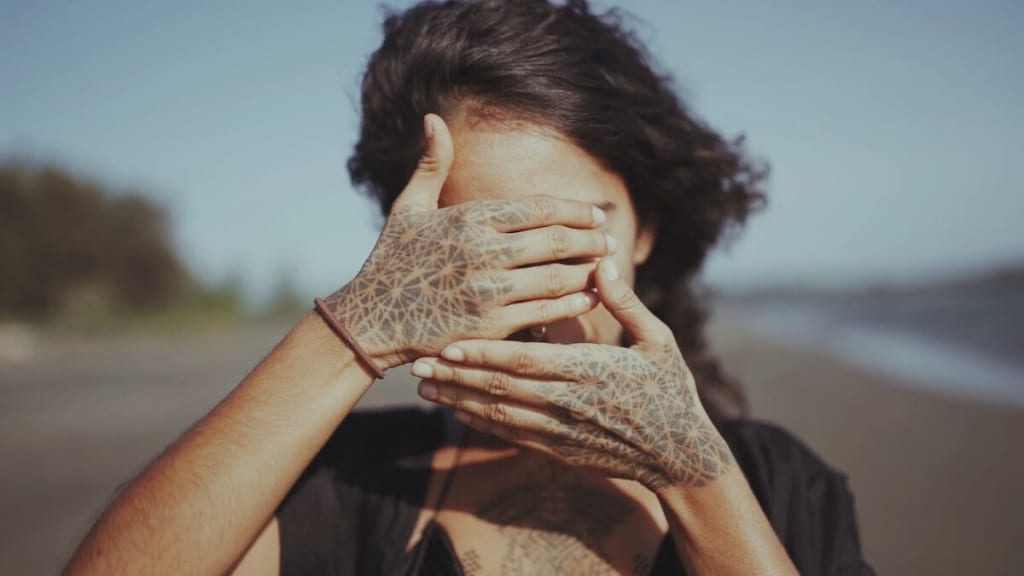
Motherhood, this role that is often celebrated for its natural and intuitive aspect, harbors underlying complexity influenced by deep sociological and psychological factors. This complexity is explored through different women in the documentary "Femenino Singular", as they reveal the challenges they faced, the joys they lived or expected, and the internal transformations that being a mother entailed. I was struck not only by the image of a mother marking her body, her skin, highlighting with ink the traces of maternity on her skin and the scars it left on her, but also by her story, testimony of her maternity experience, that radically differs from the idealized image often conveyed by society. Contrary to traditional expectations, she did not feel an immediate bond or overflowing joy at the birth of her child. This story highlights the diversity of maternal experiences, shedding light on the often-untold reality of alienation and difficulty in adapting to the role of mother. This testimony offers a valuable perspective on the process of adaptation and overcoming these feelings, contributing to a more nuanced understanding of motherhood.
This story reminds me of authors like Ruddick and McMahon,as they propose a vision of motherhood not only as an experience influenced by gender hierarchies but also as an opportunity for moral transformation for society. Indeed, this concept of "maternal thinking" emphasizes how mothers' responses to their children's needs can embody a potential for moral redemption, promoting care and peace beyond the private sphere.
However, motherhood, far from being a uniform experience, is shaped by a multitude of social and psychological forces. And "Femenino Singular" offers a precious insight into these dynamics, encouraging deeper reflection on the challenges and transformations that motherhood entails.
Another impactful moment was to see, listen to, and feel the portrait of another woman suffering from a malformation that prevents her from becoming a biological mother. Throughout her life, she has struggled against this condition while dedicating herself to teaching intellectually disabled children. The Mayer-Rokitansky-Küster-Hauser (MRKH) syndrome, which prevents natural conception, highlights the physical and psychological challenges some women face in their desire for motherhood. The works of Rothman (1989) and Hrdy (1999) address motherhood in the context of reproductive technologies and the legal and emotional complexities related to surrogacy, questioning the role of biology in defining motherhood.
The documentary also presents funny surreal moments when portraying a 47-year-old clown that is not happy with the beauty standards of her society, and a sweet message of hope from a 8-year-old child dreaming of a better inclusive world. These stories resonate with the ideology of beauty and objectification. Should we all adopt the position of this woman-clown who rejects conventional beauty standards and the objectification of her body by categorically refusing any cosmetic surgery or use of botox? Maybe we should all wear a clown nose and start talking about what we don't like. And maybe we should all have the same hopes of a 8 year old and be bold enough to refuse the objectification of women from a young age.
Femenino Singular contributes nicely to the feminist dialogue, both in Argentina and internationally. Since its premiere in Girona, it has garnered significant acclaim and accolades on the international film festival circuit so far.
The documentary's profound exploration of diverse themes has led to notable awards, including Best LGBTQ+ Film at the Athens International Art Film Festival. As it toured Indian film festivals, it won the best Documentary Film at the Rameshwaram International Film Festival, Best Women Film at both the Kalaburagi International Film Festival and the Kookai International Film Festival, and Best Feature Documentary at the Aasha International Film Festival. Additionally, the film secured award nominations at prestigious festivals, such as the Toronto International Women Film Festival for Best Women Film and the Symbiotic Film Festival for Best Documentary. Femenino Singular has also received recognition at various festivals, including a Mention Honorable and World Premiere at the Girona Film Festival. Official Selections at the Norwich Queer International Festival of Film, the Belgrade International Film Festival, and the Coliseum International Film Festival.
This collection of awards and acknowledgments truly highlights the production's impactful storytelling and its ability to resonate with diverse audiences worldwide. It's not just the storytelling that's impactful—it's how it reaches out and touches hearts across the world.
About the Creator
The Independent Filmmaker
Your guide to thought-provoking articles on the art of independent cinema. Uncovering gems, analyzing trends, and writing about the artistry that shapes the world of indie filmmaking from film reviews, interviews, articles and related news.
Keep reading
More stories from writers in Art and other communities.
Dog Shoes for Small Dogs and Puppy Shoes A Practical, Paw-Friendly Guide
Small dogs and puppies may look tough, but their paws often need more protection than people realize. Their bodies are lighter, their paws are smaller, and many of them spend a lot of time on surfaces that were never designed for delicate paw pads. Add cold sidewalks, hot pavement, rough gravel, wet grass, or even slippery indoor floors, and you start to see why dog footwear has become more than just a cute trend.
By aliyashahzadi3 days ago in Art
So You Decided To Become a Nurse Practitioner:
So you decided to become an "Advanced Practice" nurse. Congratulations!... is what I would say if this was a good idea. Grad school? In this economy? What were you thinking? Likely it was something along the lines of either 1) “I've seen these other chucklefucks do it— Why can't I?” or even 2) “I've got a nice career, I should shake it up. I miss feeling like I have no clue what I'm doing.”
By Sandor Szabo3 days ago in Fiction



Comments