
William Rotsaert
Painting in the Language of Color

By Brian D'Ambrosio
From Bruges to Santa Fe, a painter translates memory, motion, and myth through color and curiosity.
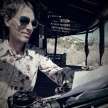
William Rotsaert paints in the language of color — heatwaves and highways, red-orange skies that shimmer with motion, and the flicker of gasoline flames under a 1957 Chevy Bel Air. His canvases pulse between abstraction and realism, fusing the discipline of the old Flemish masters with the freedom of the American West.
“I have a lot more freedom than many other artists,” Rotsaert said. “I do it without sticking to one style.”
Born in Bruges, Belgium, Rotsaert grew up surrounded by art and architecture that carried centuries of history. “I grew up with old buildings, old history, old stories — to the point where you thought that was normal,” he recalled. “Our house had foundations from the 1200s and was restored in the 1630s. You just walked past these buildings every day without thinking about it.” In medieval Bruges, history was a constant companion, an aesthetic embedded in daily life. Yet the city, often called Bruges-la-Morte — “dead Bruges” — had grown quiet by the mid-20th century, preserved by economic stagnation and neglect. “It saved the city,” Rotsaert said. “They didn’t tear anything down. They just lived in what was there.”
Rotsaert’s childhood home overlooked the cobbled corners of old Flanders. His father, a mechanic by trade but an artist by heart, painted in his spare time and took his son to local galleries on Sunday afternoons. “My very first oil painting, I was probably six or seven years old, painting next to him,” Rotsaert said. His mother later became a curator at a local gallery, and the family lived above it. “I grew up really with galleries — art was always around. I can’t deny that I grew up with it.”
He studied at the Academy of Fine Art in Bruges, grounding his technique in classical methods. The influence of the Flemish masters — Van Eyck, Bruegel, and their lineage of light and detail — still underlies his brushwork. But it was the lure of the West, its cinematic horizons and color-drenched landscapes, that called him beyond Europe’s borders. “I came from Belgium because I wanted to see the West, really,” he said. “Belgium was gray and flat — you can’t see past the next field. Then you move to the Southwest, where the sky is almost always blue and the landscapes are just mind-boggling.”
In 1978, Rotsaert and his wife, Mieke, arrived in the United States with one suitcase, a guitar, and a Greyhound bus ticket. “We took a Greyhound bus from New York City to L.A., and for $69 you could go coast to coast,” he remembered. “We stopped wherever we wanted — the Smoky Mountains, the Redwoods. When we reached New Mexico, we felt like we had actually arrived at what we wanted to experience. When we first saw Santa Fe, Mieke said, ‘You know, I could live here.’”
After briefly living in Arizona, they settled in Santa Fe, where they now run Art is Gallery on Canyon Road.
Physical, Imaginative Light of Art
Rotsaert’s work is steeped in light — not only the physical light of the desert but the imaginative light that animates memory and story. The subjects of his paintings often hover between the surreal and the familiar: a shapely woman the center of attention in a spaghetti Western spoof, surrounded by instruments and a passing train; the metallic gleam of classic cars against melting skies; swirling heat and gasoline fumes painted in red, orange, and gold. “I keep it lighthearted,” he said. “There’s so much darkness out there already.”
He works in acrylics, a medium he first encountered after leaving Belgium. “Oil painting was out of the question because of the health issues — turpentine and all that stuff,” he said.
“Acrylic was kind of a nice thing because you can use water, you can lay it thick or paint it like watercolor. When I came here, I thought acrylic was an American thing. In Belgium it wasn’t common yet.”
Though some purists may still regard oil as the higher art form, Rotsaert shrugs off the distinction. “It’s how you use it and what you paint. There’s no difference. I can prove them wrong.”
His imagery pulls freely from American culture — film, cars, and music — but always through a lens of playful sophistication. One can see echoes of the desert highways, the rhythm of Western soundtracks, and the allure of neon Americana refracted through the sensibility of a European craftsman. “I’m telling stories with my paintings, like a movie script or still — the movie comes with a process, an unfolding.”
Color as Narrator
Color, for Rotsaert, is not just visual but emotional, almost narrative in itself. “Color is a starting point,” he said. “Something that you can’t even really explain — it’s always there.” He describes taking photographs constantly, sometimes even “without a camera,” by storing compositions in his mind. “I never stop seeing paintings,” he said. “I may never paint them, but they’re there. Sometimes I find an old photo and remember why I took it — it was to make a painting.”
The light of New Mexico, he said, continues to astonish him. “The blue skies and the bright light make you paint that way,” Rotsaert said. “That’s not news — the artists who came here in the 1920s and ’30s were floored by the light and the color. It does the same thing to you no matter what part of the century you’re in.”
Though he has long since made Santa Fe his home, there’s still a trace of Bruges in his perspective — an awareness of the past, a reverence for texture, a patience learned from the old world. His paintings, even when saturated with American iconography, feel like the work of someone attuned to centuries rather than decades. Yet his attitude toward his art remains refreshingly unpretentious. “The painting chooses the buyer,” he said. “It has to call them. I paint for myself — if nobody wants them, I can live with that.”
That independence — the refusal to repeat himself, the willingness to let style evolve — has defined his long career. “I don’t work with a repeatable style,” he said. “There are too many ideas to repeat myself.” From the medieval streets of Bruges to the sunlit mesas of New Mexico, William Rotsaert has painted his own story: a journey from the shadowed alleys of history to the luminous expanse of the American imagination.
Brian D’Ambrosio is the author of New Mexico Eccentrics.
About the Creator
Brian D'Ambrosio
Brian D'Ambrosio is a seasoned journalist and poet, writing for numerous publications, including for a trove of music publications. He is intently at work on a number of future books. He may be reached at [email protected]
Keep reading
More stories from Brian D'Ambrosio and writers in Art and other communities.
Estella Loretto:
By Brian D’Ambrosio, Estella Loretto has lived her 72 years with a sculptor’s patience, chiseling each moment slowly, shaping a life balanced between Pueblo ancestry and monumental artistic vision. Each breath, she says, is a grain of stone, a measure of time, and a spark of spirit.
By Brian D'Ambrosio 3 months ago in Art
Nature Light Portraits
In a small town, nestled between towering mountains and lush forests, lived three friends: Leo, Mia, and Sam. They were curious teenagers, always exploring and getting into adventures. They shared a dream of capturing the beauty of nature in photographs, which they called “Nature Light Portraits.”
By Hamad Afridi 5 days ago in Art



Comments