
Why Are Those Buildings That Weird Shape?
"Where geometry defies expectation—architecture’s bold rebellion.

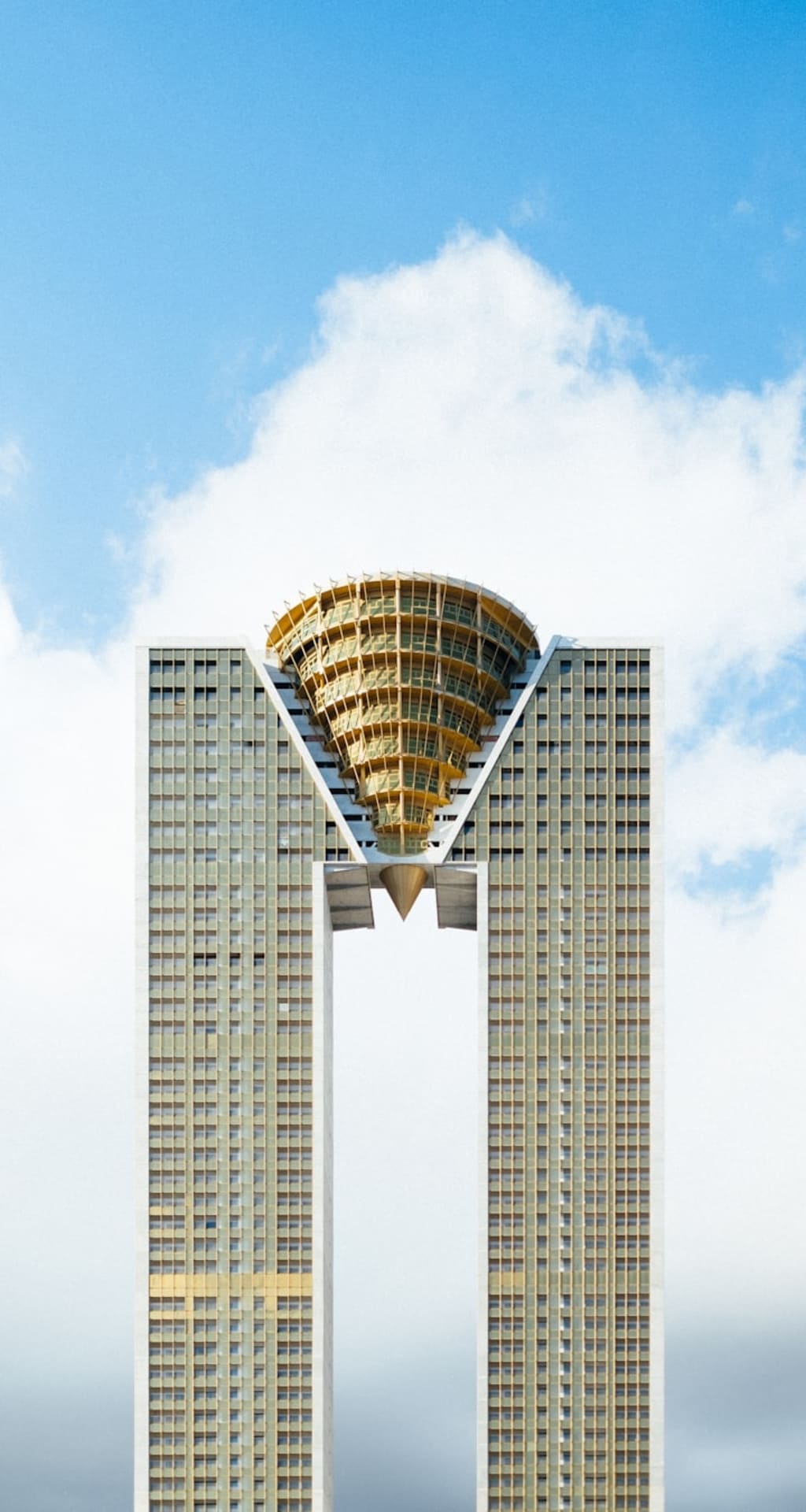
You know when you’re on a road trip and staring out the window sort of aimlessly?
Along the highway, you see all kinds of boring, boxy buildings like hotels and warehouses.
But then you pass something that looks completely different ….
like nuclear cooling towers or a salt storage dome or whatever this is.
And you wonder, “Why is it that weird shape?” The answer isn’t because the architect wanted to try something avant garde.
There’s a very good scientific reason those things are the shape they are.
So come with me on a scenic tour of our most unusual buildings.
I have to warn you: there won’t be a lot of right angles.
If you want to get really precise, we’re not actually going to talk about buildings on the side of the highway, here.
Engineers and architects tend to use the word “building” to mean something that humans spend time in, like homes and schools.
But storage tanks and cooling towers aren’t usually designed to be shelters.
A more accurate term for them would be structures.
And the cool thing about these structures— besides the fact that they’re everywhere if you start looking for them— is that there’s some really cool science and engineering behind their shapes.
Let’s start with water towers.
Many of the ones you’ll see are a squat tank supported by a few legs or a sphere on top of a narrow pipe.
Some are even painted with fun designs.
Look, it’s a corn cob!
But it’s not worth the effort to lift water dozens of meters in the air just for decoration.
Water towers are one way that engineers can make sure there’s consistent hydrostatic pressure throughout a water supply network, since people use different amounts throughout a day.
Basically, the perk of having a water tower is that you don’t need to build out a huge, expensive water infrastructure that your city doesn’t use most of the time.
Instead, you can build out an average-ish water pump and filtering system.
When a bunch of people are taking their morning showers at the same time, a water tower can supplement existing pumps to help make sure there’s enough water at high enough pressure.
Or if there’s an emergency situation where there’s no electricity for pumps, but firefighters still need running water.
We use a pump to get water up to the tower’s tank.
And the height of the water tower relative to the number of people who use it is really important, because the force of gravity pulling down on the water contributes to the water pressure.
In fact, every meter in elevation increases pressure by about 10 kilopascals.
So a water tower tank 45 meters above the ground could give everyone in a community a nice 438 kilopascals of water pressure for a luxurious shower.
That's about 63.5 pounds per square inch for our Imperial system friends.
A lot of thought goes into calculating the exact height a water tower should be relative to the buildings and networks of pipes they’re supplying water to.
The shortest are just a few meters tall, but they’re elevated on the rooftops of apartment buildings in big cities— so they’re still towering above the people who need that water.
And the tallest can reach heights around 66 meters, plenty tall enough to supply an entire town … and paint a giant peach or whatever on it for everyone to see. While we’re on the subject of tall, skinny things that are common along the highway, let’s talk about silos.
If you’ve ever driven through farmland, you’ve probably seen these cylindrical structures with domes on top.
Now, you might assume that those silos are full of grain, like oats or wheat.
but let me clear something up so farmers don’t snicker at you.
Silos store silage, which is made of leafy crops that have been ground up and fermented to preserve them for animal feed.
So it’s the entire chopped up oat or wheat plant, not just the grain.
Early tower silos were rectangular, but engineers settled on the current tall cylinder design for a couple reasons.
Fermentation is an anaerobic process, which means that you can’t have any oxygen around or the wrong microbes will grow and the wrong chemical reactions will happen… ones that will make the silage spoil and animals sick.
You also want a bunch of lactic acid, which helps preserve the silage by souring it, like yogurt or kombucha.
It’s easier to make sure the silage settles down with no air pockets when you don’t have corners to deal with.
it's easier to make sure the silage settles down With no airpockets Plus, a round footprint can hold up better from all the pressure of the silage pushing outward, as straight walls can bulge outward over time.
Silos tend to be made of wood, steel or concrete.
But all that lactic acid and other fermentation juice poses a challenge no matter the material, since wood rots and concrete or metal can corrode.
So it’s important for engineers to inspect the inner walls of those cylindrical silos and repair them over time to make sure they can continue to control how the silage is packed, how moist it is, and create ideal fermentation conditions.
That’s why silos are the shape of a soda can.
But building a thing in that shape isn’t always the best way to store stuff.
If you want to stockpile a bunch of salt, for example, you’ll probably want a dome.
Salt storage domes are one of the most recognizable shapes on this list.
And no, they aren’t holding the salt for your fries.
They’re built to house the millions of metric tons of salt produced each year that goes to deicing roads.
So first and foremost, they need to protect the salt from water so that it doesn’t get clumpy or get into the groundwater before you can use it.
And yes, this is a problem once we salt roads too, which scientists are working on.
To protect the salt, these storage domes have asphalt or concrete foundations that are sloped to funnel any water away.
But the key to their shape lies in the weight of the salt and the need to get trucks in and out without running into a bunch of support beams.
A rectangular building would be bad on both fronts.
The thousands of kilograms of salt would bow the walls, and the roof would need inconvenient supports.
Those salt domes are great at distributing the stresses across the surface of the walls, and they don’t require any internal support.
The domes you see on the side of the road typically hold anywhere from 1000 to 9000 metric tons— either in freestanding piles or packed against the walls.
Because it’s impossible to remove all water from salt storage areas, it’s important to have watertight materials like asphalt, concrete, or treated wood wherever the salt touches. Plus, it’s critical that any metal used in these structures is galvanized, or coated with zinc.
Salty water can speed up the chemical reactions that make metals corrode by making it easier for atoms to trade electrons.
So the zinc coating basically acts as a chemical sacrifice to protect the metal beneath from reacting as quickly.
Who knew there was so much science to building what basically amounts to a salt shed?
This next structure may or may not be common in your part of the world.
But here in Montana, we see a lot of them.
They’re made of steel or wood and sometimes shaped like a capital A.
Called headframes, they’re towers built above a mine shaft to help raise and lower stuff as much as a few kilometers below the Earth’s surface.
Basically an elevator for a mine.
In, say, an apartment building, an elevator that uses cables can be pulled upward by an electric motor at the top of the shaft.
On one end of the cables is the elevator that people ride in, and on the other side is a counterweight that helps balance the forces exerted on the whole pulley system.
Headframes have a cable that’s connected to a cylindrical hoist in a nearby or attached building called a hoist house, usually at around a 45 degree angle from the top.
This is often because the engines are so big and heavy that it’s safer to have them on solid ground.
Sometimes the engine’s power alone operates the elevator, and sometimes there’s a counterweight that moves up and down the mine shaft as well to balance the system out.
So the biggest engineering concern for a headframe is that it has a sturdy enough foundation— usually reinforced concrete— and structure to support the enormous weight of that cable system, plus any forces from pulling up the humans, equipment, or ores.
It also needs to be resilient to vibrations so the structure and cable don’t twist and break— which is a huge challenge when you’re engineering any moving things.
That’s why these steel headframes can weigh hundreds of metric tons.
So you need the right equipment to assemble them in the first place!
As for that capital A frame, maybe you remember from elementary school that triangles are the strongest shape?
It’s not the only form that headframes take, but it’s probably the most common one you’ll see next to a hoist house.
To keep the hoists running, of course, we need electricity.
And the power plants that produce it often have their own weird shape.
Thanks to The Simpsons, you might assume that these hourglass-shaped cooling towers are exclusively the hallmark of nuclear power plants.
But not all nuclear reactors have cooling towers, and some other kinds of power plants do.
The shape is called a hyperboloid, and anything with a tower like that has something in common: steam turbines.
Some kinds of power plants burn fuel or use uranium rods to heat up water, which evaporates and becomes steam.
That steam pushes blades in a turbine to rotate it, which drives a generator and generates electricity.
That water is reused over and over again in what’s called a closed-loop system.
But you need to cool it down and heat it back up again to generate more electricity.
That’s where cooling towers come in.
Basically, some additional water is piped in to absorb the heat from the steam turbine water.
Once that new water is hot, it gets sprayed inside the tower where it mixes with the air.
As that hot, humid air rises out of the tower, more cool, dry air gets pulled in through vents in the base.
And that causes…well… a natural draft of air currents moving up and out.
The hyperboloid shape moves air upward better than a cylinder or cone shape.
The wide base helps suck in more cool, dry air, while the wide top helps more air mix to distribute the heat and humidity.
And, according to mathematical models, we think the narrow center helps increase the velocity of air whooshing upwards.
These cooling towers are big— like up to 200 meters tall— and we need them to be sturdy.
This is another advantage of the hyperboloid shape.
It’s curved in two opposite directions, giving it even fewer weak points than a plain old cylinder.
And the curvy walls help deflect wind and distribute the force from strong gusts, instead of buckling.
Which is a nice feature when you have a nuclear reaction counting on them!
Our next structure looks like Epcot Center had babies.
They’re called radomes, which is a blend of the words “radar” and “dome.” And that’s exactly what they are— weatherproof domes that protect electronics that transmit or receive radio waves.
Engineers actually use the term “radome” to describe any size structure like this, even small attachments on planes or ships.
But the giant ones you might see along the highway with a bunch of sturdy, triangular panels are for things like weather radars, satellite communications, or radio astronomy.
Weather radomes, for example, send out short bursts of radio waves towards the sky.
By measuring what bounces back— off of water droplets in clouds, for example— we can tell all kinds of things about the speed, direction, and kind of weather that’s coming.
It’s important for radomes to be roughly spherical because the electronic equipment inside often needs to point in many different directions to send and receive different signals.
You don’t just want to look for rainclouds in one spot!
So you need enough room for an antenna to rotate around, and for every angle to have about the same amount of distortion from the radome material.
To minimize that distortion, the material needs to have what’s called a low dielectric constant.
That basically means it lets electromagnetic waves through easily rather than reflecting or absorbing them.
So most kinds of metal won’t work.
You need certain plastics, ceramics, fiberglass, or coated fabrics. All of which have the advantage of keeping water out while letting radio waves in!
As futuristic as radomes look, they have nothing on our last structure.
They kind of resemble an alien spaceship.
They’re flat and round, and some of them have an enclosed antenna on top, while others have a ring of them.
They’re just…strange.
They even have a weird-sounding name: very high frequency omnidirectional range stations, or VORs for short.
They were built starting in the 1950s in the United States to help aircraft pilots navigate with short-range radio signals in the very high frequency range, from 108 to 117.95 megahertz.
VORs are wayfinding structures to help pilots orient themselves, sort of like a lighthouse.
Except instead of a rotating beam of light, they emit a rotating radio signal.
That’s why they’re circular.
Some VORs were built with a mechanically rotating antenna, but most of them you’ll see have a ring of about 48 antennas that activate one at a time, like The Wave going around a football stadium.
In addition to the rotating signal, each VOR emits a reference radio signal towards Magnetic North.
So when you’re flying a plane, the VOR receiver will detect two radio signals at once: one pointing magnetic north, and one pointing to your plane.
And the combination of these two signals over time— because they happen repeatedly— can help you figure out where you are relative to a station, and what general direction you’re flying.
Today, most aircraft can navigate using satellites and GPS.
So many VORs across the world are being decommissioned and removed, but hundreds are being left active as a backup navigation network.
So the truth is still out there… and so are these very high frequency omnidirectional range stations.
Now that you know their purpose, maybe the shapes of these buildings don’t seem so strange.
They’re the embodiment of that old adage “form follows function.” There’s something kind of cool about that.
The next time you’re on a road trip, you can enlighten your passenger with the science behind these architectural oddballs along the highway.
You know, something to break up the monotony on your way from one boring rectangle to the next.
About the Creator
Keep reading
More stories from taylor lindani and writers in Art and other communities.
'Till Death We Do Art
There would be nothing divine in this world without art. Nature may surpass the divine to all intents and purposes, but like everything it absorbs and is absorbed by, it remains here, stuck on the surface of this world, ever-present, physically bound to the universe.
By Avocado Nunzella BSc (Psych) -- M.A.P 18 days ago in Art
Five world-renowned classic landmark sculptures
In many cities around the world, there is an iconic landmark sculpture. It may stand in a square, by the water, or at the entrance to a park, quietly becoming a symbol of the city. Over time, these pieces came to mean much more than just decoration. They become symbols, gathering places, and even cultural landmarks that represent the spirit of the city.
By Shenzhen Ruiheng Crafts7 days ago in Art
Two Grumpy Old Men Solve the Problem
Marty and Steve were two grumpy old men who lived together. They had known each other for years. Marty had been a bachelor all his life. Steve said it was because no one could stand to ever live with. Marty’s standard reply was “Well, you are, so what sort of a moron does that make you!”
By Calvin London3 days ago in Humor




Comments
There are no comments for this story
Be the first to respond and start the conversation.