
Why 316 stainless steel sculpture is the gold standard for coastal sculptures
Here are the reasons

If stainless steel sculptures are installed in coastal environments, corrosion caused by sea breezes becomes an important issue to consider. Salt in the air, high humidity, and frequent temperature changes can all accelerate surface deterioration if the material or finish is not suitable.
Among commonly used stainless steel grades, 316 stainless steel is generally considered more appropriate for coastal locations due to its chemical composition and corrosion resistance.
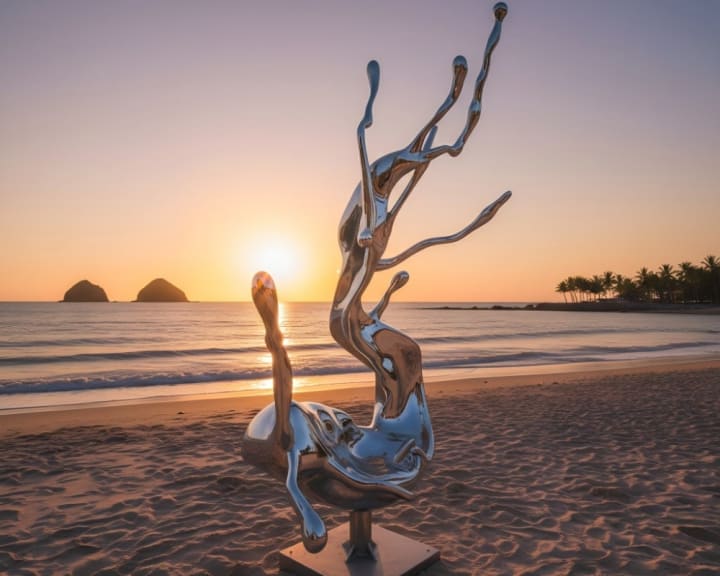
1. Why 316 Stainless Steel Is More Suitable for Coastal Areas
In coastal zones—typically within several miles of the sea—chloride exposure is significantly higher than inland environments. 304 stainless steel, while widely used, is more prone to surface discoloration and “tea staining” under these conditions. Tea staining appears as brown or rust-like marks that affect surface appearance, even if the structural integrity remains intact.
316 stainless steel contains molybdenum, an alloying element that improves resistance to chlorides and salt exposure. This characteristic makes 316 stainless steel more stable in marine or near-marine environments, particularly for long-term outdoor installations.
For stainless steel sculptures, corrosion risk does not only depend on the base material. Weld seams and joint areas are often the first locations where corrosion develops if the material quality or welding process is inadequate. Using consistent-grade material throughout the sculpture, including welded sections, reduces uneven corrosion behavior over time.
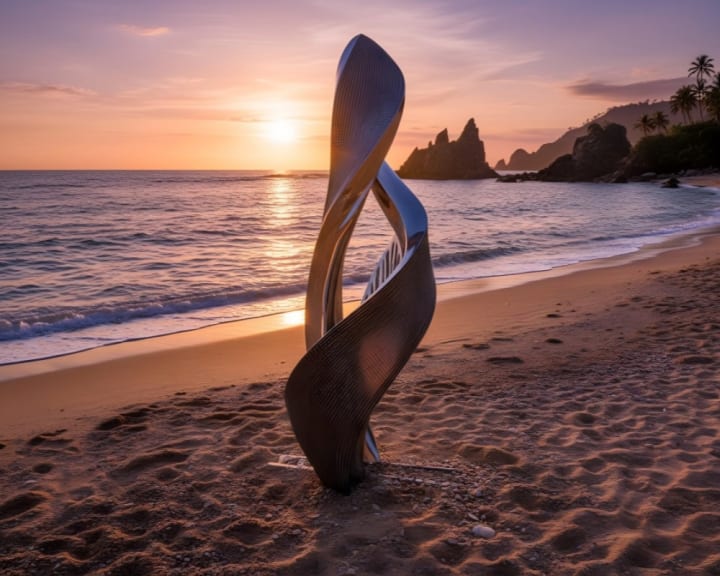
2. Importance of Surface Treatment for Coastal Sculptures
Surface finish plays a critical role in how stainless steel performs outdoors. In coastal settings, microscopic surface roughness can trap salt particles and moisture, creating localized corrosion points.
Highly polished surfaces, such as 8K mirror finishes, have lower surface roughness compared to standard brushed or semi-polished finishes. This smoothness reduces the ability of salt and moisture to adhere to the metal surface, which can slow down the corrosion process and make routine cleaning easier.
For outdoor stainless steel sculptures near the sea, surface quality is therefore a functional consideration, not only an aesthetic one.

3. Structural Considerations for Coastal Installations
Large outdoor sculptures installed near the sea must also account for wind load and environmental stress. Coastal areas often experience stronger and more persistent winds, which can affect stability over time.
To address this, large-scale stainless steel sculptures typically include internal support structures designed to distribute stress and maintain balance. Proper internal reinforcement helps prevent deformation and ensures that the sculpture remains stable under coastal weather conditions.
4. Application Scope
316 stainless steel sculptures are commonly used in:
Coastal public spaces
Seaside hotels and resorts
Waterfront commercial plazas
Private villas near the ocean
Their suitability comes primarily from material performance and surface treatment rather than decorative considerations alone.
When planning a stainless steel sculpture for a coastal environment, factors such as material grade, welding consistency, surface finish, and internal structure all influence long-term durability and appearance.
About the Creator
Shenzhen Ruiheng Crafts
https://www.craftsornaments.com/
Keep reading
More stories from Shenzhen Ruiheng Crafts and writers in Art and other communities.
What is abstract sculpture?
Abstract art often feels mysterious because it does not rely on recognizable figures, realistic animals, or a clear narrative. Abstract sculpture follows the same principle. Rather than imitating the real world, it uses form, line, surface, volume, and space to convey ideas, movement, or emotion.
By Shenzhen Ruiheng Crafts5 days ago in Art
A Matter of Coincidence
Tuesday, 3 September 2024 Ayesha Fareed Ahmed, Mirpur Khas Sheeda was a simple and innocent man. One day, he was going to his wife’s village to bring her back. On the way, he saw some donkeys grazing on grass at a certain place. Eventually, he reached his in-laws’ house. His wife’s brother asked him to sit in the guest room.
By Sudais Zakwana day ago in Art
What Fine Line Tattoo Excellence Looks Like in Professional Practice
When you sit in the chair of one of the best fine line tattoo artists, you feel it straight away. The calm, the care, the way they handle your skin and your nerves at the same time. Fine line work looks light and effortless from the outside, but real excellence is anything but casual.
By Tools of Trade Studios6 days ago in Art
The Devil's Cut
“Comrade, finally you’re awake.” The voice was smooth, sensual. A flickering incandescent bar was all that lit the white, sterile room. All Vladimir remembered was everything going black. He tried to move his arms and found them strapped to the gurney.
By Matthew J. Fromm5 days ago in Fiction




Comments
There are no comments for this story
Be the first to respond and start the conversation.