
What is abstract sculpture?
How many kinds of abstract sculpture now?

Abstract art often feels mysterious because it does not rely on recognizable figures, realistic animals, or a clear narrative. Abstract sculpture follows the same principle. Rather than imitating the real world, it uses form, line, surface, volume, and space to convey ideas, movement, or emotion.
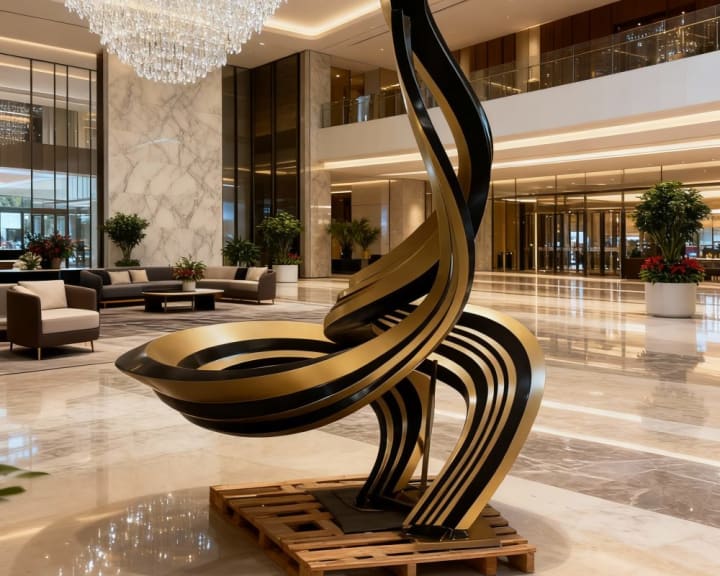
Unlike figurative sculpture, abstract sculpture does not attempt to answer “what it is.” Instead, it focuses on “what it suggests” or “how it feels.” This openness allows viewers to form their own interpretations, which is one reason abstract sculpture is widely used in contemporary environments.
The Concept Behind Abstract Sculpture
Abstract sculpture moves away from literal representation. Curves, sharp angles, flowing structures, or geometric forms are often used to express balance, tension, rhythm, or motion.
Some abstract sculptures feel calm and stable, using symmetry and smooth surfaces. Others appear dynamic or even dramatic, relying on asymmetry, sharp transitions, or rising forms. Because there is no fixed meaning, the viewer’s background, mood, and environment all influence how the sculpture is perceived.
This flexibility makes abstract sculpture suitable for shared spaces, where different audiences encounter the work in different ways.

Materials Commonly Used in Abstract Sculpture
Material choice plays a major role in both appearance and performance.
Stainless steel is frequently used for outdoor abstract sculpture due to its strength, durability, and modern visual quality. Its reflective surface can interact with light, sky, and surrounding architecture.
Fiberglass is also widely used, especially for large-scale or complex forms. It allows smooth curves, lighter weight, and greater freedom in shaping.
Resin and mixed materials are more common in indoor abstract sculpture, where weather resistance is less critical and color or texture may be emphasized.
Material selection is typically based on installation location, size, budget, and desired surface effect.
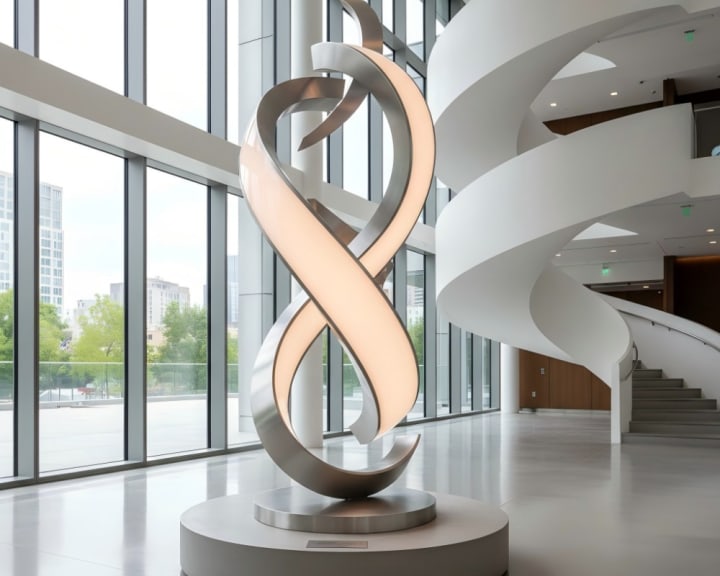
Why Abstract Sculpture Fits Modern Spaces
Modern architecture often features clean lines, open layouts, and minimal ornamentation. Abstract sculpture complements this environment because it adds visual interest without competing with architectural elements.
In large public or commercial spaces, abstract sculpture can serve as a spatial focal point. It helps define areas, guide movement, or create visual balance within open surroundings. Because abstract forms are not tied to specific cultural symbols or figures, they are generally accessible to a wide audience.
Indoor and Outdoor Abstract Sculpture
Indoor and outdoor abstract sculptures are designed with different priorities.
Indoor abstract sculpture emphasizes surface quality, detail, and interaction with lighting. Proportion and finish are important because viewers often encounter the work at close range.
Outdoor abstract sculpture must account for weather exposure, sunlight, temperature changes, and wind. Structural stability, material durability, and scale become key considerations.
In both cases, the sculpture must respond to its environment rather than exist as an isolated object.
Custom Abstract Sculpture
Many abstract sculptures are created as custom works rather than standardized designs. Customization allows the sculpture’s size, form, material, and surface treatment to align with the specific space where it will be installed.
A typical custom process involves concept development, form exploration, material selection, and structural planning. This approach ensures the sculpture fits both the physical environment and the overall design intent of the project.
About the Creator
Shenzhen Ruiheng Crafts
https://www.craftsornaments.com/
Keep reading
More stories from Shenzhen Ruiheng Crafts and writers in Art and other communities.
How to prevent outdoor sculptures from fading over time
Outdoor sculptures often appear vibrant and impressive when first installed, but after one or two summers, the colors can begin to fade. In some cases, bright surfaces become chalky, while darker tones lose depth and contrast. This fading is not a design flaw, but usually results from environmental exposure and inappropriate material or surface treatment choices during the early stages of the project.
By Shenzhen Ruiheng Crafts2 months ago in Art
'Till Death We Do Art
There would be nothing divine in this world without art. Nature may surpass the divine to all intents and purposes, but like everything it absorbs and is absorbed by, it remains here, stuck on the surface of this world, ever-present, physically bound to the universe.
By Avocado Nunzella BSc (Psych) -- M.A.P 13 days ago in Art



Comments
There are no comments for this story
Be the first to respond and start the conversation.