
Whispers in the Mirror
The Secrets of The Arnolfini Portrait
How a 1434 painting predicted selfies, symbolism, and social contracts
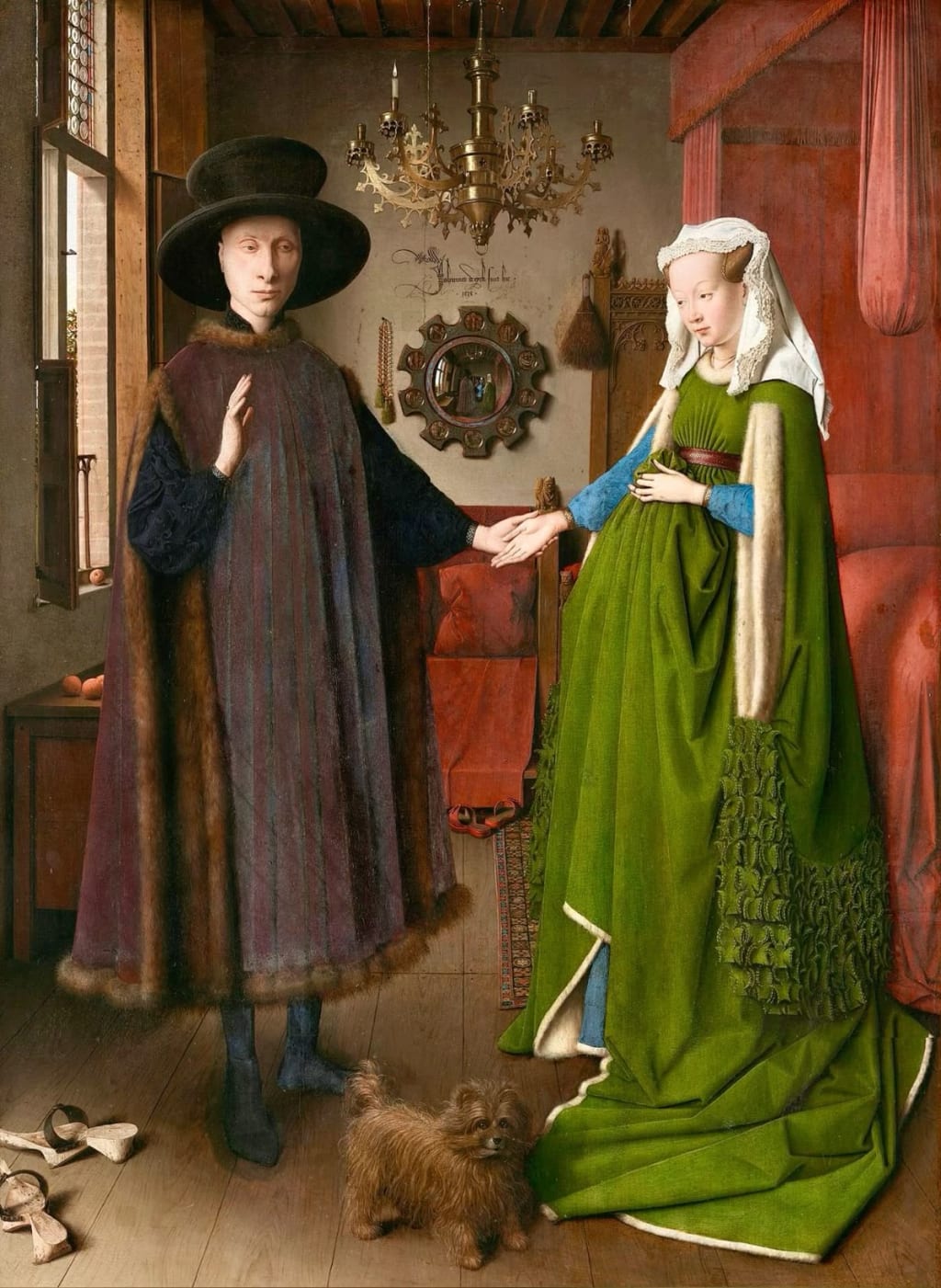
At first glance, Jan van Eyck’s Arnolfini Portrait looks like a dignified double portrait of a wealthy couple in a well-furnished room. A man in a dark hat, a woman in an emerald dress, hands joined, standing in domestic stillness. But don’t be fooled by the silence.
This painting doesn’t just hang—it listens, documents, and even witnesses.
A Marriage or a Message?
Painted in 1434, this work has long been interpreted as a marriage certificate captured in oil. Giovanni di Nicolao Arnolfini, an Italian merchant living in Bruges, stands beside his bride (possibly Giovanna Cenami), hands touching lightly, with a small dog between them—a symbol of fidelity. A candle burns above them, signifying the presence of God.
But here’s the twist: no priest is present. No ring is visible. And the woman isn’t pregnant, despite her hand resting on a rounded belly—this was just the fashion of the time.
So, what exactly are we seeing? A secret wedding? A memorial painting? A contract of some kind?
Van Eyck leaves us questions, not answers. And that’s what makes this piece so captivating.
The Mirror That Sees All
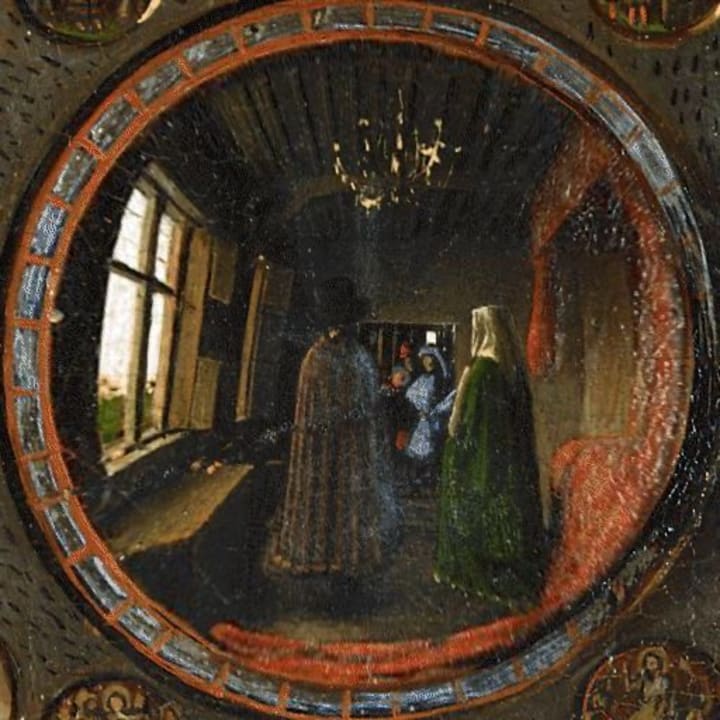
Now look closer—no, not at the couple. Turn your eyes to the mirror behind them.
It’s tiny, circular, and framed with scenes from Christ’s Passion. But in its glassy surface, you can see more than the couple’s backs. You see two additional figures standing in the doorway—one of whom may be Jan van Eyck himself.
Above the mirror, in carefully painted calligraphy, it reads: “Johannes de Eyck fuit hic”—“Jan van Eyck was here.” It’s the original signature tag, centuries before graffiti or the blue checkmark.
What’s more, this mirror serves as witness. In a time when marriages could be declared legal with verbal consent and witnesses, Van Eyck may be placing himself not as the artist—but as the notary.
Symbolism in Every Corner
This painting is rich with visual metaphors. Everything means something:
• The dog – loyalty, fidelity, and perhaps a nod to wealth.
• The oranges on the windowsill – luxury items in 15th-century Bruges, and also symbols of purity or paradise lost.
• The discarded shoes – a gesture of sanctity; standing barefoot was part of sacred ritual.
• The ornate rug and brass chandelier – show off the couple’s financial power.
• The single burning candle – divine witness, possibly referencing a loved one who has passed.
Van Eyck turns ordinary objects into layers of meaning. Nothing is accidental. Every fold, shadow, and highlight is intentional, mathematical, symbolic.
The First “Selfie”?
In an age before photography, this painting stands as a unique mix of realism and intention. The mirror reflects not only space but time. It gives the viewer the sense of being present, like a paused moment in a larger story.
That’s why many modern commentators jokingly—but not inaccurately—refer to it as the first “selfie.” It captures presence, identity, and even the signature of its creator. It’s a document, a performance, and a still life of human relationships all at once.
Why This Still Matters
In our digital age, The Arnolfini Portrait feels oddly modern. It blurs lines between public and private, art and document, truth and interpretation.
It’s also a masterclass in storytelling without a single word spoken. Through gesture, gaze, and reflection, Van Eyck captures a moment so enigmatic that we’re still decoding it six centuries later.
So next time you scroll through your feed or take a photo with your reflection in the background, remember—Van Eyck did it first. And he did it with oil, glass, and genius.
About the Creator
Zohre Hoseini
Freelance writer specializing in art analysis & design. Decoding the stories behind masterpieces & trends. Available for commissions.
Keep reading
More stories from Zohre Hoseini and writers in Art and other communities.
The Hidden Codes of Michelangelo
At first glance, the Sistine Chapel ceiling appears as a stunning celebration of biblical stories, godly forms, and divine craftsmanship. But look closer, and you begin to notice something strange. Beneath the brushstrokes and beauty lies a network of hidden symbols, anatomical secrets, and intellectual rebellion that Michelangelo may have deliberately encoded into one of the most revered religious spaces in the world.
By Zohre Hoseini11 months ago in Art
'Till Death We Do Art
There would be nothing divine in this world without art. Nature may surpass the divine to all intents and purposes, but like everything it absorbs and is absorbed by, it remains here, stuck on the surface of this world, ever-present, physically bound to the universe.
By Avocado Nunzella BSc (Psych) -- M.A.P 26 days ago in Art
Where Courage Meets the Sunrise
In a small village called Alara, nestled between rolling hills and vast fields, the sun rose each day bringing light to the world. But today was different. Today was the day of the Great Awakening, when the villagers learned of new depths of courage within themselves.
By Hamad Afridi a day ago in Art



Comments
There are no comments for this story
Be the first to respond and start the conversation.