
What is the Voltage Output of Poe Switch?
What is the Voltage Output of Poe Switch?

In industrial network deployments, industrial PoE (Power over Ethernet) switches have become key components for connecting various devices, thanks to their ability to simultaneously transmit data and power. The PoE switch voltage output directly affects device compatibility, stability, and application range, making it a crucial parameter to consider during selection.
What is the standard voltage of a PoE switch
Among common industrial-grade PoE switch port output voltages, 48V is the most widely used. This stems from mainstream PoE standards such as IEEE 802.3af and 802.3at. IEEE 802.3af specifies an output voltage range of 44V to 57V, with a typical value of 48V. The 802.3at (PoE+) standard also specifies a similar output voltage range, typically also outputting 48V.
In industrial settings, higher requirements are placed on the electrical performance of equipment, including:
Long-distance transmission requirements: In large factories or outdoor parks, network cabling distances may exceed 100 meters. 48V DC voltage effectively reduces voltage loss during transmission, ensuring stable operation of terminal devices.
Strong anti-interference capability: High-voltage transmission is relatively stable and has stronger anti-electromagnetic interference capabilities.
Wide device compatibility: Most industrial cameras, control terminals, access points, and other devices support 48V power supply, providing greater flexibility and efficient system construction.
High safety: 48V complies with human safety DC voltage standards, balancing power efficiency and safety.
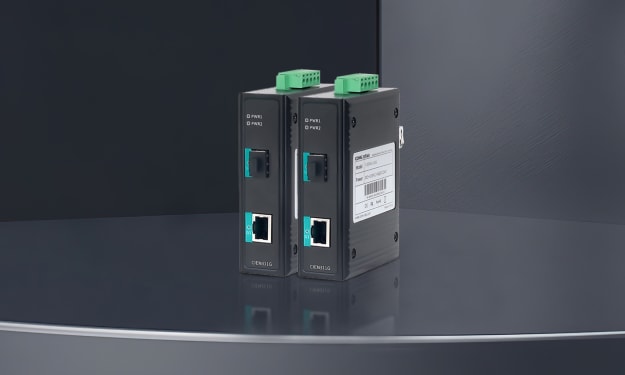
Therefore, industrial PoE switches almost universally adopt 48V standard output, not only meeting the power demands of various industrial devices but also offering reliability for long-term operation. However, PoE switches also support 24V DC input voltage. For example, Come-Star's 24V PoE switches are specifically designed for industrial environments where standard 48V power sources are hard to obtain. These switches use boost technology to efficiently convert wide-range 18–36V DC input to stable 48V PoE output, thus providing seamless power to devices compliant with IEEE 802.3af/at standards.
Do PoE switches support other voltage outputs?
Besides the standard 48V output, the market also offers some low voltage PoE switches, typically providing 24V or 12V non-standard outputs to meet certain special or customized needs. These devices are mainly used in retrofitting old systems or specific embedded scenarios.
24V PoE Switches
Common in certain industrial automation devices or older network cameras. Some industrial PoE switches offer 48V/24V switchable outputs to adapt to different terminal requirements.
12V PoE Switches
The output power is very low, suitable only for low-power devices such as sensors or small LEDs. The transmission distance is short, and voltage attenuation is significant, making it unsuitable for remote cabling. This is a non-mainstream configuration, and terminal device voltage requirements must be clearly confirmed before use.
Industrial PoE Switch Selection Advice
During actual selection, users are advised to consider the following factors based on the application scenario:
Operating temperature range (whether it supports -40°C ~ 75°C)
Power redundancy design (whether dual power input is supported)
Per-port power and total power budget Whether it is a managed PoE switch
Whether it supports IEEE 802.3af/at/bt standards
Summary
PoE technology greatly simplifies industrial network deployment, and the PoE switch voltage output determines its power supply capacity and device compatibility. The standard PoE 48 volt switch is the first choice in industrial applications, offering strong compatibility, stable transmission, and high safety. PoE switch 24V and PoE switch 48V are suitable for specific devices but must be used only after confirming terminal voltage requirements.
In actual deployment, a full understanding of PoE voltage standards and device power consumption matching will help build a safe, efficient, and sustainable industrial intelligent network system.
About the Creator
Keep reading
More stories from ethernet-network and writers in Art and other communities.
Ultimate Selection Guide of Industrial Media Converter
As demand for network communication grows in applications such as industrial automation, security surveillance, and smart cities, the limitations of traditional Ethernet in transmission distance, electromagnetic interference, and stability become increasingly apparent. Simultaneously, bus communication protocols like CAN, RS232/RS485 face challenges including short transmission distances and susceptibility to interference. The demand for diverse transmission media is surging, and media converters - critical bridging devices connecting serial ports, Ethernet, and fiber optic networks - are playing an irreplaceable role. They not only overcome Ethernet's transmission limitations but also address the pain points of bus communication, delivering exceptional versatility through a comprehensive product portfolio.
By ethernet-network7 months ago in Art
'Till Death We Do Art
There would be nothing divine in this world without art. Nature may surpass the divine to all intents and purposes, but like everything it absorbs and is absorbed by, it remains here, stuck on the surface of this world, ever-present, physically bound to the universe.
By Avocado Nunzella BSc (Psych) -- M.A.P 25 days ago in Art
How Working With a Florist in Jupiter Enhances Your Event Decor
Selecting the perfect floral arrangements can transform an otherwise ordinary event into a visually stunning experience. In Jupiter, Florida, the subtropical climate provides an ideal backdrop for an array of breathtaking floral designs that can enhance any space. By employing the expertise of a local florist jupiter, hosts can elevate their event's aesthetic beyond the commonplace and into the extraordinary.
By Shahid Sipra2 days ago in Art
Top tipple tricks
Been thinking a lot about drinking, lately. Not least because of a recent episode of over-indulgence and the inevitable after effects. Some readers may recall the earlier articles I wrote about beating the booze. Here I set out an experiment in techniques for cutting down on my alcohol intake. The experiment was successful, the techniques worked, and I have armed myself with an arsenal of weapons in the war against the demon drink. I have yet to fire the first round however. It's all a question of timing (perhaps procrastination).
By Raymond G. Taylor5 days ago in Psyche



Comments
There are no comments for this story
Be the first to respond and start the conversation.