
Ultimate Selection Guide of Industrial Media Converter
Guide of Industrial Media Converter
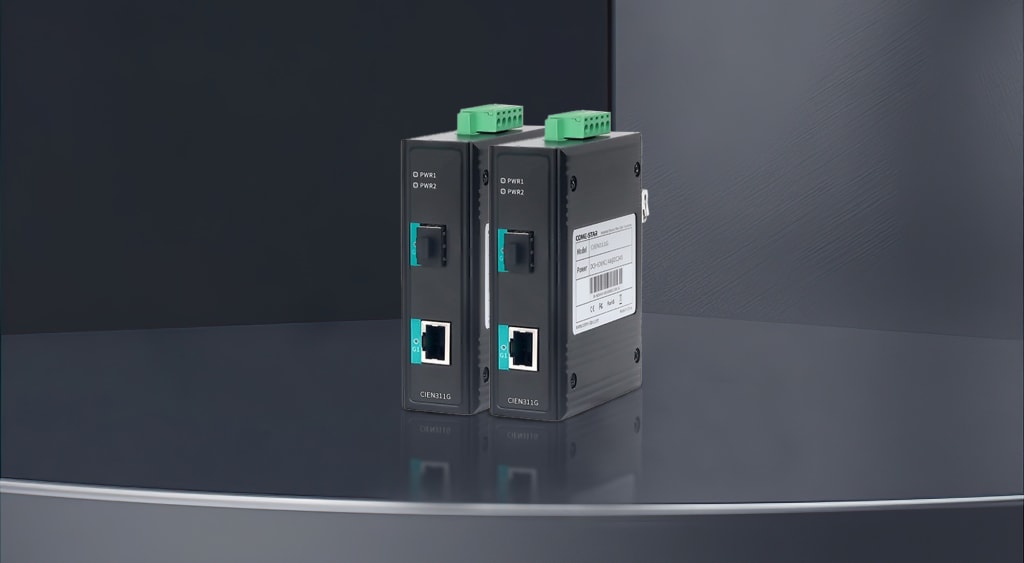
As demand for network communication grows in applications such as industrial automation, security surveillance, and smart cities, the limitations of traditional Ethernet in transmission distance, electromagnetic interference, and stability become increasingly apparent. Simultaneously, bus communication protocols like CAN, RS232/RS485 face challenges including short transmission distances and susceptibility to interference. The demand for diverse transmission media is surging, and media converters - critical bridging devices connecting serial ports, Ethernet, and fiber optic networks - are playing an irreplaceable role. They not only overcome Ethernet's transmission limitations but also address the pain points of bus communication, delivering exceptional versatility through a comprehensive product portfolio.
What is a Media Converter
A media converter is a network device that converts signals between different transmission media. It typically features one or more ports of a specific type (such as RJ45 Ethernet ports or serial ports), along with another type of port for different media (such as SC or LC fiber optic connectors). This device converts signals from one medium (e.g., Ethernet) to another (e.g., fiber optic) for long-distance transmission, then reconverts them at the other end, thereby extending the network.
In essence, it inserts a "conversion segment" into traditional transmission paths to enable long-distance, interference-resistant communication. Media converters are typically deployed in point-to-point configurations, with one device at each end - one connecting to a remote device and the other to the core network.
Unlike the integrated multi-function interfaces found in switches, media converters offer greater flexibility, cost-effectiveness, and ease of deployment, making them an economical solution for expanding network infrastructure and enhancing communication quality.
Main Types of Media Converters
Ethernet-to-Fiber
The most common type, used to convert Ethernet (RJ45) signals into fiber optic signals for long-distance transmission. This overcomes the 100-meter limit of twisted pair cables, extending the range to several or even dozens of kilometers via single-mode or multi-mode fiber. Fiber also provides excellent resistance to electromagnetic interference in industrial environments.
Ideal for pure data transmission scenarios (e.g., switch interconnection, non-PoE camera backhaul)
Supports multi-mode or single-mode fiber, with SC/LC connector options
Industrial-grade models can operate in wide temperature ranges for harsh environments
Compatible with existing Ethernet devices without changing the network architecture
PoE Ethernet-to-Fiber
In addition to Ethernet-to-fiber conversion, this type supports Power over Ethernet (PoE) to supply power to remote devices such as IP cameras, wireless APs, and sensors. It extends the transmission distance and resists interference while eliminating the need for separate power lines.
Supports IEEE 802.3af/at/bt standards (15.4W, 30W, up to 90W)
Suitable for remote devices without dedicated power sources, reducing installation costs
CAN-to-Fiber
Designed for industrial CAN bus systems, converting CAN signals to fiber for extended transmission. It solves the short-distance and interference issues inherent to CAN bus communications.
Compatible with mainstream CAN devices without system changes
High-level ESD and surge protection for stable operation in harsh environments
Available in single-fiber or dual-fiber configurations to save resources and reduce wiring costs
Serial-to-Fiber
Converts serial signals such as RS232, RS485, or RS422 to fiber, extending transmission to several kilometers and avoiding interference issues.
Broad compatibility with various serial devices
Supports both multi-mode and single-mode fiber
Ideal for PLC remote control, smart meter data acquisition, and building automation
Serial-to-Serial
Converts between different serial interface types or protocols to ensure compatibility between legacy and modern systems in scenarios without fiber optic infrastructure.
Supports common conversions such as RS232 to RS485
Enables system upgrades without replacing existing equipment
Flexible, plug-and-play deployment
Typical Industrial Applications of Media Converters
Industrial Automation - Connects PLCs, sensors, and remote I/O devices located hundreds or thousands of meters away to central control systems for efficient monitoring and control.
Video Surveillance Systems - Ensures stable high-bandwidth video transmission from distributed cameras to central NVRs over long distances, preserving image quality and real-time performance.
Smart Transportation and Infrastructure - Links sensors, traffic lights, information boards, and tolling devices spread across roads, tunnels, bridges, and highways, improving system responsiveness and safety.
Energy and Power Industry - Protects communication systems in substations, wind farms, and solar plants from lightning and electromagnetic interference by using fiber optic links.
Industrial Parks or Multi-Building Networks - Connects networks across multiple factories or buildings without redesigning switch architecture, providing stable inter-building communication.
Conclusion
Although small in size, media converters are essential in industrial network deployments. They significantly extend network coverage, enhance stability, and improve security. In long-distance transmission, high-interference environments, or complex deployment scenarios, media converters are often the most cost-effective and flexible solution.
About the Creator
Keep reading
More stories from ethernet-network and writers in Art and other communities.
Understanding the Need for QoS in Network Traffic Management
In today’s highly interconnected digital age, networks have become the lifeline for enterprise operations and daily communication. However, as applications such as video conferencing, real-time audio and video, and IoT data streaming place increasingly stringent demands on network latency, jitter, and packet loss rates, limited bandwidth resources often prove insufficient. Quality of Service (QoS) has emerged in this context — like an intelligent traffic control system, it can identify and prioritize the transmission quality of critical business traffic in complex network environments, thereby ensuring clear and uninterrupted voice communication, smooth and uninterrupted video streaming, and real-time, unlost control signals. Whether in enterprise communications or industrial IoT scenarios, QoS plays an irreplaceable role.
By ethernet-network4 months ago in Art
'Till Death We Do Art
There would be nothing divine in this world without art. Nature may surpass the divine to all intents and purposes, but like everything it absorbs and is absorbed by, it remains here, stuck on the surface of this world, ever-present, physically bound to the universe.
By Avocado Nunzella BSc (Psych) -- M.A.P 26 days ago in Art
Essential Traditional Performance Arts Around the World for Curious Travelers
Traditional performance arts are powerful cultural expressions that connect communities to their history and identity. Through dance, music, theater, and ceremonial storytelling, societies share values, beliefs, and experiences that have shaped their heritage. These performances often combine artistic creativity with historical traditions preserved across generations.
By Producer James Simon4 days ago in Art
Why Didn't Anyone Tell Us
Men, move along. This is not for you. This is for the women. I was forty-five when I began menopause. It is pretty young for that to be going on in a woman’s life, but I had undiagnosed PCOS, my entire life. Thank you to all the gynecologists I had seen my entire life. That in itself should encourage women to keep seeking second opinions, especially when you are not getting correct answers or any at all.
By Alexandra Grant4 days ago in Humans




Comments
There are no comments for this story
Be the first to respond and start the conversation.