
This is Laura Knight
This is me


Today, I have rediscovered an art treasure I thought I had lost. And on my own doorstep. Foolishly, when I saw it in the Queer British Art exhibition in 2017, I didn't check where the painting was located. It is ironic, then, that despite several visits to the National Portrait Gallery in London over the past year, I had not seen the gallery where this sumptuous painting hangs in pride of place. Not until today, April 21, 2025.

Artist self-portraits are subjects I find fascinating. When an artist paints a self-image, they may well try to capture something of themselves in the painting. More particularly they are likely to want to project an image to an audience, a marketplace.
Van Gogh, for instance, famously painted himself with a bandaged ear, demonstrating to the world how he suffered for his art, showing his struggles, his inner turmoil. Many artists show themselves painting in their studios, which is hardly surprising.

Laura Knight's self-portrait is, to this extent, no different. Commentaries on this painting dwell on one aspect of the work, sometimes a distraction, in my view. They focus on the artist as a woman struggling in a man's world. It is of course vital that we understand that throughout history it has been harder for women to succeed as artists. There is a danger, however, that in our obsession with women's rights and the careers of women in history, we lose sight of the art and the artist.
While it is therefore important to understand that Knight's work was in part exceptional because the artist was a woman, it is far more important to see the exceptional nature of Knight's self portrait in its own right.
In the painting, the artist is wearing a dashing crimson jacket, a rakish hat adorned with a hatband that has something of the gypsy about it. She is in the act of painting a nude model, a fellow artist, who is posed, like her painter, facing away from the audience. Thus we see painter, model and canvass, each from behind and each relating to the other, as if we have just opened the door to the studio and stepped in.
Now, the fact that this artist, a female artist, painted a nude was indeed exceptional and noteworthy. As an art student, Knight was forbidden to participate in life classes alongside her male counterparts. At the time, and for most of Knight's career, the Royal Academy would not countenance women painting the naked human form. And while the RA may have accepted her as a member of their exclusive, establishment body, the only woman at the time, it had to be on their terms.
So that, first and foremost, this painting was a very prominently raised middle finger to the British art establishment. Or was it? Knight became a member of this exalted body and was at the time the only woman member. To that extent she was, or at that time became, of the establishment. I like to think that this kind of acceptance is indicative of the power of art to build upon itself. Knight (unlike every other woman artist at the time) was considered so exceptional as to warrant the title RA, and was also later invested as a Dame of the British Empire.
Enough of career and accolades. Regardless of whether this woman painter was exceptional among other painters or not, this painting certainly is. Despite the inclusion of, not one but two, female nude figures in the painting, our eyes are drawn to the central figure, the artist herself. This is not least because of the bright and stark crimson red of the stylish jacket. So that the figure of the artist is very much the center of attention despite being offset to the left of the painting.
She stands poised, brush in hand, as if in contemplation of her subject. A closer look at the artist's face may suggest otherwise.
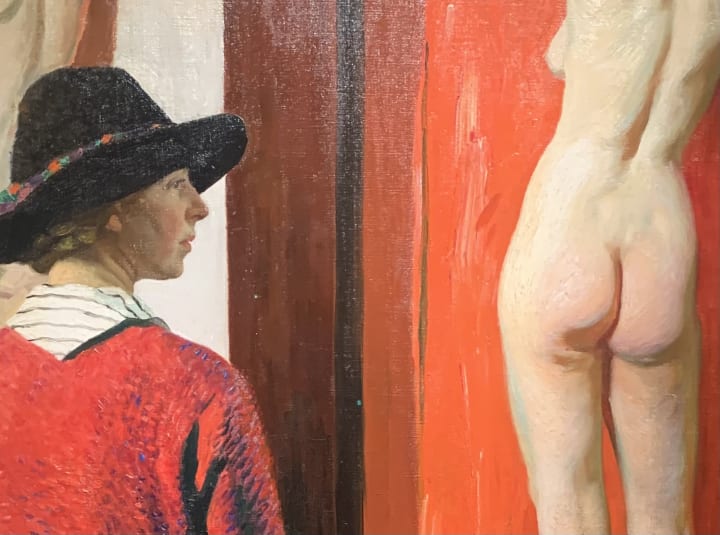
The gaze is not directed at the model but appears to be fixed on something that is out of the frame of our vision. A mirror, perhaps? We cannot know but we can always speculate, which is much more fun. Perhaps this painting captures the moment the artist notices her own reflection in an act of artistic insubordination. Perhaps, in this instant, she sees her own image as the artist taking on the establishment. Perhaps she sees herself in the rebellious act of painting a nude for all the world to see.
If you look again at the paintbrush, you may see that it is lowered. Given the importance of the paintbrush to the painter, this can only be a signal, a code. The artist is not about to daub paint from her palette and apply it to canvass so she must be doing, or be about to do, something else. Indeed, the colour palette is hidden from view, presumably held in the unseen left hand. Why is she hesitating to paint? Again, we can only speculate but perhaps her intention is to focus our attention on the painter, herself, and not her painting. Perhaps she is saying, "This is Laura Knight. This is me." We could add all manner of additional comments like "I am not afraid to be seen with a nude, despite what everyone will think."
What everyone thought of the painting was what one might expect of post-Victorian sensibilities. First exhibited privately in 1913, critics described it as "dull", "regrettable" and "vulgar," although The Times said it was "extremely clever." Then later, in 1939, the newspaper criticized its "mistaken attempts at solidity" and called it "regrettable".
Solid is not a bad description of the work. Although at first sight the painting gives an overall impression of softness, it also has a strong element of angularity. There are the warm tones of the orange background and the gentle curves of the model. But there are also the harsh lines of the orange screen and the stripes of the base of the plinth the model is standing on.
If we imagine a straight line from the top and the brim of the artist's hat, and another from her shoulders, they appears to focus attention on the model's buttocks. They appear to direct our attention from the stark red and black into the cool flesh tones. The buttocks themselves have a slightly red blush, as if to draw further attention to them. Is this the artist showing a defiant bottom to her audience and to the RA? Or perhaps I am trying to read too much into it.
As a nude study, the impression of the pose and its rendering in paint is more anatomical than erotic. Although the arms are posed in the artistic convention that suggests invitation, accessibility, it is directed away from us. This is in itself a defiance of convention. Throughout art history, a frontal female nude with arms raised to head, usually lying on a lavish bed or couch, has always suggested courtesan or expectant lover, or 'whore'. The purpose of such an image was generally to gratify a male audience, in some cases to adorn a rich man's room.
In Laura Knight's study, it is almost as if she is trying to reverse the role, to see the other side. Not only is the model directing the 'invitation' away, she is standing, not lying down. The pose is reversed literally as well as being a figurative reversal of roles. Not just for the model, but also the artist. A nude study such as this would, historically, be modelled by a man. While female nudes would have been painted with soft flesh tones, emphasising curves, bums and breasts, a male nude would have been drawn or painted with emphasis on muscular features, lines showing sinews and strength, athleticism and fighting ability. Art students of past eras (perhaps still now) were given male models to draw to help the student learn about anatomy and how to draw it. It was a learning exercise, not something to paint for public view. The lessons learnt would inform all figure painting, drawing and sculpture, which would mostly have been clothed. That these classes were denied to the few female students, was another way in which the careers of women artists were restricted.
This all leads us to the conclusion that a large part of this self portrait is a statement from the artist that "I don't care what you think. I will paint nude women, and I will do it in a way that pleases me, and not my male colleagues."
The nude model, an understanding friend of the artist, is depicted in a way that emphasizes her humanity and femininity without pandering to erotic convention. A viewer may see it as an erotic image or they may see it as nude study. In this painting the nude is there primarily as a statement of artistic intent on the part of the artist. It is a statement of Identity.
This is me. I am Laura Knight
Latest update
February 12, 2026
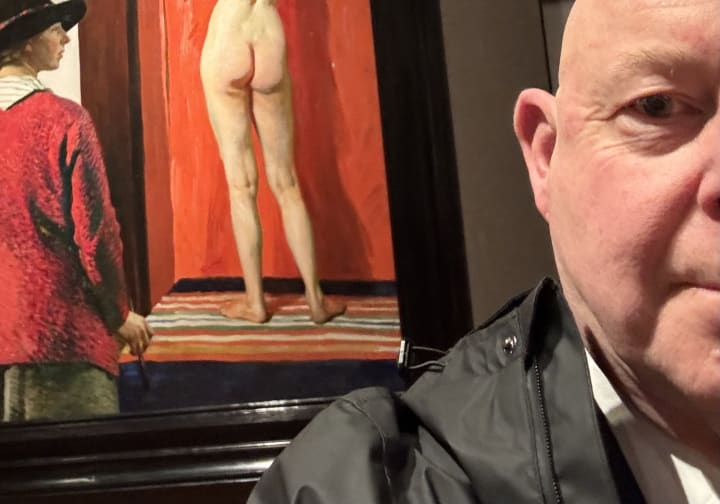
And here am I, the author Ray Taylor, doing a cheeky selfie with Laura. I was in London, on movie business in Leicester Square, and just had time to pop into NPG to take another look at the artist and her subject.
Thanks for reading
About the Creator
Raymond G. Taylor
Author living in Kent, England. Writer of short stories and poems in a wide range of genres, forms and styles. A non-fiction writer for 40+ years. Subjects include art, history, science, business, law, and the human condition.
Keep reading
More stories from Raymond G. Taylor and writers in Art and other communities.
Paintress paint thyself
There is an old party game where guests are challenged to name five women artists off the top of their head. Try it, without checking, and you will know what I mean. Did your list include Freda Kahlo? Now try restricting your answers to 17th, 18th or even 19th centuries. It's a long time since I have heard anyone say "None of the great artists were women" but this phrase does spring to mind.
By Raymond G. Taylorabout a year ago in Art


Comments (14)
Well deserve Top Story. Very fascinating piece for sure. We are the spectators of art. It is interesting what the artist is really looking at her double self portrait in her painting.
Excwllwnt analysis and that you for sharing this art
"Loved this!"
Ray, I love your in-depth analysis. Before I read the history and your story, at just face value of the painting, here were my observations: I loved the concept of the artist giving us an intimate picture of herself. Seemed to imply that was important for her. Then I noted the color red which always brings a bold and positive statement. I noticed the blush on the buttocks...as if she had been spanked/punished or might signify a bit of shame? Reading the background made more sense of the painting. Kudos for Laura Knight! And for you, too :)
Great
Wow, this is a whole new level of appreciation Raymond. Congratulations on top story
Back to say congratulations on your Top Story! 🎉💖🎊🎉💖🎊
damn this was crazy well researched, considered, and written! i'll be doing a deeper dive into laura knight now :) thank you
My youngest is finishing up grad school in New York City and when I visited her last, she took me to the Met. I have never enjoyed art so much than when you go with someone who knows what they’re talking about. It completely opens a new door to what we’re looking at. You did that with this Painting thank you so much.
This article beautifully captures the essence of painting! The way you described the techniques and emotions behind each stroke truly brought the art to life. Very inspiring!
"I don't care what you think. I will paint nude women, and I will do it in a way that pleases me, and not my male colleagues." She's such a badass! I aspire to be her. I enjoyed reading your musings!
I love the painting, your analysis, & her attitude! Well done, Raymond! Even better done, Laura Knight!!!!!
Brilliant analysis, Ray! Loved the lesson and the painting!
What an interesting read. I too have always been fascinated by art and the artist. I will have to look Laura Knight up and read more about her. Thanks for sharing!