
Paintress paint thyself
400 years of women artists: Now You See Us

There is an old party game where guests are challenged to name five women artists off the top of their head. Try it, without checking, and you will know what I mean. Did your list include Freda Kahlo? Now try restricting your answers to 17th, 18th or even 19th centuries. It's a long time since I have heard anyone say "None of the great artists were women" but this phrase does spring to mind.
It’s not that there was a lack of women working as professional artists in any of these centuries. There were countless female practitioners. They just didn’t get the recognition, were not taken seriously and were exhibited less. If they were given commissions, it was for considerably lower fees than male painters. When it came to writing the history of art, at least until relatively recently, women were all but excluded and expunged from the records.
Which is why Tate’s Now You See Us exhibition was so important and so utterly astounding in its breadth, depth and WOW! factor. It included many works from the Royal Collection and private collections that are unlikely to be seen at any other time. If you would like to see it, I am afraid it ended in October 2024. You can see some of the works and commentary in the link.
It is difficult for me to describe the feeling of awe that this exhibition generated. Was I surprised to see so many women artist covering a span of four centuries. Well, frankly, yes. What does not surprise me, however, is the degree to which the success of women artists over these centuries has been actively supressed. My thanks to the Guerrilla Girls for this understanding. Some years ago, there was a gallery dedicated to their work at Tate Modern, which was all but ignored by most visitors, as they strode past the propaganda posters to catch a look at some Warhol and French (male) artists' work. I wrote a presentation on these works at the time, which was never delivered as the works were deinstalled in 2019 (I think) after a burst of interest shown by visitors in 2018, for reasons that I hope are obvious.
To understand more about the fate of so many women artists, let's take a look at the following work, seen in the Tate exhibition:
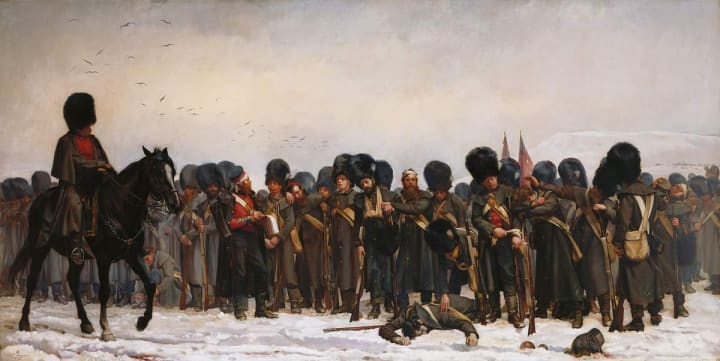
A typical post-battle scene you might think. Certainly the title confirms the assumption: The Roll Call, 1874 from the Royal Collection of King Charles.
Described by the Royal Collection Trust thus:
In the cold light of morning, the remnants of a battalion of Grenadier Guards, many exhausted and wounded, are answering a roll call in the aftermath of a battle...
The Roll Call captured the imagination of the country when exhibited at the Royal Academy in 1874, turning the artist into a national celebrity. So popular was the painting that a policeman had to be stationed before it to hold back the crowds and it went on to tour the country in triumph. The painting's focus on the endurance and bravery of ordinary soldiers without reference to the commanders of the army accorded with the mood of the times and the increasing awareness of the need for social and military reforms.
Though the public had been exposed to other images of the Crimean War, primarily prints, photographs and newspaper illustrations, never before had the plight of ordinary soldiers been portrayed with such realism. Butler researched her subject by studying A. W. Kinglake's seminal history of the Crimean War, as well as by consulting veterans of the Crimea, several of whom served as models for the painting. She also painstakingly sought out uniforms and equipment from the Crimean period in order to be correct in the smallest military details. The sombre mood and simple yet dramatic composition Butler achieved in The Roll Call vividly epitomised the grimness not only of the Crimean War but of all wars.
It can therefore be surmised that the artist, Elizabeth Southerden Thompson Butler (Lady Butler, 1846-1933), found favour with Queen Victoria, for the empathy shown in the painting. Though the work was commissioned by a wealthy industrialist, it was eventually acquired by the Queen, hence is now a part of the Royal Collection. Despite the huge popularity of the painting at the time, the artist never found further success and so became one of the many women artists whose name is barely known beyond the world of academics and art historians. And those, of course, fortunate enough to have seen it in the Royal Collection and during the Tate exhibition.
One might think that a subject like this would have been painted by a man, perhaps an official war artist present at the battle. Lady Butler, according to the description, painted this from painstaking research into the history of the battle, the precise patterns of the uniforms, and having spoken to surviving veterans. She spoke to men suffering from what we now call post-traumatic stress disorder: battle fatigue, shell shock. If you compare this painting with a typical soldierly line-up of its era, you might well see some of the empathy of the artist in the work. This makes me wonder if a female artistic approach might be more sympathetic, more involved, more understanding, than a disciplined approach that might be taken by a male artist. Or am I over-generalizing.

Clara Maria Pope, Composition of flowers, 1818
Something I like to do is understand the different approaches to artistic endeavour made by women when compared with their male counterparts. It is an exercise in trying to understand any apparent contrast between the masculine and the feminine mind, and how they might differ in emphasis. I am particularly interested in the feminine understanding of the nude.
For this reason I was fascinated by the few nudes included in the display. The small number of nudes was a disappointment but nothing like the apparent lack of interest in them by the visitors. Has the nude in art got a bad name recently? Yes, emphatically so. Along with sex and nudity in general. Seems to me we are heading for another moralistic Victorian age of fear of sexual expression.
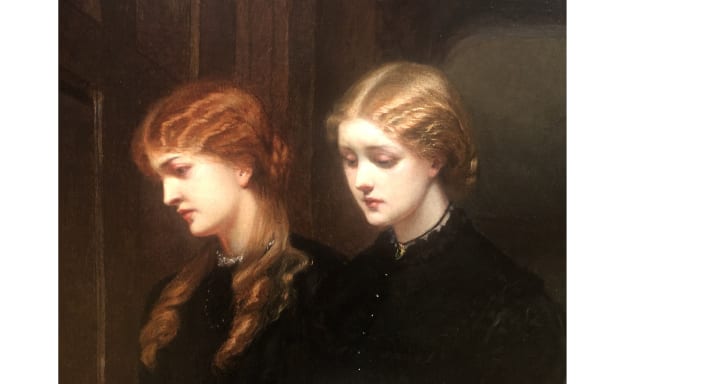
This painting by Emily Osborn is more in keeping with Victorian morality. Though popular in its day, it was more so for the lesson it gave about mortality and the proper role of women artists in keeping within the designated sentimental and moral compass. For the Last Time, 1864 shows two young women pausing at the door, about to bid farewell, it seems, to a loved one. Their creamy white complexions and glorious flame red and straw blond locks, sensibly and soberly tide back, are in stark contrast to the severe mourning black and drab décor.
I spent some time studying the few nudes on show, in order to try to understand how the female form was depicted by the female artists in the show. While I was doing this, I noticed that every other visitor bypassed these pictures and one or two appeared to be glancing over to me. I wondered if I was showing too much interest in the naked form and exciting some feeling of contempt for doing so. Perhaps I was just imagining it. Or perhaps I was spending too much time marvelling over these images of nudity... male gaze and all that, eh?
Interpretations of the female form by women artists seem to me to carry so much more meaning, than those painted by men. At the risk of over generalization, the typical male-painted nude seems to emphasize boobs, bums and bushes. Women artists, on the other hand, seem to me to be inclined to use the nude as a way of expressing other qualities, be they muscularity, athleticism, intellectual or spiritual virtues or allegorical subjects. Any sop to alluring sexuality would seem to me to be shown in a far more sympathetic way by women artists. Or perhaps it is simply a better appreciation and understanding of the female aesthetic. If the intention (as much as artistic intentions can be interpreted) is erotic, then the eroticism comes not from the open invitation and display, but in a much more holistic and emotionally complete way. The subjects are not desexed so much as being sexually more subtle and empathetic in their presentation.
WOMEN AND THE PROFESSIONS
One thing I did learn from visiting the exhibition is that many of the women engaged professionally as artists over the past 400 years were employed as copyists and painters of miniatures. There were several exquisite examples on display at the exhibition which, alas, I am unable to show by way of example. If you ever have a chance to see any part of the Royal Collection, perhaps on a visit to Buckingham Palace in London, you will hopefully see what I mean.
That women artists should be seen as capable of the artisanal work of copying well-known works, and making miniatures portraits (these days, jobs done by the iPhone camera and other digital devices) should be no surprise. In an age where prints of famous paintings are easily obtainable, it is easy to forget the value of being able to make an accurate and convincing copy of a work that an artist or wealthy patron might want to be seen more widely, or to be able to gift to a friend or business associate. To be able to copy a Leonardo convincingly? Who is the better artist?
One artists prominent in the Tate exhibition who is well known to art experts and her aficionados, and not surprisingly once you have seen her work, is Artemisia Gentileschi. Many came, I am sure, just to see her work. Having seen some of it myself, I would certainly want to do so if her work is included in any other exhibitions, as it is bound to be.

Artemisia Gentileschi (1593-52), Susanna and the Elders, c.1640, depicts a Biblical scene of morality and virtue. Susanna, caught bathing by two elders, resists their attempts at rape and is accused of adultery, a charge she is subsequently exonerated of when a witness comes forward in her defence. Virtue shines through, for the client at least, but the artist still captures some of the fear, emotion of Susanna, and obvious lust and ill-intentions of the would-be rapists. This in a style of sumptuous color and brilliant lighting. Gentileschi was, for a time, highly popular in the royal courts of Europe and ranked alongside any male artist if not above. She was an A-list celebrity of her time but her popularity faded, as fashions do, and she is only really known to art experts, and her devotees, of today.
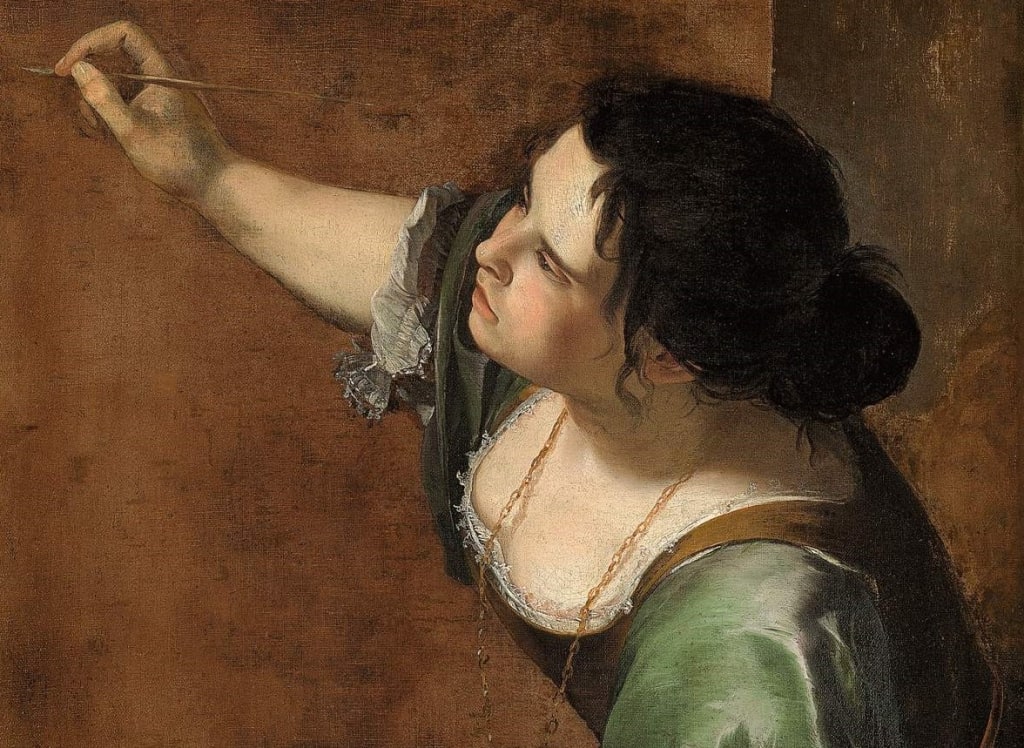
For me, the most interesting work in the Tate show was the one shown as my featured image and further detailed here.
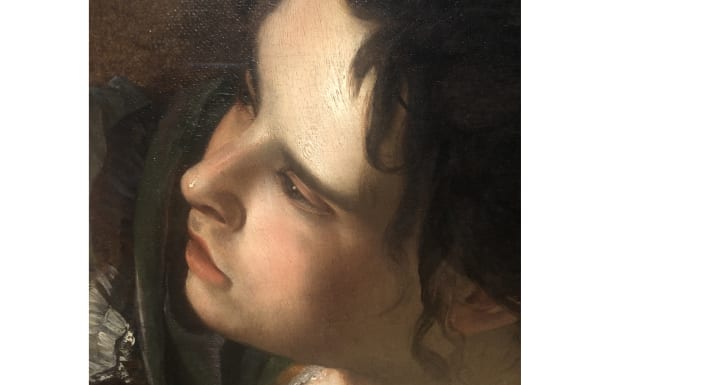
Self-Portrait as the Allegory of Painting (‘La Pittura’), demonstrates a typical Caravaggio-influenced approach of rich color and dramatic, theatrical styling. Looking at the expression on the artist's self-depicted features demonstrates a powerful concentration and almost a bewitching of the artist by her calling.
Gentileschi's life story is a tale in itself. Taught by her famous father in his workshop in Rome from a young age, she was raped by one of father's associates and forced into a betrothal which lasted a year. After this her father had the rapist prosecuted, resulting in Artemisia being tortured under interrogation as a witness. Even though the rapist was convicted, his sentence of exile from Rome was not enforced, leaving his victim to exile herself. If you are interested in knowing more about her life story, there are plenty of sources online.
Seeing this exhibition was a truly enriching experience. The only criticism I would have of the curation is that, in placing emphasis on the careers of women artists over 400 years (an understandable and laudable focus) it seemed to me that there was less emphasis on the art itself in the descriptions given, and the curatorial choices made.
No matter, the collected works spoke for themselves and demonstrated, beyond any doubt, that the old saying "none of the great artists were women" does not stand up to any kind of scrutiny. Rather, the issue is:
Why have so many of the great women artists been excluded from the popular history of art?
I hope readers will ponder this question further, now, and when they next visit an art museum or view an exhibition.
Thanks for reading
Ray
About the Creator
Raymond G. Taylor
Author living in Kent, England. Writer of short stories and poems in a wide range of genres, forms and styles. A non-fiction writer for 40+ years. Subjects include art, history, science, business, law, and the human condition.
Keep reading
More stories from Raymond G. Taylor and writers in Art and other communities.
Left handed snail
This may be a first. The first time that a new work of art has been publicly unveiled and announced to the Vocal Art Community. Please tell me if it is not, and other new works have been formally announced in this forum. Either way, I am delighted to present to you for the first time: Left-handed snail, 2025, freehand digital drawing. I drew this work yesterday evening, January 16, 2025. It is all my own work.
By Raymond G. Taylorabout a year ago in Art


Comments (5)
A fascinating, enlightening read. Interesting too, considering the difference in styles and interpretations of males v females. Thanks ✅🤗.
Another great article. Really good insider eye. Love the questions you raise.
Fabulous article and discussion of an amazing show, Ray! Thanks for sharing!
Omgggg, my heart broke so much for Artemesia 😭😭😭😭😭😭
What a great Art history lecture. Loved the paintings and the discussion that followed each one. Good job.