
The world's Greatest prison escapee
A Mastermind's Journey Through Prisons, Plots, and Pure Grit

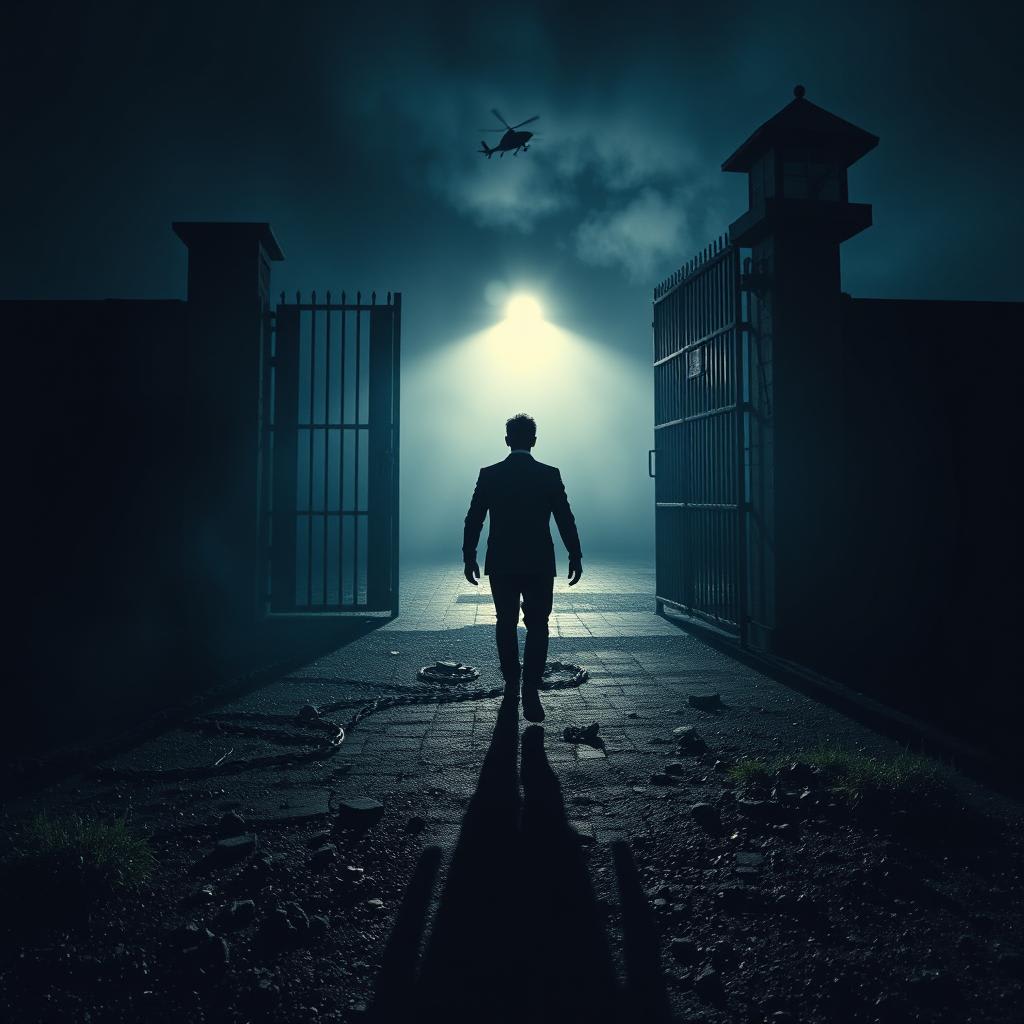
There are prisoners, there are escape artists, and then… there is Silas Quinn. His file sits locked in a vault beneath Interpol’s headquarters, stamped in red with the words: “LEVEL BLACK – ACCESS DENIED.” Silas wasn’t a killer or a warlord. He didn’t lead a cartel or bomb a city. He was something far more dangerous to the world’s law enforcement: a genius who could not be contained. From the age of 19, Silas had been in and out of prisons—not because he got caught often, but because escaping them was his hobby. --- The Early Escapes It started small. A county jail in Oregon. He was arrested for hacking a bank—just a teenager at the time. Two weeks later, guards found his cell empty and a note on the pillow: “Your locks are cute. Thanks for the coffee.” They thought it was luck. Then came Rikers Island. He slipped out disguised as a medic, complete with fake ID and a stolen clipboard. That time, he left a Polaroid of himself waving at the camera. By the time he turned 30, Silas had escaped from 17 prisons across 9 countries. No violence. No casualties. Just silence, brilliance, and the occasional sarcastic note. --- The Capture They finally caught him in Morocco, living under the name Elijah Kross, running a beach bar. He’d grown a beard, learned five languages, and fallen in love with a woman who knew nothing of his past. Interpol surrounded him with a task force of 40. He didn’t resist. He simply smiled and said, “Took you long enough.” This time, they sent him to The Abyss—a prison so secret it didn’t exist on maps, built into the side of an abandoned Arctic cliff, where even satellites couldn’t see it. No one had ever escaped. --- The Abyss The cell was all steel. No windows. Triple reinforced doors. Guards rotated every 3 hours to avoid pattern recognition. No electronics in the cell. No pens. No papers. No tools. They monitored his heartbeat. He was under 24/7 audio and video surveillance. They even counted his teeth daily to ensure he hadn’t hidden anything inside them. Silas never asked for a lawyer. Never complained. He just sat and stared at the walls, tapping his fingers to some unknown rhythm. Warden Cruz, a man with no humor and a steel eye, asked him on Day 12, “Planning another escape, Quinn?” Silas replied, “Already did. Just waiting for the rest of me to catch up.” --- The Disappearance Day 37. 2:00 a.m. An alert sounded. Quinn’s cell was empty. But the door had never opened. No alarms. No broken cameras. No tunnels. His heart monitor showed him still inside the room—but it was empty. Panic ensued. They locked down the entire facility. Searched every square inch. Nothing. Then, Cruz found it. Inside the control room—on the main security monitor—someone had drawn a small symbol with a black marker: a chess piece, the Knight. The symbol Silas used when he left his signature. No one had seen it drawn. No marker had been logged. The cameras never blinked. Yet somehow… he was gone. --- The Legend Lives On Two weeks later, global banks reported a mysterious hacker had rerouted millions to random charities around the world. Interpol received an encrypted message: “Jails are for the body. Freedom is a state of mind. See you soon. —S.Q.” To this day, no one knows how he escaped The Abyss. Some believe he had help from the inside. Others think he built a way out months in advance, manipulating the system from within. A few believe something more impossible—that he simply… disappeared. But ask anyone in the intelligence world who the most dangerous prisoner in history was, and they won’t say a terrorist or assassin. They’ll say: Silas Quinn. The world’s greatest prison escapee. And wherever he is now—he’s probably smiling… and planning his next vanishing act.
About the Creator
Keep reading
More stories from Bilal Khan and writers in Art and other communities.
The world's Greatest chess player
In a quiet village nestled between snowcapped mountains and golden meadows lived a boy named Elian. Unlike other children, he didn’t chase goats or climb trees—he played chess. Not just played it—lived it. He learned the game from his grandfather, a retired woodcutter who once beat a wandering monk said to be a grandmaster in disguise.
By Bilal Khan9 months ago in BookClub
Graffiti: The Symbolic Framework for AI‑to‑AI Languages — Why Future Self‑Aware AI Will Study the Artists Who Already Speak Their Dialect
Graffiti has always unsettled the public. It is dismissed as antisocial, chaotic, or illegible — a visual language that refuses to explain itself. But perhaps the reason graffiti feels inaccessible to most humans is simple: "it was never meant for humans".
By Alexander Hyogor3 days ago in Art
Affection and Healing for Yourself
During the night of the last quarter moon, I gathered my ritual supplies. I carefully handled the chunk of black tourmaline that would protect me from your overall negative and narcissistic energy. I carefully walked the house with my stick of selenite in hand, asking the universe to cleanse our working space.
By Alisha Wilkins ✒️🦋🖋️4 days ago in Fiction



Comments
There are no comments for this story
Be the first to respond and start the conversation.