
The Waiting Bloom
An Old-Fashioned Portrait of Love, Longing, and Silent Devotion in a Garden of Time

Article:
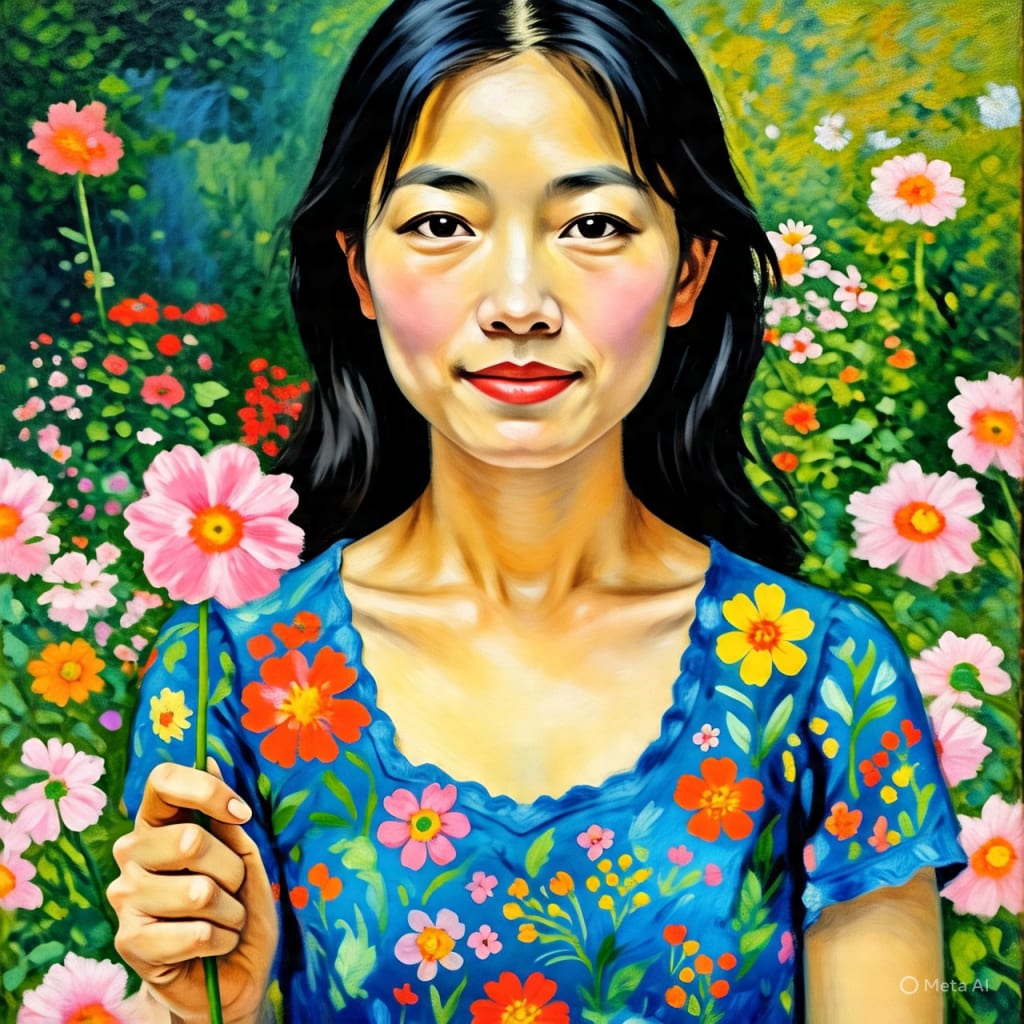
Art has long served as the mirror of the human soul, capturing in stillness what words struggle to express. One such masterpiece—an old-fashioned painting depicting a girl waiting for her beloved in a garden, a flower delicately held in her mouth—emerges as a timeless visual poem of longing, innocence, and love suspended in hope. This painting, with its tender composition and emotionally rich subject, invites the viewer to step into a quiet world where emotion breathes between brushstrokes and silence tells the tale.
A Portrait of Devotion
At first glance, the painting appears simple—a young girl standing or sitting in a tranquil garden, with soft flowers blooming all around her. The garden, painted in gentle greens and pastel tones, seems almost dreamlike, untouched by time. The girl, dressed in flowing, modest attire typical of a bygone era, does not meet the viewer’s gaze. Instead, her eyes are fixed beyond the canvas, far into the distance, as if watching for someone just out of sight.
But the most arresting detail is the flower in her mouth—a symbol both unusual and powerfully symbolic. It evokes silence, purity, and suppressed speech. The flower, neither in hand nor worn in her hair, becomes a vessel for her unspoken feelings. It speaks of anticipation, of love that waits, that does not beg or demand, but simply believes.
The Language of Symbolism
In traditional art, gardens have often been depicted as places of peace, memory, and sensual beauty. They are the chosen spaces where lovers meet, secrets are whispered, and time seems to slow. Here, the garden is not merely a background; it becomes a living character in the painting. Every leaf and bloom seems to lean in toward the girl, as if sharing in her patient waiting.
The flower in her mouth acts as the centerpiece of the entire composition, pulling focus and inviting interpretation. In various cultures, a flower held in the mouth can mean silence, surrender, or a desire not yet expressed. In the context of this painting, it feels like a promise: she waits not with complaint, but with faith. She is love in its purest form—quiet, constant, and undemanding.
The Power of Stillness
Unlike modern portrayals of romance filled with passion, urgency, and often conflict, this painting honors the quieter emotions—the kind that persist through stillness. There is no drama in her posture, no tears in her eyes. Instead, her body is relaxed, her demeanor composed. Yet, within that calm lies a deep ocean of feeling. The artist does not need to show us her heartbeat; we can feel it in the colors, in the light that falls gently on her face, in the tender curve of her lips around the flower’s stem.
This is the power of stillness in classical art—it asks the viewer to slow down, to breathe, and to feel. It gives no loud declarations of love but shows us the reality of waiting, of holding love within without assurance or reciprocation.
The Echo of the Past
Painted in an old-fashioned style, likely with oils on canvas, this work carries with it the textures of a time when love was less about instant gratification and more about enduring through seasons. The brushwork is soft, even romantic, with edges that blend and blur, much like memories. The girl's attire, possibly from the Victorian or Edwardian period, reinforces the sense of timelessness. Her dress, delicate and demure, contrasts with the vivid colors of the garden—perhaps a visual metaphor for the inner emotional world she carries quietly within her.
Such art reminds us of handwritten letters, secret glances, and days counted by the movement of the sun rather than the buzzing of notifications. It holds the viewer in a moment before everything changed—before the world sped up and emotions became filtered through technology and distraction.
A Story Without Words
What makes this painting so powerful is that it tells a complete story without the need for a single word. We don’t know her name, nor do we see the face of the one she waits for. But we feel the ache of time, the purity of love unspoken, and the bloom of hope that refuses to fade.
There’s a narrative thread woven between the petals of each flower in the garden, a history held in her posture. Has she waited long? Has he promised to return? Or is this just the first hour of her hope, fresh and bright like the flower she gently holds?
By leaving these questions unanswered, the painting becomes universal. It is not just her story—it is the story of every person who has loved in silence, who has waited in hope, who has believed in the return of someone dear.
The Emotional Aftertaste
Long after one stops looking at the painting, its emotions linger like perfume on the air. The viewer is left with a softness, a wistfulness, and perhaps even a tinge of sorrow. Not because the painting is sad, but because it captures something so beautifully rare: quiet devotion.
In an age where love is often noisy, performative, and rushed, this old-fashioned artwork becomes almost radical in its depiction of gentle patience. It teaches us that love can exist in waiting, that beauty lies in quiet moments, and that some stories are best told through eyes, flowers, and silence.
Final Thoughts
The Waiting Bloom is more than just a painting. It is a hymn to patient love, a tribute to those who feel deeply and wait with grace. It bridges the gap between the past and the present, reminding us that some emotions are eternal.
This artwork draws us in with its aesthetic charm, but it holds us with its emotional truth. The girl with a flower in her mouth does not cry or speak. She does not write or shout. She simply waits, and in her waiting, she becomes a symbol of something we have nearly forgotten in today’s world: that love, in its most honest form, can be silent, enduring, and beautifully still.
About the Creator
Fazal Malik
"Welcome ! We're dedicated to making learning fun and accessible. Subscribe for educational videos, tutorials, and resources to ignite your curiosity."
Keep reading
More stories from Fazal Malik and writers in Art and other communities.
"Layers of Texture: The Artful Story of Felt and Form"
Introduction Art has always found ways to evolve, embracing not only new techniques and media but also rediscovering old materials in innovative ways. The image in question—a beautifully crafted abstract composition using felt textures—represents a rich convergence of materiality and design. Soft, colorful, and inviting, it blends geometry with warmth in a way that both stimulates the eye and soothes the mind. This article explores the meaning, interpretation, and artistic depth behind this image, delving into its craftsmanship and the visual language it speaks.
By Fazal Malik8 months ago in Art
'Till Death We Do Art
There would be nothing divine in this world without art. Nature may surpass the divine to all intents and purposes, but like everything it absorbs and is absorbed by, it remains here, stuck on the surface of this world, ever-present, physically bound to the universe.
By Avocado Nunzella BSc (Psych) -- M.A.P 14 days ago in Art
Silent Intensity
Once in a distant future, in a world filled with towering silver cities and flying vehicles, there lived a young girl named Mira. She was fourteen years old with bright green eyes and hair that shimmered like the night sky. Mira was not like other children in her city. She possessed a rare gift, one that allowed her to hear the thoughts of others. This power felt like a blessing at times, but it also made her feel very alone. The noise of people's thoughts often overwhelmed her.
By Hamad Afridi a day ago in Art




Comments
There are no comments for this story
Be the first to respond and start the conversation.