
"Layers of Texture: The Artful Story of Felt and Form"
"Exploring Depth, Emotion, and Creativity Through Abstract Felt Art"

Introduction
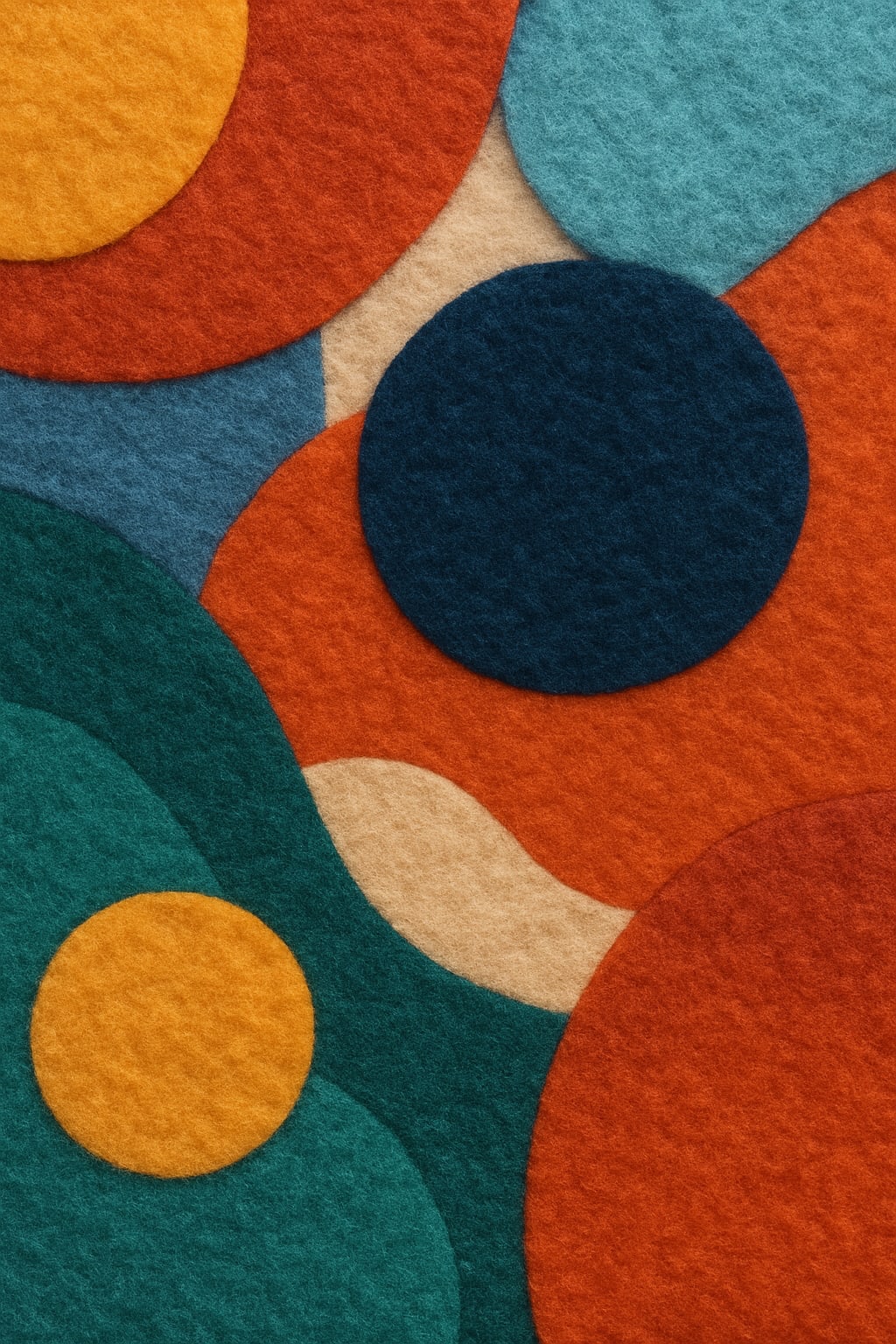
Art has always found ways to evolve, embracing not only new techniques and media but also rediscovering old materials in innovative ways. The image in question—a beautifully crafted abstract composition using felt textures—represents a rich convergence of materiality and design. Soft, colorful, and inviting, it blends geometry with warmth in a way that both stimulates the eye and soothes the mind. This article explores the meaning, interpretation, and artistic depth behind this image, delving into its craftsmanship and the visual language it speaks.
---
The Language of Felt
Felt is one of humanity’s oldest textiles. Historically, it’s been used for everything from clothing and insulation to storytelling through applique. In modern craft and design, it carries a symbolic weight: comfort, childhood, softness, and care. But in the hands of an artist, felt transcends mere materiality. It becomes a visual metaphor—a medium that conveys tactile emotion and structural depth.
This abstract artwork capitalizes on felt's unique characteristics. The image features a carefully arranged layering of circles, waves, and organic shapes in various hues: warm oranges and yellows paired with calming blues, teals, and neutrals. Each element looks as though it's hand-cut and gently pressed into the next, creating a playful sense of layering and movement.
---
Composition and Geometry
What stands out immediately is the dominance of circular forms. Circles often symbolize unity, wholeness, and infinity. Their repetition here does not suggest monotony but rhythm. Much like musical beats or flowing patterns in nature—ripples on water, the sun and moon, cells under a microscope—these forms echo natural harmony.
The shapes overlap in a collage-like manner, yet their edges remain distinct. The layering technique gives depth without chaos. There’s order in abstraction, a structure that holds even though it isn’t literal. This balance between freedom and control is central to successful abstract art.
The layout leads the eye from one section to another, encouraging discovery. Whether the viewer starts at the bold mustard yellow circle or is pulled toward the rich navy patch, there's an invitation to explore the artwork as a physical landscape of felt.
---
The Color Palette: Emotion Through Hue
Color is the soul of this piece. Each hue is carefully chosen, evoking a range of emotions:
Rusty Orange and Burnt Red: Warmth, passion, grounded creativity.
Golden Yellow: Optimism, playfulness, childlike wonder.
Deep Teal and Forest Green: Stability, peace, connection to nature.
Navy Blue: Depth, calmness, introspection.
Beige and Off-White: Neutrality, space, restfulness between bursts of color.
Together, these colors aren’t just harmonious—they’re psychological. They evoke the kind of feelings one might associate with handcrafting, cozy interiors, and the satisfaction of touching something real and soft in a digital, sharp-edged world.
---
The Role of Texture
In most digital or painted abstract artworks, texture is often implied. Here, it is central. The felt texture—visible even through a digital image—adds a tactile quality that speaks directly to the senses. One doesn't just look at this image; one almost feels it. That sensory illusion makes it more intimate.
Texture in art is often associated with physicality, memory, and comfort. The fuzzy softness of felt recalls childhood crafts, nursery toys, or the lining of winter coats. By leveraging this familiarity, the artist creates a visual field that's deeply personal and emotionally charged.
---
Symbolism in Simplicity
Though abstract, the artwork is not without symbolic interpretation. The layered elements can be read as metaphors for:
Human complexity: Each shape, though simple, overlaps with another—suggesting how personalities, histories, and experiences build upon one another.
Cultural layering: In design, especially textile-based art, layers often represent cultural influence, migration, and shared artistic histories.
Time and rhythm: As the eye moves across the image, it mimics the experience of time—cyclical, repetitive, yet always forward-moving.
The lack of figurative elements forces the viewer to project their own thoughts and emotions onto the work. This interpretative openness is the hallmark of effective abstraction.
---
Craft Meets Concept
This image also sits at the intersection of craft and fine art—a space often underappreciated in the broader art world. Craft is traditionally seen as utilitarian or decorative, while fine art is perceived as conceptual or expressive. Felt bridges that gap beautifully.
In this piece, we see craftsmanship in the precision of the shapes and the harmony of composition. But we also see conceptual depth in the choice of medium and visual storytelling. It’s not just about making something beautiful—it’s about making something felt, both literally and emotionally.
---
The Influence of Modernism and Mid-Century Design
The abstract forms and the use of strong yet simple shapes pay homage to mid-century modern aesthetics. Artists like Ellsworth Kelly and Sonia Delaunay come to mind—those who championed the use of color fields and bold geometric abstraction. However, unlike their canvas-based works, this image translates that legacy into felt, grounding it in the world of contemporary craft.
The style is clean, yet cozy. Retro, yet timeless. It plays with nostalgia while remaining distinctly modern.
---
A Meditation in Fabric
Looking at this image for an extended period offers more than visual pleasure—it provides a kind of meditative experience. The slow rhythm of the shapes, the softness of the materials, the calming colors—all these elements encourage the viewer to pause and breathe.
In a fast-paced world dominated by screens and constant noise, this piece of felt art becomes a visual form of stillness. It invites not just viewing but reflection.
---
Conclusion: A Gentle Boldness
This felt artwork is a quiet revolution. It takes a humble material and elevates it to the realm of sophisticated abstraction. It replaces hard lines and sharp textures with gentleness and warmth, without losing complexity. It doesn't shout—it hums.
The image reminds us that art doesn't always have to be grandiose or difficult to interpret. Sometimes, the most profound experiences come from soft textures, familiar forms, and a thoughtful arrangement of color and shape.
In short, this abstract felt composition is not just an artwork. It's a story, a mood, a memory, and an invitation—all wrapped into one. It teaches us that softness, in all its forms, can be powerful.
About the Creator
Fazal Malik
"Welcome ! We're dedicated to making learning fun and accessible. Subscribe for educational videos, tutorials, and resources to ignite your curiosity."
Keep reading
More stories from Fazal Malik and writers in Art and other communities.
"Stillness in Motion: The Portrait of a Quiet Power"
Introduction: In a world dominated by hustle, noise, and screens, images that communicate calm and stillness hold a rare power. The art piece in focus here—a traditionally dressed man seated on a grassy patch, holding a modern energy drink—captures more than just a person. It reflects a moment, a culture, and a state of mind. This isn’t merely a portrait; it is a meditation in visual form. It speaks to identity, balance, tradition, and the emotional weight of pausing in a fast-paced world.
By Fazal Malik6 months ago in Art
Impressive Artwork by Odilon Redon
French symbolist artist Odilon Redon was famous for his drawings in the 1880s. The artist’s artworks were mentioned in the popular 1884 novel “A Rebours,” or “Against the Grain,” by Joris-Karl Hysmans. His later artworks were created in oils and pastels. He developed an interest in Hinduism and Buddhism, and this interest in mysticism is reflected in his works of art.
By Rasma Raisters5 days ago in Art
What Is A5 Service on Mercedes and When Do You Need It?
If you’re a Mercedes‑Benz owner, you’ve likely seen a maintenance message pop up on your dashboard — perhaps showing something like “Service A5 due”. But what exactly is a5 service on Mercedes, why it matters, what it includes, and how much it costs? This complete, easy‑to‑understand guide answers all those questions so you can keep your luxury vehicle running smoothly and avoid costly repairs down the road.
By Vincent Otiri7 days ago in Art




Comments
There are no comments for this story
Be the first to respond and start the conversation.