

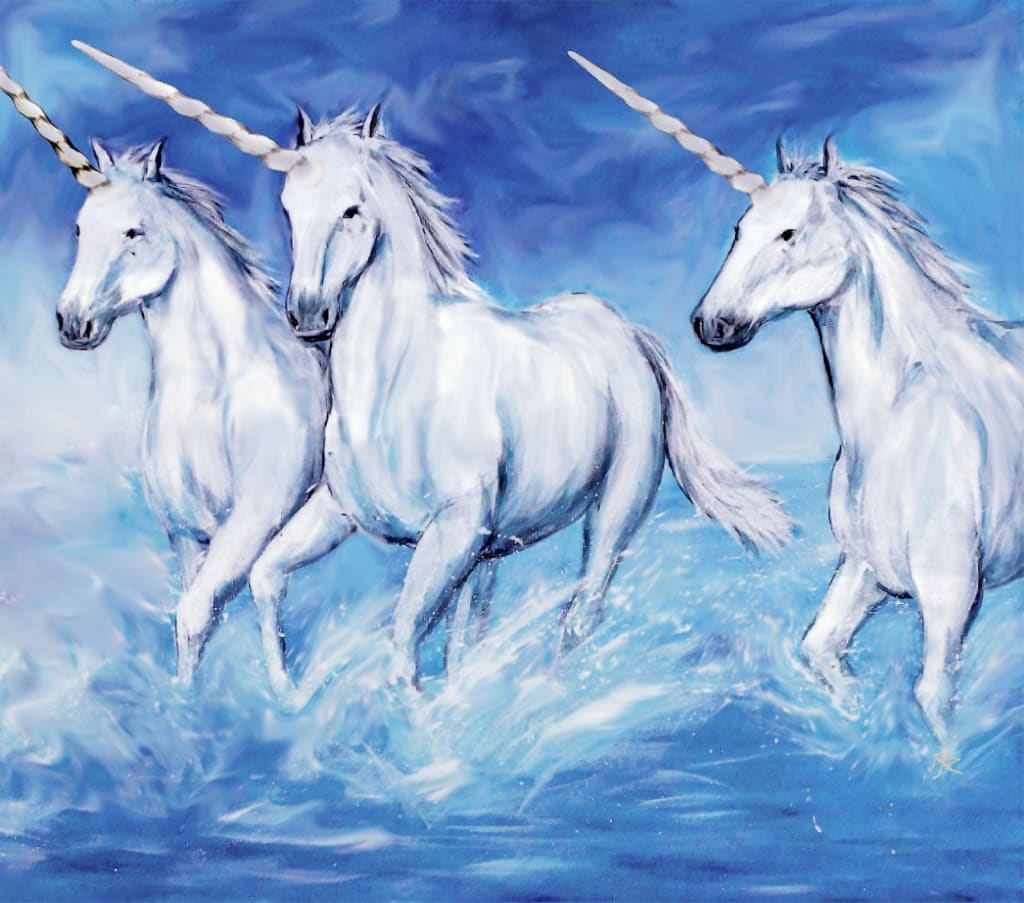
What looks like a pair of submerged swordsmen dueling for the hand of a maiden is, in reality, two mottled gray male narwhals fighting for dominance and the right to mate with a herd of females. Male narwhals have been seen to 'cross-swords' as a preliminary courtship and mating. The fights can be bloody – most large males have scars about the head to prove it and many have broken tusks.
The sword itself is curious. It is offset to the left and points downwards. It can grow up to 3m (10ft) in length which makes it a rather awkward protuberance to be carried about by a whale only 5m (15ft) long. The tusk is an elongated left canine tooth that grows in a tight spiral out through the upper lip. The narwhal's only other tooth remains small, although in some individuals both teeth grow into long tusks. In the female one of the pairs of functionless teeth grows into a small 20cm (8in.) tusk.
The narwhal was brought to the attention of the scientific community after the return of Martin Frobisher from his search for a northern Atlantic-Pacific sea route. In July 1577, his three ships were sheltering from a storm in what is now known as Frobisher Bay, when crew members discovered 'a great dead fish' that was 'round like a porpoise, being twelve feet long' and it possessed 'a horn of two yards length'. Frobisher thought they had found a 'Sea Unicorn' and the long piece of spiraled ivory was presented to Queen Elizabeth I. What Frobisher had found, of course, was not a fish but an air-breathing marine mammal and a relative of the beluga or white whale.
Magical medicinal properties were attributed to the narwhal's elongated tooth. Crushed tusk was said to ‘expel ill vapors by sweat'. It was also recommended for strengthening the heart and curing epilepsy.
Indeed, it was prescribed by leading physicians up until the late eighteenth century, providing a healthy business for Arctic whalers who were able to sell narwhal tusks for their weight in gold. The seventeenth-century Danish anointment throne in Rosebay Castle, Copenhagen, features narwhal tusks and, according to a Danish bishop, it is more splendid than Solomon's ivory and golden throne.
Today the narwhal is protected, although a small catch of 542 animals by Inuit hunters is allowed by the Canadian Government. Trade in horns was reduced by the US Marine Mammal Protection Act of 1972. Until the European Economic Community banned the import of narwhal tusks in 1983 a good specimen could raise as much as $1,000, but only clients dealing with dedicated collectors will secure a high price. In New York a tusk was reported to have changed hands for $4,500. Greenlanders still eat the meat and the people of Baffin Island relish the skin, called 'mukluk', which is rich in vitamin C.
Little is known about narwhal biology, migration or distribution and population sizes. They are usually seen in groups of about ten to twenty animals moving at the edge of the pack-ice, although mariners have reported seeing thousands of animals on the move. Robert Peary, for example, witnessed narwhals 'dashing to windward, their long white horns flashing out of the water in regular cadence'. In winter they move out into deeper water and to the south. In spring, when the ice breaks up, they migrate inshore into fjords and estuaries, often alongside white whales. They eat cod, halibut, flounders, squid and shrimps which they must suck into their mouth and crush between the jaws because their two teeth have no grasping or chewing function. They make whistling and clicking sounds while travelling. The whistles are thought to be communication sounds between individuals in a herd and the clicks are likely to be echo-location signals used for pinpointing food.
It is estimated that at present there are over 30,000 narwhals, divided into three distinct populations, living in Arctic seas. The largest group is 20,000 strong and lives in the Baffin Bay-Davis Strait area. Although they are very much polar sea inhabitants they have been found occasionally further to the south. One was even found stranded 30 miles up the estuary of the River Thames.
About the Creator
Keep reading
More stories from Uzzal Hossen and writers in Art and other communities.
'Till Death We Do Art
There would be nothing divine in this world without art. Nature may surpass the divine to all intents and purposes, but like everything it absorbs and is absorbed by, it remains here, stuck on the surface of this world, ever-present, physically bound to the universe.
By Avocado Nunzella BSc (Psych) -- M.A.P 24 days ago in Art
The Great Museum Scandal: Half of the Artworks in French Museums Found to Be Fake
France is home to some of the most famous museums in the world, attracting millions of visitors each year who come to admire priceless works of art and historical artifacts. However, a recent investigation has sent shockwaves through the art world after suggesting that a significant number of artworks displayed in certain French museums may actually be fake.
By Irshad Abbasi 2 days ago in Art



Comments
There are no comments for this story
Be the first to respond and start the conversation.