
The U.S.-China Trade War in 2025: A Global Economic and Geopolitical Tipping Point
How Escalating Tariffs, Tech Rivalries, and Shifting Alliances Are Redefining Global Power and Trade

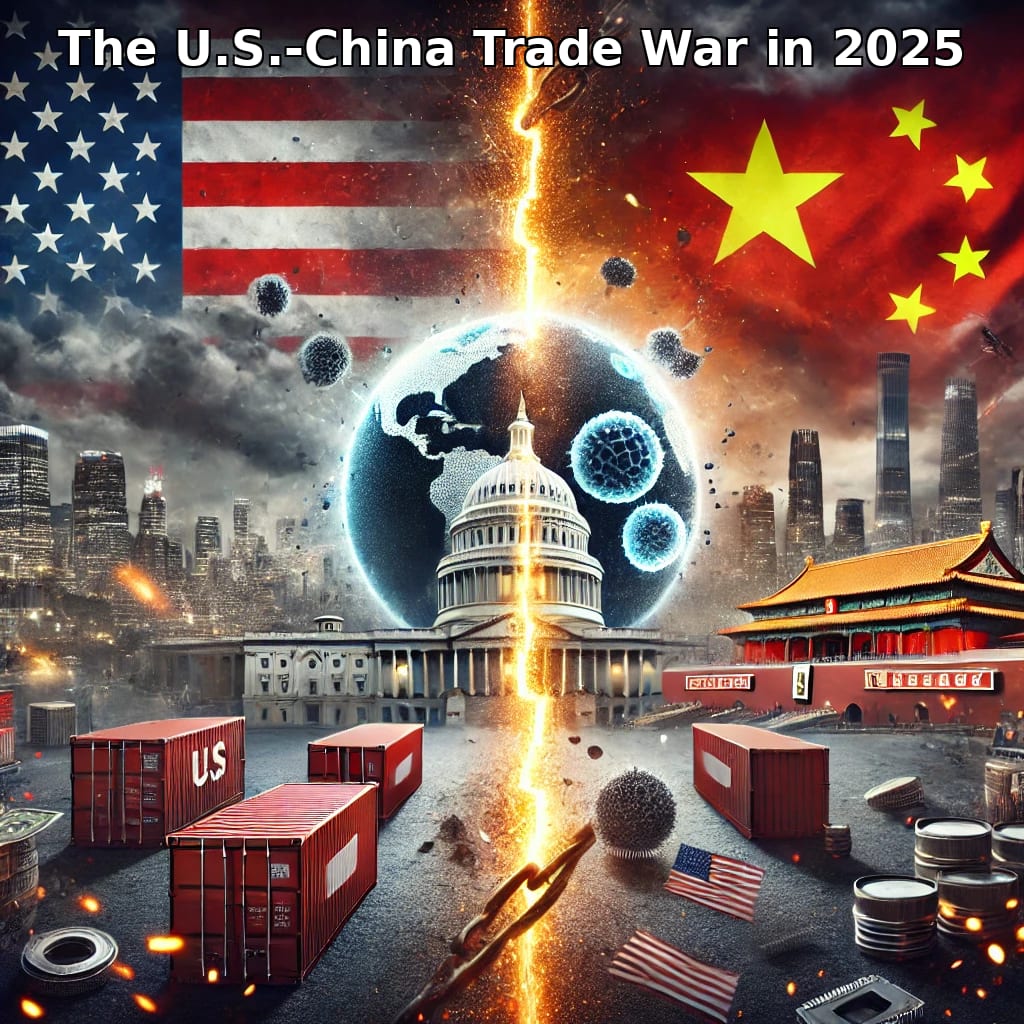
The two largest economies in the world, the United States and China, are currently involved in a growing trade war that is altering the dynamics of global economics and geopolitical alliances. The United States of America has recently implemented extensive tariffs, which has prompted significant responses from China and other nations. This article delves into the current state of the U.S.-China trade war as of April 2025, examining the implications of recent tariff measures, the reactions from affected countries, and the broader impact on global trade and economic stability.
Escalation of Tariffs and Immediate Repercussions
President Donald Trump has imposed numerous tariffs with the intention of promoting an isolationist economic model, marking a significant shift toward protectionism. An executive order introduced a baseline 10% tariff on all imported goods, with significantly higher rates for specific countries: China faces a 54% tariff, India 27%, and Cambodia, Laos, and Myanmar are subjected to tariffs of 49%, 48%, and 44% respectively. The global trade system that existed before World War II is thought to have been undermined by these measures, which have been widely criticized around the world.
It has had a significant impact on the economy right away. Investor uncertainty and concerns about stagflation were reflected in the $2.5 trillion decrease in the S&P 500. Key trade partners, notably China and Canada, have retaliated with their own tariffs and restrictions, intensifying the global trade conflict. According to economists, these actions may result in a fragmented global market with decreased scale and efficiency, reshaping the dynamics of trade and the economy for years to come.
repercussions for China's regional allies The U.S. tariffs are significantly impacting countries with close ties to China, such as Cambodia, Laos, and Myanmar, which now face some of the highest U.S. tariffs globally. These nations, along with others like Vietnam and Lesotho, are experiencing economic strain due to their reliance on Chinese supply chains and the “China+1” production strategy. Analysts suggest that these moves may push China’s regional allies closer to Beijing, enhancing China’s influence in Southeast Asia.
Domestic Responses and Political Ramifications
The tariff measures have sparked a wide range of responses domestically. California Governor Gavin Newsom extended an invitation to foreign nations for trade discussions, emphasizing California’s economic strength—accounting for 14% of the U.S. GDP and ranking as the fifth-largest global economy—as leverage in opposing what he called the “largest tax hike of our lifetime.” While states lack constitutional authority to enact trade measures independently, Newsom’s remarks highlight internal dissent and the potential for states to seek alternative economic partnerships.
The "Technology Cold War" and technological decoupling In addition to tariffs, the trade war has intensified the "Tech Cold War" between the United States and China over technology. Allies have been encouraged to follow suit by the United States, which has increased restrictions on Chinese tech companies like Huawei and SMIC. China has also made significant investments in its technology sector in an effort to become self-sufficient in fields like artificial intelligence, green technologies, and semiconductors. With the emergence of distinct tech ecosystems, this decoupling poses a threat to global collaboration and innovation.
Geopolitical Implications and Global Alliances
The trade war has strained alliances and heightened regional tensions. The U.S. has leveraged platforms such as the G7, Quad, and NATO to isolate China economically and politically, pressuring allies to align policies with the U.S. Conversely, China has strengthened its ties with BRICS nations and expanded its Belt and Road Initiative to counter U.S. influence. In the Indo-Pacific region, where both nations are competing for strategic dominance, this polarization has extended to military posturing.
Economic Fragmentation and Supply Chain Disruptions
Global supply chains have been disrupted as a result of the aggressive tariff policies, creating uncertainty for multinational corporations. Costs for producers and consumers are rising as a result of companies' efforts to reshoring, higher tariffs, and shifting regulations. For instance, the complexities and financial repercussions of such shifts are demonstrated by Apple's accelerated plans to diversify production outside of China.
Conclusion
As of April 2025, the U.S.-China trade war has escalated into a multifaceted conflict with significant economic, technological, and geopolitical ramifications. The implementation of sweeping tariffs by the U.S. and the subsequent responses from China and other nations have disrupted global trade, strained alliances, and accelerated technological decoupling. The outcome of this confrontation will shape the trajectory of the global economy and the balance of power for decades to come, underscoring the urgency of finding a resolution.
About the Creator
Samiullah
I am Dr.Samiullah from Pakistan and i am also a Professional Writter and Article Writter Hope u will like my article and stories thank u
When the Artist Becomes the Art
We like to think we can separate the art from the artist, but can we, really? Art is born from the same place as sin. It mainly emerges from conflict: between what is felt and what is permitted, between the self that is lived and the self that must be hidden. No figure embodies this tension more vividly than Oscar Wilde: a man who transformed his own contradictions into style, wit, and devastating clarity. His novel The Picture of Dorian Gray is not merely a tale of aesthetic decadence but the battleground on which this question is fought.
By Yasmine Lagras4 days ago in Art
My New Book is Finally Here
My poetry collection Beautiful and Brutal Things is done. It's actually done and finally published over 270 pages. Over a year of my life went into this book. More than a year, really. Long days at my computer, sometimes seven days a week because I couldn't stop even when I probably should have. Then two months of editing that felt harder than the writing itself. But it's finished, and I'm still standing, and the book is real.
By Tim Carmichael7 days ago in BookClub



Comments (1)
Nice work! 🌟 I really enjoyed reading your Vocal post. 😊📖 Keep it up! 💪✍️