
The House That Waited for Spring
Some places never forget the people who once called them home.

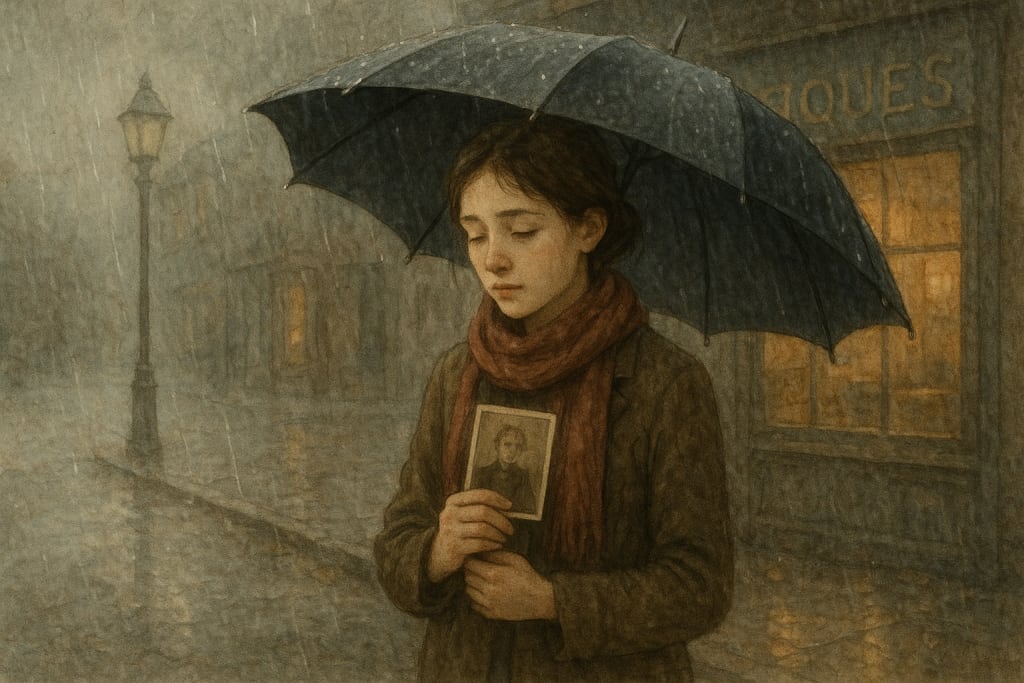
The rain had been falling since morning, slow and steady, like the world was washing itself clean. The streets of the small town were almost empty, except for a woman standing under a broken umbrella, staring at the front window of a little antique shop.
Her name was Elena Ward, thirty-two years old, tired in a way that had nothing to do with sleep. She had returned to her hometown after ten years, carrying only a suitcase and a silence that felt heavier than her luggage.
The shop in front of her used to be her mother’s. Ward’s Antiques, the sign still said, though the gold letters had almost worn away. Through the glass, she could see shelves filled with old clocks, cracked teacups, faded books, and a hundred other things nobody really needed but everyone secretly wanted.
She pushed the door open. A small bell above it chimed — the same soft sound that had once followed her every day after school. The air smelled like dust and lavender. Behind the counter, an older man looked up, adjusting his glasses.
“Can I help you?” he asked kindly.
Elena hesitated. “I used to live here,” she said softly. “This was my mother’s shop.”
The man’s face brightened. “You must be Clara Ward’s daughter. I bought the place from her estate years ago. She was a lovely woman.”
Elena smiled faintly but didn’t answer. Her mother had passed away suddenly when Elena was twenty-two, just after their last argument — the one she never stopped replaying in her mind. She hadn’t even come back for the funeral. She told herself she couldn’t, but the truth was she didn’t know how.
“Would you like to look around?” the man asked, breaking her thoughts.
She nodded and wandered through the narrow aisles. Every corner held ghosts — the chair her mother used to sit in, the counter where she wrapped tiny boxes in brown paper. Elena ran her fingers over a cracked wooden cabinet, remembering how her mother once called it “a stubborn piece of history.”
Then, near the back of the shop, something caught her eye.
It was a photograph — framed, slightly crooked, leaning against a shelf of old picture frames. The image showed a young woman and a little girl, both laughing, holding hands under a large umbrella. Rain blurred the background, but the smiles were clear.
Her heart stuttered. It was them — her and her mother.
She lifted the frame carefully. The edges were worn, and a faint watermark streaked across the corner. She turned it over. On the back, written in her mother’s looping handwriting, were five simple words:
“For when she comes home.”
Elena froze. Her throat tightened, her hands trembling slightly. She looked around as if expecting her mother to step out from behind the counter, wiping her hands on a cloth, saying something ordinary like, “You’re soaked, sweetheart.”
But there was only silence — and the steady rhythm of rain tapping the window.
“Do you know where this came from?” she asked the shopkeeper, her voice uneven.
He walked over, squinting at the photo. “That one? It was already here when I bought the shop. I always thought it belonged to the last owner, but… looks like it was waiting for you.”
Elena smiled weakly, blinking back tears. She placed the frame gently on the counter.
“I’d like to buy it,” she said.
He waved a hand. “Take it. It’s yours.”
She thanked him quietly and stepped outside. The rain hadn’t stopped, but she didn’t bother opening her umbrella. The street shimmered with reflections — light bouncing off puddles, the air soft and gray.
She walked slowly, clutching the photo to her chest. Every few steps, she looked down at it, tracing the outline of her mother’s smile with her thumb.
When she reached the old stone bridge at the edge of town, she stopped. Beneath it, the river moved lazily, swollen with rain. She used to come here as a child, tossing pebbles and making wishes she’d never remember. Her mother would stand beside her, patient and smiling, always letting her believe the water could carry dreams somewhere safe.
Now, standing there again, Elena finally understood. Her mother had never been waiting for forgiveness — she had simply been waiting for her to come home.
She sat on the bridge railing, the rain soaking her hair and sleeves. For a long time, she said nothing. Then she whispered,
“I’m sorry, Mom. For all of it. I’m here now.”
The wind picked up slightly, and a small gust lifted the corner of the photograph. She held it tighter, laughing through the tears that blurred her vision. The sound was soft — the same sound her mother once said could make any room brighter.
When the rain began to ease, the clouds parted just enough for a sliver of pale sunlight to touch the water. It shimmered gold, faint but real, like an answer.
Elena stood, wiped her face, and turned back toward town. She didn’t know if she’d stay or just visit for a while, but she knew one thing: the past no longer hurt the same way. It had turned into something gentle — something she could hold without breaking.
As she walked away, the photograph pressed close to her heart, she thought of her mother’s handwriting — For when she comes home.
And for the first time in ten years, she finally was.
About the Creator
Charlotte Cooper
A cartographer of quiet hours. I write long-form essays to challenge the digital rush, explore the value of the uncounted moment, and find the courage to simply stand still. Trading the highlight reel for the messy, profound truth.
Keep reading
More stories from Charlotte Cooper and writers in Art and other communities.
The Letter That Never Arrived
It was a cold morning in early November when the postman stopped coming to the old lane of Maple Street. No one really noticed, except for Clara. Every morning for three years, she had waited by her cracked blue door, wrapped in her grandfather’s scarf, watching the streetlight fade as dawn slowly took its place.
By Charlotte Cooper5 months ago in Art
'Till Death We Do Art
There would be nothing divine in this world without art. Nature may surpass the divine to all intents and purposes, but like everything it absorbs and is absorbed by, it remains here, stuck on the surface of this world, ever-present, physically bound to the universe.
By Avocado Nunzella BSc (Psych) -- M.A.P 18 days ago in Art
Ink & Imagination
In a small town named Inkwood, nestled between hills and rivers, there existed a peculiar bookshop called “The Imagination Hub.” The shop was run by a kind old man named Mr. Penrose. He was the type of person who could bring stories to life with just a few words. Every child in Inkwood believed that Mr. Penrose had a magical power. They would gather around him every Saturday to hear tales of adventure, bravery, and far-off worlds.
By Hamad Afridi 6 days ago in Art
Bomb Scare
It was 2027, and the world never thought it would happen. A missle hit the United States, but it wasn't where they had anticipated. A little town in the northeast was hit by a missile strike, they didn't know why, and they didn't know exactly where it hit, but they did know it was a coastal community, somewhere between Maine and Delaware.
By Gregory Paytona day ago in Fiction




Comments
There are no comments for this story
Be the first to respond and start the conversation.