
The Tale of a Stranger Instrument
A narrative of the Rubab, an instrument seeking its identity and roots in exile

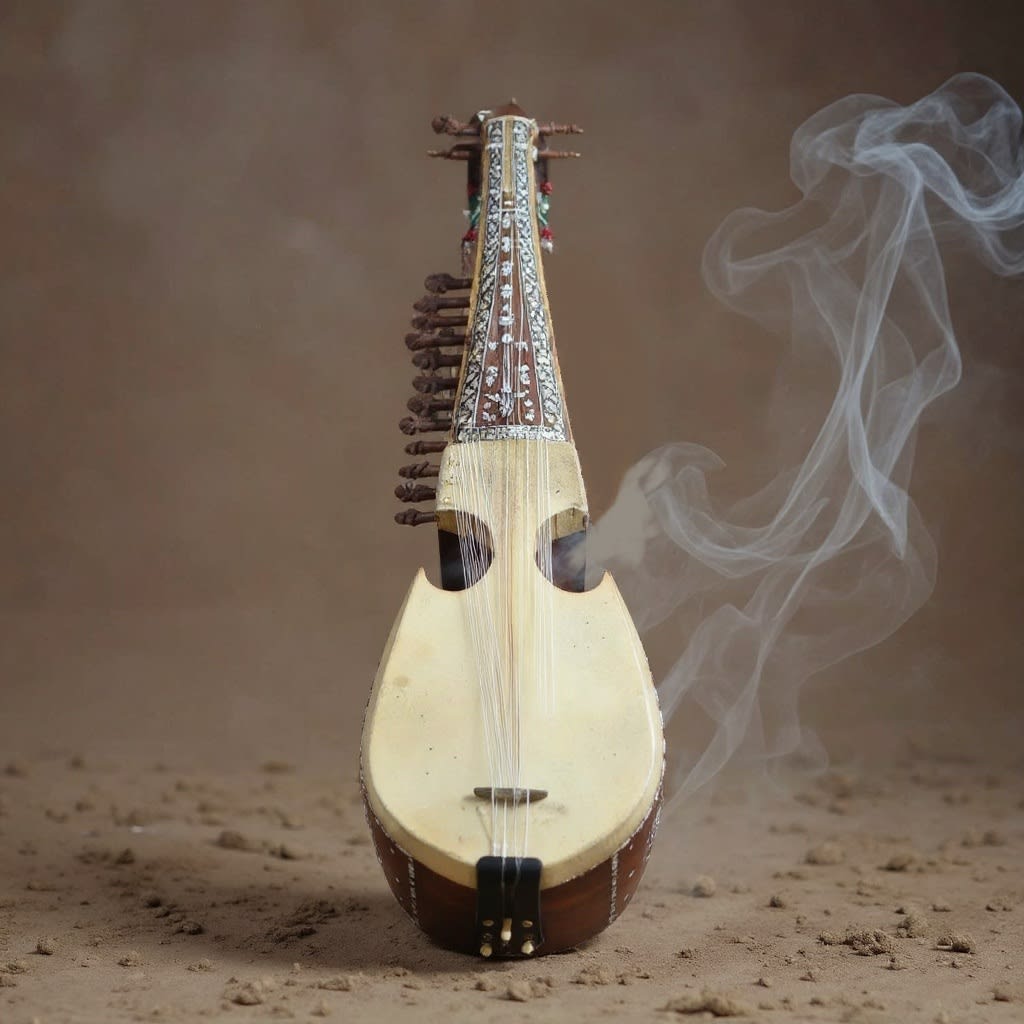
The Tale of a Stranger Instrument
Yes! Who am I?
I am the one who once played in the courts of kings; trembled in the hands of scholars; resounded in the ghazals of poets, and was a companion in the solitude of lovers. I was the instrument of tears and joys, the solace of lonely nights, and the fellow traveler of hopeful days. They held me close, let the fingers of love glide across my strings, and poured their deepest secrets into my soul.
My land, that magnificent cradle of civilization, nurtured me with care. Its people for thousands of years placed me in the heart of their culture and rituals. I was born in the land of Arya, in the foothills of Hindu Kush, under the shadow of Ahura Mazda and Zoroaster, in the Vedic hymns and the whispers of the Avesta. In towering mountains, green plains, winding valleys, stones, and carvings, I discovered art and permanence.
My land, the abode of eloquent speakers and prophets, the dwelling of brave men and heroes; the same land that the great Ferdowsi called “Iran” in his Shahnameh, once named “Khorasan” by Muslims, and today—breathing with tales and legends—is called “Afghanistan.”
A land where every particle of soil holds traces of Rostam and Sohrab’s heroism, echoes of Zoroaster’s prayers, and the melodies of thousands of poets and mystics. Here, its majestic mountains are the keepers of people’s sorrows and joys, its rushing rivers carry ancient tales, and its plains have opened their arms to countless generations.
Yes! I am the Rubab; from this great land, an instrument with deep roots, a grandeur as old as history itself.
But oh, what longing!
In that gem-filled land, where once its people embraced me as a rare treasure and with loving caresses illuminated my soul, they suddenly attacked me; they broke my bones, set my weary spirit ablaze, and abandoned me to the roads of exile.
They wounded me as if I were the source of their pain; as if my sound had spread a dark cloud of sorrow across the sky of their lives. But never, never was that true.
I was the silent guardian of all their sorrows and anxieties; every sigh trembled through my veins, and every tear fell like dew upon my wooden face. I was a wounded, lonely child in their arms, laughing with my melody in joy, and crying with its trembling voice in grief.
Every stroke upon my strings reflected the beating of their hearts; every vibration of my body was a whisper of their tears and laughter. I was the mirror of their souls, the breath of hidden silences, and the gentle song of smiles that none but I could hear.
Yes, now I am in a foreign land. Here, they caress me, play me in magnificent halls, admire my beauty, and praise me. But no! This praise tastes bitter. No feeling can replace what I had in my homeland.
My birthplace is still there. My mother is the mulberry tree; my body carved from her essence, a tree whose fruit is sweet and whose song is even sweeter. Today she too is saddened by my absence, left lonely and sorrowful. I know she weeps and waits for me.
I want to tell her:
Mother! Do not grieve; I will return. One day I will rest in your embrace again and wipe away your tears. You are dearer to me than anything. I still remember the day of parting, when we both cried bitterly. That day was the bitterest of my life; the day I was torn from you and from my homeland.
Ah, Mother! Ah, Homeland!
I love you. I will return. And you will grow once more, you will be magnificent again. Then I, the Rubab of hearts, will play in your arms, bring joy, and drive away your sorrows.
Yes, I will return! To hands that will play me with enduring love. Perhaps not a return in body, but a return in meaning—a return that conveys my legacy to future generations, so they know that the Rubab is not merely an instrument; it is part of an identity born from soil and love.
So wait, O kind Mother, and O suffering Homeland! Fix your gaze on tomorrow, a tomorrow when silent strings will sing again and strokes will descend not to break, but to heal. A day will come when fresh hands, with eternal love, will glide upon my soul and return my melodies to the bright sky. The return may be slow, and its steps trembling, but know with certainty it will come; for no wound touched by true love decays in darkness. That wound becomes an eternal tale, and its name is nothing but “Hope”—a hope that, like dawn after the longest nights, inevitably rises and illuminates the sky of life once more.
About the Creator
Prof. Islamuddin Feroz
Greetings and welcome to all friends and enthusiasts of Afghan culture, arts, and music!
I am Islamuddin Feroz, former Head and Professor of the Department of Music at the Faculty of Fine Arts, University of Kabul.
Keep reading
More stories from Prof. Islamuddin Feroz and writers in Art and other communities.
The Exile of an Instrument: Musical Representation
The Exile of an Instrument: Musical Representation Abstract The Rubab, the ancient instrument of Afghanistan, is not merely a musical tool; it is the voice of a nation, a repository of collective memory, and a storyteller of the sufferings and hopes shaped throughout the history of this land. Today, amid waves of migration and exile, the Rubab wanders alongside its owners across distant lands. Every sound that emanates from its strings narrates a tale of longing and exile, yet simultaneously conveys a message of hope and cultural resilience. This paper is a journey into the world of the Rubab: an instrument that continues to play in exile, revealing silent wounds.
By Prof. Islamuddin Feroz6 months ago in Art
'Till Death We Do Art
There would be nothing divine in this world without art. Nature may surpass the divine to all intents and purposes, but like everything it absorbs and is absorbed by, it remains here, stuck on the surface of this world, ever-present, physically bound to the universe.
By Avocado Nunzella BSc (Psych) -- M.A.P 21 days ago in Art
Wander the World
In a not-so-distant future, the world had changed in many ways. Cities floated in the sky, and robots helped people with their daily tasks. Among these wonders lived a curious girl named Elara. She was sixteen years old and always dreamed of exploring the world beyond her floating city called Skyhaven. Elara had long, wavy hair, bright green eyes, and a heart full of adventure. She spent her days in her small room, gazing at the stars through her window, imagining the places she would go.
By Hamad Afridi 4 days ago in Art




Comments
There are no comments for this story
Be the first to respond and start the conversation.