
The Philosophy of Ludwig Wittgenstein
A Journey Through Language and Meaning

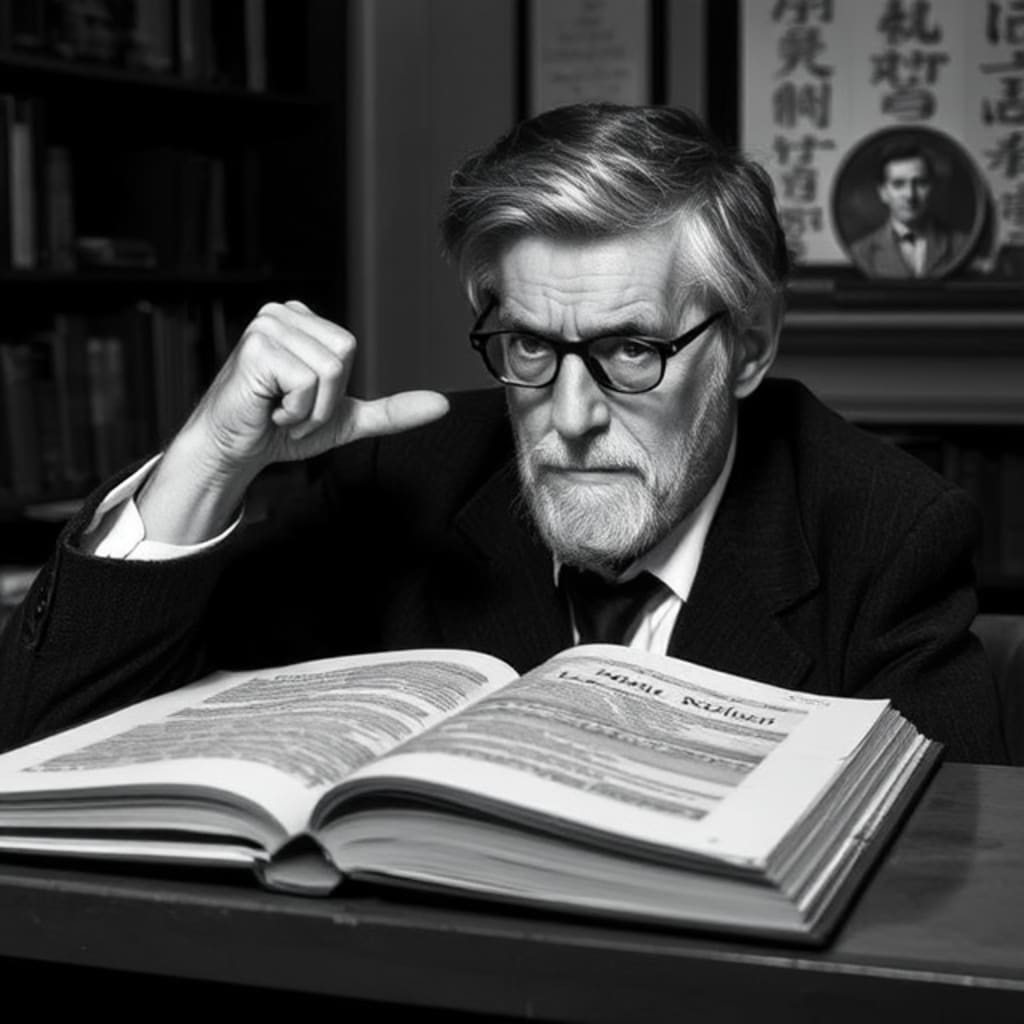
Ludwig Wittgenstein (1889–1951) is one of the most enigmatic and influential philosophers of the 20th century. His work has reshaped the fields of logic, language, and the philosophy of mind, leaving behind a legacy that continues to inspire debate and reflection. Wittgenstein’s philosophical journey was marked by radical transformations, encapsulated in two major works: Tractatus Logico-Philosophicus (1921) and Philosophical Investigations (1953, published posthumously). These texts present two contrasting views of language and its relationship to the world, reflecting the evolution of Wittgenstein’s thought over his lifetime.
Early Wittgenstein: The Logical Structure of the World
Wittgenstein’s first major work, Tractatus Logico-Philosophicus, was written during his time as a soldier in World War I. It reflects his ambition to establish a definitive framework for understanding the relationship between language, thought, and reality. Drawing inspiration from the work of his mentor Bertrand Russell and the logician Gottlob Frege, Wittgenstein argued that language mirrors the world by representing it through logical structures.
The central claim of the Tractatus is that the world consists of facts, not things. Facts are arrangements of objects in states of affairs, and language functions as a "picture" of these facts. Each meaningful proposition corresponds to a possible state of affairs, and the logical structure of language must align with the logical structure of reality. Wittgenstein famously wrote, "Whereof one cannot speak, thereof one must be silent," suggesting that philosophy’s role is to clarify what can be meaningfully said, while remaining silent on matters beyond the limits of language, such as ethics, aesthetics, and metaphysics.
This austere vision of philosophy aimed to dissolve traditional philosophical problems by revealing them as misunderstandings of language. For Wittgenstein, once the logical form of language was understood, philosophical puzzles would vanish, leaving only clarity.
The Turning Point: From Logical Structure to Language Games
After publishing the Tractatus, Wittgenstein believed he had solved all philosophical problems and left academia to work as a schoolteacher in rural Austria. However, by the late 1920s, he returned to philosophy, dissatisfied with his earlier work. This intellectual shift culminated in Philosophical Investigations, which presented a fundamentally different view of language and its role in human life.
In the Investigations, Wittgenstein rejected the idea that language has a single, fixed logical structure. Instead, he introduced the concept of "language games" to describe the diverse and context-dependent ways in which language is used. Language, he argued, is a social activity governed by rules, and its meaning arises from its use in specific practices. For example, the word "game" encompasses activities as varied as chess, soccer, and tag, yet there is no single essence that unites them all. Similarly, language has no underlying universal structure; its meaning is rooted in the myriad ways it is employed in daily life.
Wittgenstein’s later philosophy emphasizes the "ordinary" use of language and criticizes the tendency of philosophers to abstract language from its practical contexts. He saw many philosophical problems as stemming from the misuse of language, likening such confusions to knots that needed untying. His approach shifted the focus of philosophy from uncovering metaphysical truths to understanding the grammar of our concepts and the practices that give them meaning.
Key Themes in Wittgenstein’s Philosophy
The Limits of Language: Both in his early and later works, Wittgenstein grappled with the boundaries of language and what can be meaningfully expressed. While the Tractatus sought to delineate these limits through logical analysis, the Investigations explored them through the dynamic and fluid nature of language games.
Meaning as Use: Wittgenstein’s later philosophy famously states, "The meaning of a word is its use in the language." This idea challenges the notion that words have fixed meanings independent of their contexts and underscores the importance of social practices in shaping language.
Philosophy as Therapy: Wittgenstein viewed philosophy not as a theoretical discipline but as a therapeutic activity aimed at resolving the confusions and misunderstandings that arise from language. By examining how words function in practice, philosophers can dissolve rather than solve philosophical problems.
Rule-Following and Forms of Life: Wittgenstein explored how linguistic rules are established and followed within particular "forms of life"—shared cultural and social practices. This idea highlights the embeddedness of language in human activities and the impossibility of understanding it in isolation from its users.
Wittgenstein’s Legacy
Wittgenstein’s work has had a profound impact on numerous fields, including analytic philosophy, linguistics, psychology, and cognitive science. His insights into the nature of language have influenced thinkers such as J.L. Austin, Gilbert Ryle, and the proponents of ordinary language philosophy. Additionally, his emphasis on the social dimensions of meaning has resonated with postmodern and critical theorists.
Despite his immense influence, Wittgenstein’s philosophy remains a subject of ongoing debate. Critics argue that his later work lacks the systematic rigor of the Tractatus and that his focus on ordinary language neglects broader theoretical concerns. Supporters, however, praise his ability to illuminate the subtle workings of language and to challenge entrenched assumptions about meaning and truth.
Conclusion: Wittgenstein’s Enduring Relevance
Ludwig Wittgenstein’s philosophy offers a profound exploration of the relationship between language and the world. His transition from the logical precision of the Tractatus to the pragmatic, context-sensitive approach of the Philosophical Investigations reflects a lifelong commitment to understanding the complexities of human communication. Whether one agrees with his conclusions or not, Wittgenstein’s work continues to inspire philosophers to examine the intricate interplay between language, thought, and life. As he himself remarked, "Philosophy is not a theory but an activity," and his writings remain a testament to the transformative power of philosophical inquiry.
About the Creator
Fred Bradford
Philosophy, for me, is not just an intellectual pursuit but a way to continuously grow, question, and connect with others on a deeper level. By reflecting on ideas we challenge how we see the world and our place in it.
Keep reading
More stories from Fred Bradford and writers in Art and other communities.
Alan Watts: The Way of Zen and The Wisdom of Insecurity
Alan Watts remains one of the most influential thinkers of the 20th century, celebrated for his ability to distill complex philosophical ideas into accessible, poetic language. An interpreter and popularizer of Eastern philosophy for the Western audience, Watts seamlessly bridged the cultural gap between East and West, offering profound insights on life, meaning, and existence. Two of his seminal works, The Way of Zen and The Wisdom of Insecurity, stand as enduring legacies that continue to inspire readers around the world.
By Fred Bradford12 months ago in Art
Why 316 stainless steel sculpture is the gold standard for coastal sculptures
If stainless steel sculptures are installed in coastal environments, corrosion caused by sea breezes becomes an important issue to consider. Salt in the air, high humidity, and frequent temperature changes can all accelerate surface deterioration if the material or finish is not suitable.
By Shenzhen Ruiheng Crafts2 days ago in Art
How to prevent outdoor sculptures from fading over time
Outdoor sculptures often appear vibrant and impressive when first installed, but after one or two summers, the colors can begin to fade. In some cases, bright surfaces become chalky, while darker tones lose depth and contrast. This fading is not a design flaw, but usually results from environmental exposure and inappropriate material or surface treatment choices during the early stages of the project.
By Shenzhen Ruiheng Crafts8 days ago in Art
Wild Card Weekend Recap: What Happens Now?
I think I figured out why I love Wild Card Weekend so much. It's because it's the first playoff anything of the calendar year. The NFL season starts in the fall, and once upon a time, the champion was crowned either on or slightly before New Year's. The evolution of the NFL schedule has resulted in the playoffs starting just into the New Year, and currently, the final week of the season falls on the first weekend of the New Year, with Wild Card Weekend coming a week after that. So yes, chronologically, the NFL's Wild Card Weekend serves as the first playoff anything of the calendar year.
By Clyde E. Dawkins3 days ago in Unbalanced




Comments
There are no comments for this story
Be the first to respond and start the conversation.