
The Paintings of Bouchra Belghali
Where Color Listens
By Brian D’Ambrosio
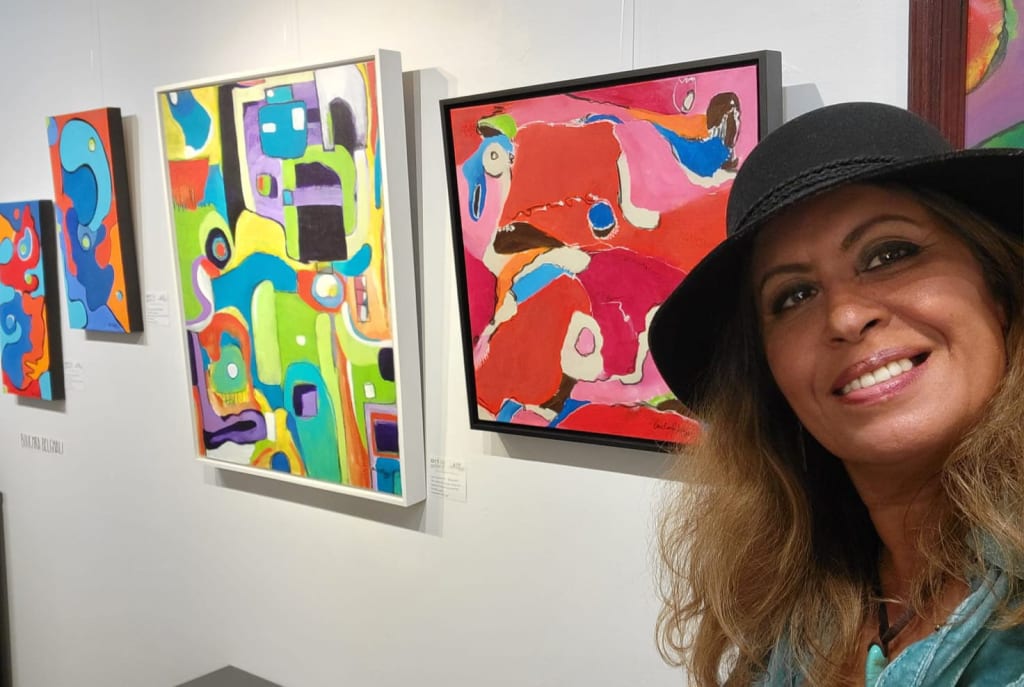
To stand before a painting by Bouchra Belghali is to experience something closer to listening than looking. It unfolds the way music does—not by telling a story or depicting a recognizable scene, but by setting color into motion, allowing it to vibrate, collide and resolve into feeling. Like a melody unburdened by lyrics, it bypasses explanation and goes straight to sensation.
Belghali’s paintings do not describe the world so much as they sound it. Color is her instrument, rhythm her method. She advances and retreats hues, layers contrasts, and blends tones until form emerges organically, as if coaxed from the surface rather than imposed upon it. The result is a palpable sense of movement—an undulation, a pulse—that invites the viewer into a shared interior space.
“Some artists like to paint what they see around them,” she said. “I paint what I don’t see… what’s inside me. I paint the mystery of our subconscious mind. I paint the unknown.”
Born in Marrakesh, Morocco, and now based in Santa Fe, Belghali carries two landscapes within her work, joined by a devotion to color as lived experience. Marrakesh—the Red City, oral-Hamra—is defined by chromatic contrasts: ochre walls against sharp blue sky, palm greens breaking through dust, bursts of bougainvillea pink and orange trees lining the streets. In the souks, color becomes almost architectural. Rugs cascade like weather fronts. Pottery glazes catch the light. Spices are stacked into pyramids—vermilion, turmeric yellow, cumin brown—not for sale but for spectacle, an aesthetic declaration that beauty itself has value.
This immersion in color was formative. Moroccan life, Belghali notes, is saturated with visual richness—textiles, caftans, food, ceramics, music—each bearing the mark of a culture shaped by centuries of convergence. Morocco sits at a geographic and historical crossroads: Amazigh (Berber) traditions, Arab influences from the Peninsula, Andalusian echoes carried back from Spain, traces of Roman, Portuguese, French, Jewish, and sub-Saharan African presence. The variety is audible in Moroccan music—Amazigh rhythms, African-inflected beats, Andalusian melodies, Jewish songs sung in Moroccan Arabic—and visible everywhere else.
“When you go to Morocco,” she said, “from north to south, you experience different cultures, different traditions. It’s a whole mix.”
That mix animates Belghali’s paintings. They do not quote Moroccan motifs so much as absorb their energy. Color becomes identity—not symbolic, but embodied; her canvases carry history not as illustration but as resonance.
“In Morocco, our tradition is our identity,” she said.
Equally foundational was the influence of her father, Rachid Belghali, whom she describes as a beautiful soul: kind, honest, intellectual, open, strict, loving. A teacher by profession, he believed in visual learning. Rather than relying on lectures alone, he illustrated concepts for his students, especially younger ones, turning knowledge into image. He painted, drew, and filled the house with books on art. Kandinsky was a favorite—“my master,” she calls him—along with Dalí and Miró. Abstract art entered her life not as rebellion but as inheritance.
The loss of her father two years ago remains present in her work, not as mourning but as continuity. His curiosity, openness, and belief in art as a way of knowing echo in her practice, she said.
She recalled that a fellow Moroccan artist once told her, “You paint like a child. Your art is free, raw, and genuine. I wish I could paint like you.” It was praise Belghali embraced. Freedom, for her, is not lack of discipline but trust in intuition.
That trust governs her process. Facing the blank canvas, she does not plan so much as enter a state of attention. Painting becomes meditation: “I don’t think as an artist—I live,” she said. “The energy moves and stops me.”
Color arrives first, carrying emotional charge. From it, form slowly takes shape. Her work recalls Cézanne’s dictum that when color is at its richest, form is at its fullest. Broad patches and subtle gradations, warm modulations and complementary pairingscreate depth and volume without drawing a single outline. Form is felt rather than defined.In this sense, Belghali’s art resists titles and fixed meanings.
“Titles are limiting and constricting,” she said. “I want to make people not so dependent on what they see.”
A rose, after all, has already been perfected by nature. To recreate it on canvas would be redundant. What interests her is the unseen—the emotional weather beneath appearances, the inner movement that abstraction makes visible.
Santa Fe, where Belghali has lived and worked since the early 2000s, provides a sympathetic environment for this approach. Like Marrakesh, it is a city of earth tones and open skies, where color is inseparable from place. Adobe ochres, high-desert blues, and intense light create a visual language that feels familiar rather than foreign. Belghali has supported herself here both as an artist and as a licensed massage therapist. That dual practice—working with the body’s energies by touch and with emotional energies by color—feels less like a contradiction than an extension of the same sensibility.
Belghali’s paintings do not demand explanation. They simply ask to be noticed, like music playing quietly in a room. Slowly, almost without awareness, they settle into mood and memory. Color carries the weight of feeling—sometimes bright, sometimes hushed—without insisting on interpretation. What remains is the simple, human pleasure of color, the pull of rhythm, and the quiet sense of having been moved by something that speaks directly to the senses.
Brian D'Ambrosio is the author of several books, most recently "New Mexico Eccentrics."
About the Creator
Brian D'Ambrosio
Brian D'Ambrosio is a seasoned journalist and poet, writing for numerous publications, including for a trove of music publications. He is intently at work on a number of future books. He may be reached at [email protected]
Reader insights
Outstanding
Excellent work. Looking forward to reading more!
Top insight
Heartfelt and relatable
The story invoked strong personal emotions
Keep reading
More stories from Brian D'Ambrosio and writers in Art and other communities.
Jim Sloan
By Brian D’Ambrosio At 90, Jim Sloan has lived several lifetimes’ worth of work—carpenter, sign painter, excavator, sawmiller, road-builder and the go-to rattlesnake remover of Galisteo, New Mexico. Art may be the through-line, but it has never been the source of his income, nor the center of his universe. Sloan has always kept one foot in the studio and the other in the soil, without bothering to decide which world he truly belongs to. The truth is that he fits cleanly into neither, and he has long since stopped trying.
By Brian D'Ambrosio 20 days ago in Art
Strangest Thing I Ever Saw
You’ll find the oddest sculpture called The Big Giving outside of the Royal Festival Hall in South Bank, London. This art installation was created between 2006 and 2007 by Klaus Weber. It consists of three rock sculptures with human heads and hands that are doing odd things like spitting, vomiting, and pissing water.
By Rasma Raisters4 days ago in Art
Gifts
This is the story of a beautiful valley settled at the foot of a hill, where nature itself seemed alive. Colorful flowers spoke lovingly to children, the breeze carried gentle laughter, and every corner reflected cleanliness and harmony. The children of this valley were eager learners who valued knowledge, discipline, and neatness. They kept themselves tidy and took pride in their appearance and surroundings.
By Sudais Zakwan3 days ago in Art



Comments
There are no comments for this story
Be the first to respond and start the conversation.