
💔 The One Glance That Lost Everything
Orpheus and Eurydice in the Forest Between Worlds

They say the dead don’t return.
But one man tried.
Orpheus — the poet, the singer, the man whose music could move mountains — once walked into the underworld for love. Not to conquer. Not for glory. But for Eurydice. His bride. The woman who died too soon, taken by a snake’s bite before their life together could begin.
He sang his grief to the gods of the dead.
And the gods — perhaps weary of eternity, or simply moved by a beauty they could never hold — gave him a cruel bargain: Eurydice may follow you to the world of the living. But you must not look back. Not even once.
And so they walked.
He in front, trembling but determined.
She behind him, silent as fog, her steps light as shadow.
The world behind them was death.
The world before them was life.
And somewhere in between — they walked.
This is where Jean-Baptiste-Camille Corot finds them.
In a painting done in 1861, we see not gods or monsters, not the blaze of tragedy or the drama of divine punishment. No. We see a path, narrow and dim, winding through a forest that could be anywhere — or nowhere.
We see Orpheus: wrapped in earth-toned robes, his face turned forward, tense with effort. One hand stretched back behind him — toward her.
And Eurydice: barefoot, fading, more idea than woman, more memory than flesh.
There is no sound here.
Only the hush before a heart breaks.
But why tell this story again?
Because maybe we’ve all walked this path.
Maybe not through Hades, no. But through some grief of our own — where we’re trying to carry someone with us. A lost love. A memory. A version of ourselves we’re afraid we’ll lose forever.
And like Orpheus, we try to be strong. We promise ourselves: I won’t look back. I’ll keep walking. I’ll trust.
But then comes the doubt.
Is she really there?
Is this really working?
What if I’ve already lost her?
And so — we turn.
Just to be sure. Just to see. Just for a second.
And that second is everything.
Corot’s painting doesn’t show the moment Eurydice disappears.
It shows the moment before.
That’s what makes it more haunting than any scream or fall.
Because we know what’s coming — and they don’t.
Because we’ve lived in that same fragile moment — and maybe we still are.
In Greek myths, it’s always the look that ruins everything.
Pandora opens the jar.
Psyche lights the lamp.
Orpheus turns.
Sight is the end of faith. The end of innocence. The moment reality steps in and magic steps out.
And yet — we look anyway.
Because we’re human. Because love without reassurance is a hard road to walk.
Because sometimes we’d rather lose everything than not know.
When Corot painted this scene, the world around him was changing. France was on the edge of modernity. Old beliefs , old certainties were fading. Artists like Corot tried to capture something that still felt true — something timeless.
And so he gave us not just a myth.
He gave us a feeling.
The feeling of holding on to someone who’s slipping through your fingers.
The feeling of trying not to break a rule that feels impossibly cruel.
The feeling of almost making it.
But not quite.
They are still walking.
She still follows.
He still trusts.
But the forest presses in.
The silence thickens.
And you can feel the weight of the question forming behind his eyes:
Is she still there?
Maybe that’s why this myth still matters.
Because love and loss are not about the grand gestures.
They’re about the quiet hesitations. The moments before the fall.
The unbearable seconds before everything changes.
And in those seconds — we are all Orpheus.
Final Thought
So if you’ve ever held your breath, hoping a lost voice would return…
If you’ve ever looked back when you shouldn’t have, just to make sure someone was still with you…
If you’ve ever ruined the magic with a single question:
You already know this story.
And maybe that’s why it keeps being told.
About the Creator
Zohre Hoseini
Freelance writer specializing in art analysis & design. Decoding the stories behind masterpieces & trends. Available for commissions.
Keep reading
More stories from Zohre Hoseini and writers in Art and other communities.
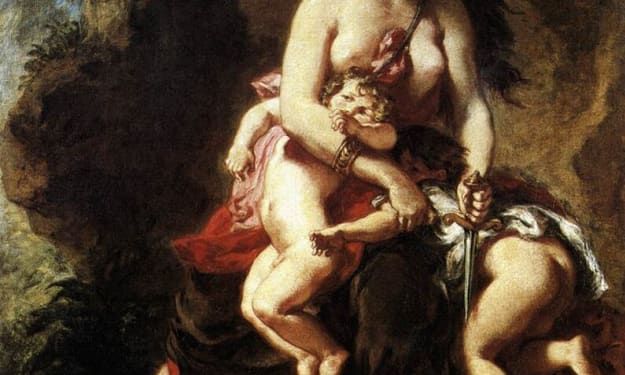
Delacroix’s Medea, The Painting That Looked Into the Heart of Hell
She Loved Them. Then She Killed Them. Imagine yourself stepping into a dimly lit gallery, where shadows stretch long across the walls. Before you stands Eugène Delacroix’s Medea about to Kill Her Children, a scene frozen in time—a tragedy held captive on canvas. The light flickers over Medea’s wild, desperate eyes, over the trembling innocence of the children who cling to her. This is not just a painting. It is an unraveling of the human soul.
By Zohre Hoseini9 months ago in Art
'Till Death We Do Art
There would be nothing divine in this world without art. Nature may surpass the divine to all intents and purposes, but like everything it absorbs and is absorbed by, it remains here, stuck on the surface of this world, ever-present, physically bound to the universe.
By Avocado Nunzella BSc (Psych) -- M.A.P 26 days ago in Art
The Rising Demand for Custom Physical Therapy Apps
Healthcare delivery is evolving faster than ever, and rehabilitation is no exception. Physical therapy — once limited to in-clinic sessions and paper-based exercise plans — is now being transformed by mobile technology. With increasing smartphone adoption and a growing demand for remote care, healthcare providers are exploring digital solutions to improve patient engagement and treatment outcomes.
By Steve Waugh2 days ago in Art



Comments
There are no comments for this story
Be the first to respond and start the conversation.