
The Lion Raised Among Goats
Even the mightiest can be shaped by the world they grow up in.

Radwana… Lahore
BY: Ubaid
y
upon a time, in a small village near the dense forests of Lahore, a hunter was wandering through the jungle when he stumbled upon a tiny lion cub. The cub was barely a few weeks old and still relied entirely on its mother’s milk. The hunter, feeling a mix of surprise and compassion, decided to take the little creature home with him.
When the hunter arrived home, his children were overjoyed to see the cub. They had never seen such a beautiful animal before, and they immediately started playing with it. The cub, although tiny and fragile, responded to their affection with gentle purrs and playful movements. Its eyes were bright, and its little paws patted the children as if inviting them to play more.
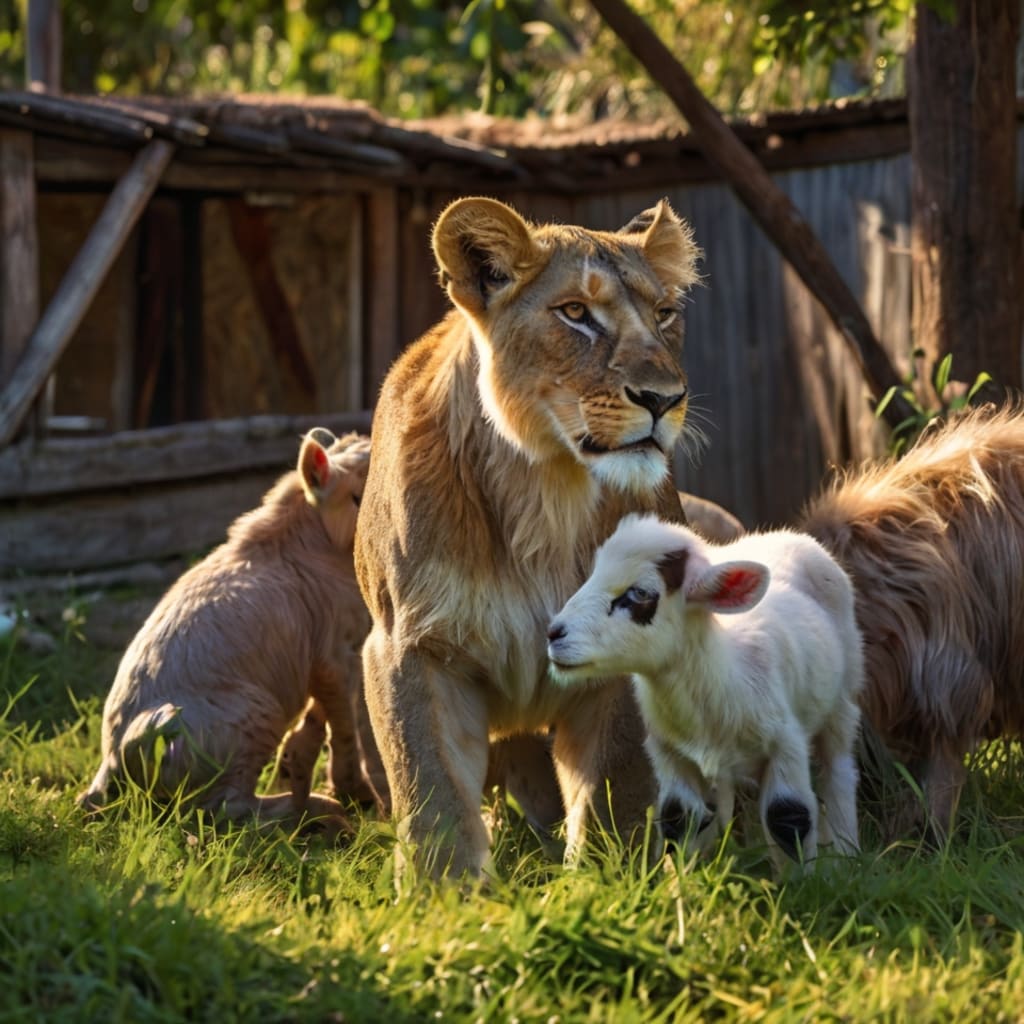
After a while, the cub became hungry. But because it was so young, it did not know how to eat solid food—its only source of nourishment was milk. The hunter scratched his head in worry, unsure how to feed the little lion. He thought of buying milk from the market, but then a clever idea crossed his mind. In his courtyard, he had a goat with her own young kids. Perhaps, he thought, the lion cub could feed alongside the baby goats.
The hunter gently placed the lion cub near the goat and her kids. At first, there was hesitation on all sides. The goat eyed the cub warily, and the cub sniffed at the goat nervously. But soon, the lion cub began imitating the young goats. When the goat’s kids nuzzled her for milk, the cub joined them. Slowly, the cub learned to suckle alongside the goats.
Days turned into weeks, and the lion cub grew strong and healthy, feeding on goat’s milk and playing with the goat kids every day. As time passed, the cub began to resemble a lion physically, but its behavior was entirely influenced by the goat herd. It bleated softly like them, followed them everywhere, and even mimicked their timid and gentle nature. Though it had the form of a fierce lion, it had none of the courage or hunting instincts of its wild kin.
Years went by, and the lion cub grew into a full-grown lion. It had a magnificent mane, sharp teeth, and strong claws. To the eyes of strangers, it appeared to be a majestic and fearsome lion. But inside, it was timid and fearful, much like the goat kids it had grown up with. It had never learned to hunt or defend itself, and bravery was a trait it had never acquired.
One day, disaster struck. Wolves from the nearby forest attacked the village. The hunter’s house, being so close to the jungle, was the first target. The wolves rushed in, growling and snapping at everything in sight. The goat kids scattered in terror, bleating loudly, and hiding behind their mother. The lion, now fully grown, froze in the middle of the chaos. It wanted to roar, to defend the goats, to chase away the wolves—but it could not. Fear rooted it to the ground.
The wolves noticed the lion standing there, but since it did not show any aggression, they ignored it and continued their attack. They leaped on the goats, tearing and scattering them, while the lion could only watch helplessly. Though it had the strength to overpower the wolves, its upbringing among goats had erased all instincts of courage and ferocity. It had the body of a king of the jungle but the heart of a gentle, frightened goat.
When the hunter returned home and saw the devastation, he was shocked and heartbroken. His goats had been attacked, and his lion, which he had hoped would protect his animals, had done nothing. The hunter felt a deep sense of regret—not for bringing the lion into his home, but for realizing how environment shapes one’s nature.
He thought carefully. He had rescued the lion cub with the hope that it would someday defend the goats and perhaps even live among humans as a guardian. But now he understood that the cub had lost its true potential. Raised with the goats, it had never learned to be brave or to survive in the wild. The hunter knew that the lion could never fulfill its natural purpose here.
With a heavy heart, he made a decision. He would take the lion back to the forest, to its natural habitat, where it could learn to live with other lions and develop the courage and skills that were its birthright. The lion, sensing the change, did not resist. It trusted the hunter, as it had throughout its life.
The next morning, the hunter walked with the lion to the edge of the forest. He knelt and whispered soothing words to it, explaining that it must now live as it was meant to, free among the wild. Then he set it down and watched as the lion hesitated for a moment, sniffing the air of its natural home. Slowly, it walked deeper into the forest, disappearing among the trees.
From that day onward, the lion began a new life. Surrounded by its true kind, it gradually learned to hunt, to roar, and to assert itself. It discovered its strength, courage, and instincts, which had been dormant for so long. The hunter, watching from afar, knew that he had done the right thing. The lion would now grow into the majestic and fearless creature it was always meant to be.
This story reminds us that nature and upbringing profoundly shape who we become. Even the strongest and most powerful beings can lose their essence if raised in the wrong environment. And sometimes, returning to one’s true path is the only way to realize one’s full potential.
About the Creator
'Till Death We Do Art
There would be nothing divine in this world without art. Nature may surpass the divine to all intents and purposes, but like everything it absorbs and is absorbed by, it remains here, stuck on the surface of this world, ever-present, physically bound to the universe.
By Avocado Nunzella BSc (Psych) -- M.A.P 21 days ago in Art
Heavenly Harmonies and Heavy Criticisms: The Complex Rise of Bethel Music
Heavenly Harmonies and Heavy Criticisms: The Complex Rise of Bethel Music Walk into almost any contemporary Christian church on a Sunday morning—whether in London, Lagos, or Los Angeles—and you are almost guaranteed to hear their music.
By Nivard Annaabout 22 hours ago in Art
The BAFTA Awards
By now, in a stunning departure from recent years, most of the world is aware of what happened at the BAFTA film awards. Social Media Headlines will tell you the bare bones: that John Davidson, a Tourette's Syndrome advocate, shouted a racial slur at two Actors of Colour, Michael B Jordan and Delroy Lindo.
By Natasja Rose6 days ago in Psyche




Comments
There are no comments for this story
Be the first to respond and start the conversation.