

[By Najeeb Ullah]
Ellenton was the kind of town where strangers still waved at one another, where shopkeepers knew your name, and where the pace of life never quite caught up with the rest of the world. Nestled between rolling hills and endless cornfields, it felt suspended in time, as if the modern world had only brushed against it before moving on.
On the corner of Pine Street and Alder Avenue stood a house that had become more than just wood and brick—it had become legend. Peeling white paint clung stubbornly to its siding. A crooked mailbox, rusted at the hinges, sat beside a rose bush that still bloomed with surprising beauty each spring. But what truly set the house apart was its window—more specifically, the soft, amber light that always glowed from it.
For as long as anyone could remember, that light had never gone out.
Kids who rode their bikes past the house in the summer dared each other to ring the bell. Teenagers whispered stories about a ghost who waited there for someone who would never return. Adults, meanwhile, grew so used to the light they no longer questioned it. It became part of the landscape. Eternal. Familiar.
What most didn’t know was that inside the house lived Evelyn Harper.
Evelyn had moved to Ellenton in 1947, a fresh-faced bride of twenty who had married her sweetheart, Thomas, just before he shipped out to war. They had one perfect year together—sharing early morning coffee, dancing in the kitchen, scribbling dreams on napkins, and promising the world to each other. On the day he left, she walked with him to the edge of town.
"I’ll be back before you know it," he said, kissing her forehead. "Leave a light on for me, just in case I’m late."
She smiled. "Always."
But he never came back.
The letter arrived six months later. A folded piece of government stationery that shattered her world. Thomas had been killed during a raid in a French village. He never made it home.
Evelyn never remarried. Not out of bitterness or grief, but because, in her heart, she had already found her home—and lost it. What followed was a life built in quiet dignity. She became the town librarian, where she worked for 42 years. Her hands touched thousands of books, her voice introduced generations of children to fairy tales and poetry, and her laughter echoed through the dusty library walls.
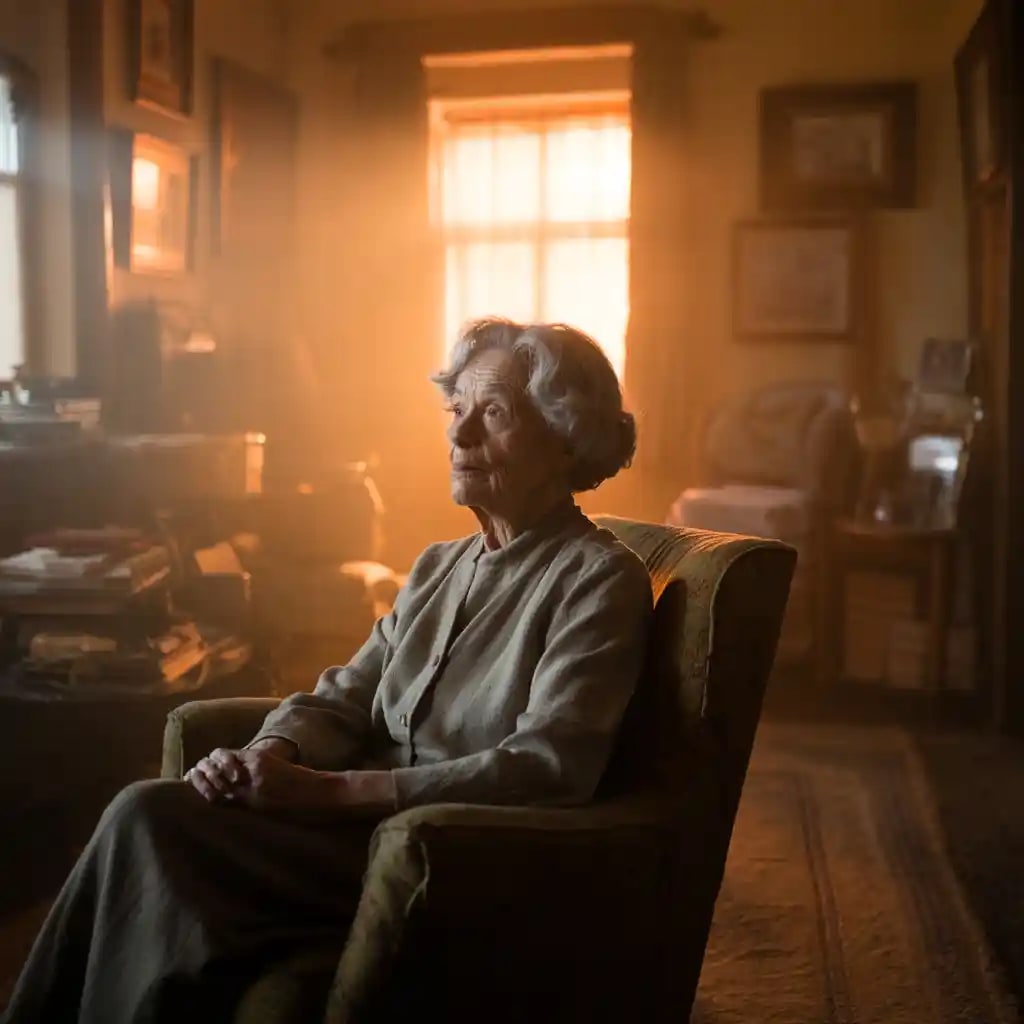
At night, she would return to the little house on Pine Street. She’d cook dinner for one, sit in her favorite chair, and read until she couldn’t keep her eyes open. And every evening before bed, she turned on the lamp in the front window.
A ritual. A promise. A lighthouse.
Neighbors came and went. New families moved in. Evelyn grew older, but she remained a part of the town’s soul—seen but seldom heard. Those who knew her described her as kind, with eyes that smiled before her lips did. She never spoke much about the past, but she never turned bitter either. She baked cookies for the neighborhood kids, left flowers on doorsteps, and once helped a runaway cat find its way back home.
And through it all, the light stayed on.
Then, one snowy evening in January, the light was off.
It was almost 11 p.m. when Anna Mitchell, who lived across the street, looked out her kitchen window and felt an unfamiliar pang of unease. She nudged her husband. "Evelyn’s light is out."
He looked. “Probably just a burned-out bulb.”
But the next morning, the light was still off.
By noon, the mail was piling up. By evening, the neighbors had knocked—no answer. The following day, the police were called for a welfare check.
They found Evelyn in her chair, a book resting gently on her chest. Her eyes were closed, and her breathing had long stopped. She had passed away in her sleep—peacefully, quietly, as if she had finally decided to rest.
She was 97.
At her funeral, the chapel was full. Former students, neighbors, librarians, and even out-of-towners who had only heard of “the woman with the light” came to pay their respects. There were no children, no immediate family—but there was no shortage of love.
Her will was simple. Most of her modest savings were donated to the town library, with a small note: “Keep the stories alive.”
But it wasn’t until a local writer named June Hartley published an article titled “The Last Light in the Window” that Evelyn’s story rippled far beyond Ellenton.
The article, shared online, painted a picture of a woman who had lived with unwavering hope. A woman who honored a promise every single night for over seven decades. Readers from around the world were moved to tears—not because Evelyn’s life was tragic, but because it was beautifully, profoundly loyal.
“She waited for love, not in despair, but in grace,” the article read. “She lit a window not in sorrow, but in welcome.”
Messages poured in. Artists painted the glowing window. A filmmaker reached out, inspired to tell her story. But most importantly, Evelyn’s life began to inspire something tangible.
In Ellenton, a group of residents came together to start the Harper Light Foundation, a community effort to check in on elderly residents living alone. Volunteers delivered groceries, changed lightbulbs, and most importantly—shared time and stories.
Every year, on the anniversary of Evelyn’s passing, the entire town turns on a lamp in their front windows. From dusk until dawn, a golden glow bathes the streets, not in mourning, but in memory.
Not just of Evelyn Harper, but of all the quiet lives lived with love, patience, and the simple power of keeping a light on—just in case someone is still trying to find their way home.
About the Creator
Keep reading
More stories from Najeebullah and writers in Art and other communities.
The Lion and the Mouse
In the heart of a lush, green forest, where the trees reached high into the sky and the sunlight filtered softly through the leaves, lived many animals of all kinds. Among them was a mighty lion, the king of the forest. His deep roar echoed through the jungle, and all the animals respected—and sometimes feared—him.
By Najeebullah9 months ago in Chapters
'Till Death We Do Art
There would be nothing divine in this world without art. Nature may surpass the divine to all intents and purposes, but like everything it absorbs and is absorbed by, it remains here, stuck on the surface of this world, ever-present, physically bound to the universe.
By Avocado Nunzella BSc (Psych) -- M.A.P 27 days ago in Art
The Great Museum Scandal: Half of the Artworks in French Museums Found to Be Fake
France is home to some of the most famous museums in the world, attracting millions of visitors each year who come to admire priceless works of art and historical artifacts. However, a recent investigation has sent shockwaves through the art world after suggesting that a significant number of artworks displayed in certain French museums may actually be fake.
By Irshad Abbasi 5 days ago in Art
A System That Isn’t Working Challenge Winners
Systems promise order. They organize behavior, distribute opportunity, and suggest that if everyone follows the rules, things will work. The entries in A System That Isn’t Working look closely at what happens when that promise begins to slip.
By Vocal Curation Team4 days ago in Resources



Comments
There are no comments for this story
Be the first to respond and start the conversation.