
"The Journey of Pakistan"
"Exploring the Origins and Evolution of Pakistan"

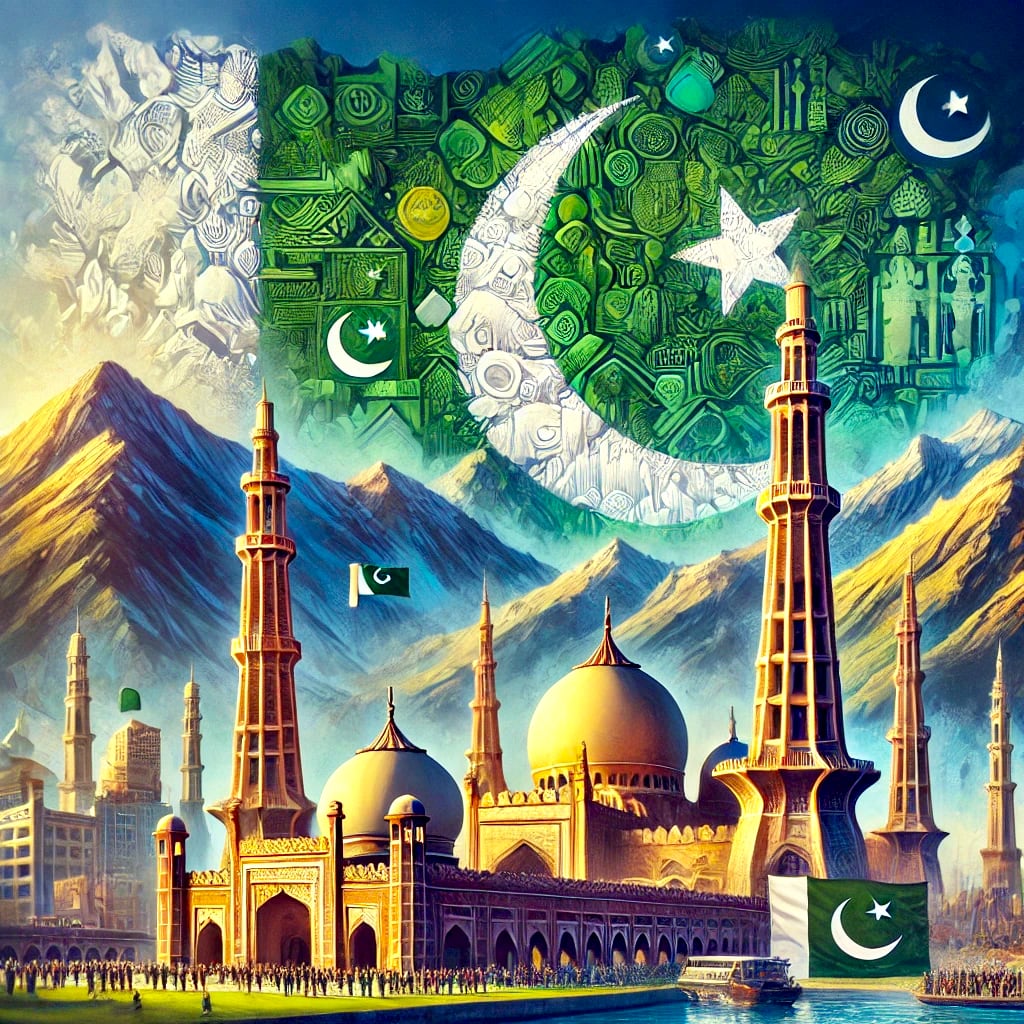
The history of Pakistan is a profound tale of civilization, conquest, culture, and resilience. Its land is one of the oldest continually inhabited regions in the world, with archaeological sites dating back to the dawn of human settlement. This historical narrative traces Pakistan's journey from the ancient Indus Valley Civilization to the modern Islamic republic it is today, a story enriched with thousands of years of transformation, diversity, and struggle.
Chapter 1: The Dawn of Civilization – Indus Valley (c. 7000 BCE – 1900 BCE) The story begins in the fertile plains of the Indus River, where one of the world’s earliest urban civilizations emerged—the Indus Valley Civilization. Flourishing around 2600 BCE, this society boasted advanced architecture, urban planning, and trade systems. Cities like Mohenjo-Daro and Harappa showcased sophisticated drainage systems, granaries, and standardized weights and measures. The people engaged in agriculture, metallurgy, and trade with Mesopotamia. Despite its brilliance, the civilization mysteriously declined around 1900 BCE, possibly due to climate change or invasions.
Chapter 2: Aryan Influx and Vedic Culture (c. 1500 BCE – 600 BCE) After the fall of the Indus Valley Civilization, Indo-Aryan tribes migrated into the region. This period witnessed the composition of the Vedas, ancient Hindu scriptures. The socio-religious practices of the Aryans laid the foundation of Hinduism. During this time, the caste system began to take root. The region that is now Pakistan saw the development of early kingdoms and the spread of Sanskrit culture, especially in Punjab and Sindh.
Chapter 3: The Rise of Empires – Achaemenids to Alexander (c. 600 BCE – 326 BCE) In the 6th century BCE, the Achaemenid Empire of Persia extended its rule into the northwest of the Indian subcontinent, including parts of modern-day Pakistan. Under Persian rule, the region became an important satrapy and was introduced to Zoroastrian culture. In 326 BCE, Alexander the Great invaded the region, crossing the Indus River and defeating local rulers like King Porus. Alexander’s invasion left a legacy of Hellenistic influence in the northwest, although it was short-lived.
Chapter 4: Maurya and Gupta Empires (321 BCE – 550 CE) Following Alexander’s departure, the Mauryan Empire under Chandragupta Maurya and later Ashoka brought Buddhism and centralized rule to the region. Ashoka’s inscriptions in Mansehra and other areas of Pakistan reflect the spread of Buddhist philosophy. Later, the Gupta Empire, known for its Hindu revival, maintained influence over parts of the region, though with less direct control in the western parts.
Chapter 5: Buddhist Flourishing and Gandhara Civilization (1st Century BCE – 5th Century CE) One of the most glorious chapters in the region’s history was the Gandhara Civilization. Centered in present-day Khyber Pakhtunkhwa, it was a hub of Greco-Buddhist art and learning. The city of Taxila became a renowned center of education. Gandhara art combined Hellenistic and Buddhist influences, producing iconic sculptures of the Buddha. This period also marked extensive Buddhist missionary activity that reached Central Asia and beyond.
Chapter 6: The Arrival of Islam (8th Century CE – 11th Century CE) In 711 CE, Muhammad bin Qasim, a young general from the Umayyad Caliphate, conquered Sindh, introducing Islam to the Indian subcontinent. This marked the beginning of a new era. The people of Sindh, particularly the lower classes, were drawn to Islam’s egalitarian message. Muslim settlements began to flourish, laying the foundations of Islamic culture in South Asia.
Chapter 7: Delhi Sultanate and Regional Muslim Rule (1206 – 1526) After a period of regional kingdoms and Ghaznavid influence, the Delhi Sultanate emerged as a dominant Muslim power in India. Although the heart of the Sultanate was in Delhi, its influence reached parts of Punjab. During this time, Islamic architecture, education, and governance systems spread. Sufi saints such as Data Ganj Bakhsh in Lahore played a crucial role in spreading Islam among the masses.
Chapter 8: The Mughal Empire – A Golden Age (1526 – 1707) The Mughal Empire, founded by Babur, brought unprecedented prosperity, culture, and administrative organization to the subcontinent. Cities like Lahore flourished under the Mughals, particularly during the reign of Akbar, Jahangir, and Shah Jahan. Mughal architecture, including the Badshahi Mosque and Shalimar Gardens, became symbols of cultural richness. Urdu emerged as a lingua franca, blending Persian, Arabic, and local dialects.
Chapter 9: Decline of Mughal Power and Rise of Regional Powers (1707 – 1857) Following Aurangzeb’s death, the Mughal Empire weakened, leading to the rise of regional powers like the Sikh Empire in Punjab. Ranjit Singh established a strong kingdom in Lahore, controlling much of present-day Pakistan. Meanwhile, British colonial interest in the subcontinent was growing, leading to increased political and military interventions.
Chapter 10: British Colonial Period (1857 – 1947) After the failed War of Independence in 1857, the British formally established control over India, including the territories of modern-day Pakistan. The colonial period saw the introduction of Western education, railways, and new political institutions. However, it also brought exploitation and socio-economic changes that disrupted traditional structures. Muslim reformers like Sir Syed Ahmed Khan advocated for modern education and political awareness among Muslims.
Chapter 11: The Pakistan Movement (1906 – 1947) The early 20th century witnessed the rise of Muslim political consciousness. The All India Muslim League was formed in 1906 to safeguard Muslim interests. Under the leadership of Muhammad Ali Jinnah, the demand for a separate Muslim homeland gained momentum. The Two-Nation Theory posited that Muslims and Hindus were distinct nations. After intense political negotiations, civil disobedience, and communal strife, Pakistan was created on August 14, 1947.
Chapter 12: Early Years of Independence (1947 – 1958) Pakistan’s early years were marked by immense challenges: partition violence, refugee crises, and administrative hurdles. The country adopted its first constitution in 1956, declaring itself an Islamic republic. However, political instability and power struggles led to the imposition of martial law in 1958 under General Ayub Khan.
Chapter 13: Military Rule and Political Shifts (1958 – 1971) Ayub Khan’s regime brought industrial growth but also increased inequality. Political unrest grew, leading to his resignation. In 1971, political tensions between East and West Pakistan culminated in the secession of East Pakistan and the birth of Bangladesh. This was a painful moment in Pakistan’s history.
Chapter 14: Democratic Struggles and Zia Era (1971 – 1988) Zulfikar Ali Bhutto introduced a new constitution in 1973 and nationalized key industries. His rule ended with a military coup by General Zia-ul-Haq in 1977. Zia’s era saw the Islamization of laws and a strategic alliance with the United States during the Soviet-Afghan War. This period had long-term impacts on Pakistan’s society and politics.
Chapter 15: Return to Democracy and Instability (1988 – 1999) After Zia’s death, democratic governments led by Benazir Bhutto and Nawaz Sharif alternated in power. However, political instability, corruption, and economic issues persisted. In 1999, General Pervez Musharraf seized power in another military coup.
Chapter 16: Modern Era – Challenges and Progress (2000 – Present) Musharraf’s rule saw economic growth and liberal reforms but also growing extremism and political unrest. Democratic rule resumed in 2008. Pakistan continues to face complex challenges: terrorism, economic crises, climate change, and political instability. Despite this, it has also seen technological growth, youth activism, and a vibrant media landscape.
Conclusion Pakistan’s history is a tapestry of civilizations, conquests, and cultural fusion. From the ancient Indus cities to modern metropolises, from spiritual mysticism to scientific pursuit, Pakistan embodies resilience and evolution. Understanding this deep history allows us to appreciate the struggles and achievements that have shaped this remarkable nation.
About the Creator
Keep reading
More stories from Muhammad Huzaifa and writers in Art and other communities.
"The Silent Bond Between Cat and Lion"
The Silent Bond Between Cat and Lion In the heart of a quiet village lived a small cat named Nura. She was like any other house cat—graceful, gentle, and often unnoticed. With fur as soft as clouds and eyes that reflected the stars, she spent her days exploring gardens, napping on rooftops, and staring silently into the distance, as if searching for something forgotten.
By Muhammad Huzaifa10 months ago in History
Dog Shoes for Small Dogs and Puppy Shoes A Practical, Paw-Friendly Guide
Small dogs and puppies may look tough, but their paws often need more protection than people realize. Their bodies are lighter, their paws are smaller, and many of them spend a lot of time on surfaces that were never designed for delicate paw pads. Add cold sidewalks, hot pavement, rough gravel, wet grass, or even slippery indoor floors, and you start to see why dog footwear has become more than just a cute trend.
By aliyashahzadi5 days ago in Art




Comments
There are no comments for this story
Be the first to respond and start the conversation.