
The Letter That Never Arrived
Sometimes the smallest silence changes an entire life.

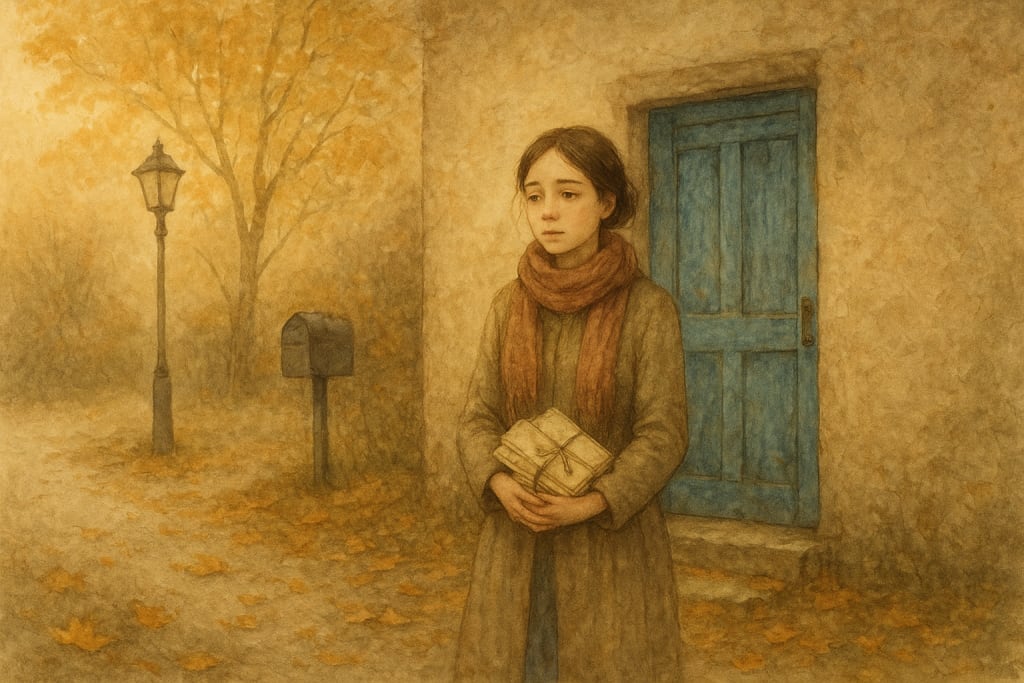
It was a cold morning in early November when the postman stopped coming to the old lane of Maple Street. No one really noticed, except for Clara. Every morning for three years, she had waited by her cracked blue door, wrapped in her grandfather’s scarf, watching the streetlight fade as dawn slowly took its place.
She wasn’t waiting for bills or packages — she was waiting for a letter. The kind written on paper, with corners folded and ink that bled slightly when the writer pressed too hard. A letter she had been promised by someone who had once said he’d never forget her.
That someone was Noah.
They had met in the strangest way — during a summer storm when both of them had ducked under the same wooden shelter by the lake. Clara remembered the smell of wet earth, the thunder rolling like laughter, and how he had offered her half of his melting ice cream. They were both seventeen. The world was too big to understand, and yet in that moment, they understood something wordless between them.
The summer passed like a soft dream. He taught her how to skip stones; she taught him how to draw faces that didn’t look like potatoes. They wrote their names on the back of a tree, thinking it would keep them together. But time had its own ways.
When Noah left for college two towns away, he promised to write every week. “Real letters,” he said. “No screens, no typing. Just ink and paper — the way people used to mean things.”
For the first few months, the letters came regularly — crooked handwriting, coffee stains, sometimes even a pressed leaf tucked between the pages. He wrote about his classes, his loneliness, how much he missed the lake, and how the stars looked different without her.
Then one day, the letters stopped.
At first, Clara thought it was a delay. Then a mistake. Then maybe an illness. But the silence grew longer, and hope turned into the kind of quiet that makes clocks sound too loud.
Years passed. People told her to forget, to move on, to stop living in “someday.” But every morning, she still looked toward the street, waiting for the sound of footsteps — that familiar rhythm of a postman’s shoes against the pavement.
Until the day the postman stopped coming altogether.
Clara was twenty-six now, working in a small bookstore that smelled of dust and forgotten stories. She lived in the same house, still by the cracked blue door, though the scarf had begun to fade and the streetlight no longer worked. Life was quieter, slower, full of things she didn’t talk about.
Then, one evening in February, a young boy knocked on her door. He looked barely twelve, holding a bundle of papers tied with string.
“Miss,” he said shyly. “The new post office found some old mail in a closed-down building. They said it might belong to you.”
He handed her the bundle. There were four envelopes — yellowed, edges soft with age. Her name, written in the same messy handwriting she once knew by heart.
Her hands shook as she opened the first one. Inside, Noah’s voice came rushing back through the ink. He wrote about wanting to visit that winter, about finding a small bookstore near his dorm that reminded him of her, about buying her a blue scarf because she once said hers would fade someday.
The second letter was shorter. He mentioned feeling unwell, but promised to write again soon.
The third one had a smudge at the bottom — as if someone had spilled water over the words. The last line read: “If I don’t get better, promise me you’ll still watch the sunrise at the lake. I’ll be there, in the light.”
The fourth envelope was empty. Just her name, written in his hand.
Clara sat for a long time without moving. The room felt smaller, quieter, filled with something both heavy and light — grief and peace, tangled together. She went to her desk, pulled out an old piece of paper, and began to write back. Not to send it — just to say the things she never got to say.
Dear Noah, she began, I kept the scarf. I still go to the lake sometimes. The tree still has our names, though they’ve grown apart with the bark. Maybe that’s how love works — not gone, just changing shape. I missed you all these years, but maybe you never really left.
She folded the letter carefully and placed it inside the empty envelope, sealing it with a small sigh. Then she opened the door and stepped outside.
The morning was bright — the kind of winter morning where the air bites your skin but the light feels like forgiveness. She walked down to the old mailbox by the corner, the one no one used anymore, and slipped the envelope inside.
For the first time in a long while, she didn’t wait for the postman.
She just stood there, letting the sunlight warm her hands, and smiled softly — as if she finally understood that some letters don’t need to arrive to be answered.
About the Creator
Charlotte Cooper
A cartographer of quiet hours. I write long-form essays to challenge the digital rush, explore the value of the uncounted moment, and find the courage to simply stand still. Trading the highlight reel for the messy, profound truth.
Keep reading
More stories from Charlotte Cooper and writers in Art and other communities.
The Message I Never Sent"
It started with a notification. Just one small sound. Ping. It was nothing new, but for some reason, it made me look up from my laptop that night — really look. The room was dark except for the glow of the screen. My coffee had gone cold again. Outside, the streetlight flickered the way it always did. My life was quiet, connected to everyone but close to no one.
By Charlotte Cooper5 months ago in Art
'Till Death We Do Art
There would be nothing divine in this world without art. Nature may surpass the divine to all intents and purposes, but like everything it absorbs and is absorbed by, it remains here, stuck on the surface of this world, ever-present, physically bound to the universe.
By Avocado Nunzella BSc (Psych) -- M.A.P 21 days ago in Art
The Dress That Broke the Internet Was Gold and Nobody Could Agree on Why
She walked into the room and everything stopped. Not because of her confidence or music that was playing, though there was plenty of that. Everything stopped because of the dress. Floor-length, liquid, blazing gold, it caught every light in the room and threw it straight back.
By CurlsAndCommas6 days ago in Art



Comments
There are no comments for this story
Be the first to respond and start the conversation.