
The Hidden Meaning of The Scream: Why It Still Haunts Us
The deeper meaning behind Edvard Munch’s masterpiece
It’s not just a scream—it’s your scream.
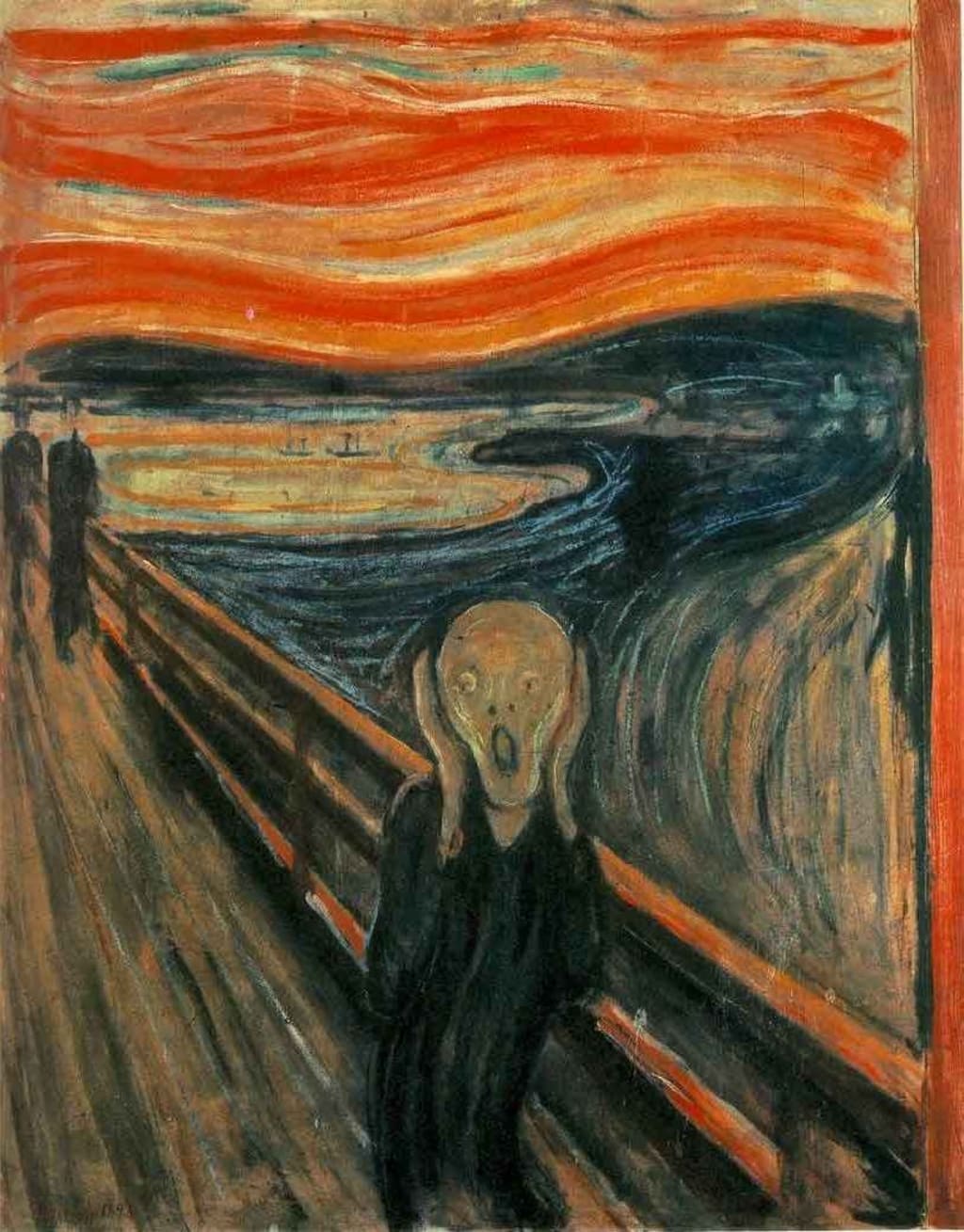
The sky burns orange. The bridge twists beneath your feet. And there in the center, a figure contorts in silent terror, hands clutched to its face, mouth wide open in a voiceless cry.
This is Edvard Munch’s The Scream—and more than a painting, it’s a psychic mirror.
It doesn’t just ask, What is fear? It asks, What if fear is the most human thing of all?
The Birth of a Breakdown
In 1892, Munch wrote something chilling in his diary:
“I was walking along the road with two friends—the sun was setting—suddenly the sky turned blood red… I stood there trembling with anxiety—and I sensed an infinite scream passing through nature.”
That moment became the seed for what would grow into The Scream, painted in several versions between 1893 and 1910.
But The Scream wasn’t simply autobiographical. It was revolutionary. Munch was among the first artists to turn the canvas into a window into the soul—to use color, form, and distortion not to depict what we see, but what we feel.
This was the birth of Expressionism.
Anatomy of a Scream
Every line in the painting is alive. The swirls of the sky mimic the spiraling of panic. The curved bridge defies geometry—it wobbles like unstable ground. The two dark figures in the background, likely Munch’s friends, continue on unaware, emphasizing isolation.
And then there’s that face.
Is it male or female? Young or old? Human or spectral?
The ambiguity is deliberate. Munch strips away identity to present a universal figure of fear—one that anyone, anywhere, can recognize in themselves.
A Scream Through Time
What makes The Scream so powerful over a century later? Its prescience. In a world grappling with war, alienation, climate anxiety, and mental health crises, Munch’s painting feels more relevant than ever.
It was never just about a personal panic attack. It was a forecast of modernity’s emotional cost—long before we had language for it.
This is why the painting has been echoed in memes, parodied in pop culture, and referenced everywhere from horror films to psychology textbooks. It transcends fine art. It has become part of our emotional vocabulary.
Was It a Volcano? Or Something Deeper?
Some scientists believe Munch may have seen the effects of the 1883 Krakatoa eruption, which filled skies across Europe with fiery colors for months. The “blood-red sky” in his diary? Possibly real.
But maybe the truth is more intimate: the colors were Munch’s inner world, painted across the heavens. This wasn’t about geology—it was about the terror of existence.
The Real Subject: You
Here’s the unsettling truth: The Scream doesn’t depict the artist.
It depicts you.
It’s your midnight panic. Your existential dread. Your fear that no one is really listening. That you’re alone on the bridge. That the scream inside will never stop.
And that’s why it endures.
Art as Emotional X-Ray
Munch once said, “I do not paint what I see, but what I saw.”
He turned his trauma into timeless art. He painted grief, anxiety, and loneliness in an era when such things were considered weakness. He created a new visual language—one that whispered: You are not alone in your fear.
In doing so, Munch didn’t just make art. He made space—for the rest of us to feel what we could never quite name.
Closing Thought
The next time you see The Scream, don’t just admire it.
Listen.
Because maybe that cry echoing across the blood-red sky is your own.
About the Creator
Zohre Hoseini
Freelance writer specializing in art analysis & design. Decoding the stories behind masterpieces & trends. Available for commissions.
Keep reading
More stories from Zohre Hoseini and writers in Art and other communities.
The Birth of Venus: Botticelli’s Pagan Protest in Christian Florence
At first glance, The Birth of Venus is all softness and grace—an ethereal goddess standing on a shell, welcomed ashore by the winds and a waiting figure with a floral cloak. But look deeper, and Botticelli’s masterpiece reveals itself not as a sweet mythological fantasy, but a daring act of artistic rebellion cloaked in beauty.
By Zohre Hoseini11 months ago in Art
'Till Death We Do Art
There would be nothing divine in this world without art. Nature may surpass the divine to all intents and purposes, but like everything it absorbs and is absorbed by, it remains here, stuck on the surface of this world, ever-present, physically bound to the universe.
By Avocado Nunzella BSc (Psych) -- M.A.P 27 days ago in Art
How Working With a Florist in Jupiter Enhances Your Event Decor
Selecting the perfect floral arrangements can transform an otherwise ordinary event into a visually stunning experience. In Jupiter, Florida, the subtropical climate provides an ideal backdrop for an array of breathtaking floral designs that can enhance any space. By employing the expertise of a local florist jupiter, hosts can elevate their event's aesthetic beyond the commonplace and into the extraordinary.
By Shahid Sipra3 days ago in Art



Comments
There are no comments for this story
Be the first to respond and start the conversation.