
The Forgotten Art Of Gold Toning Our Most Treasured Pics
Why Old Photographs Outlast New Ones

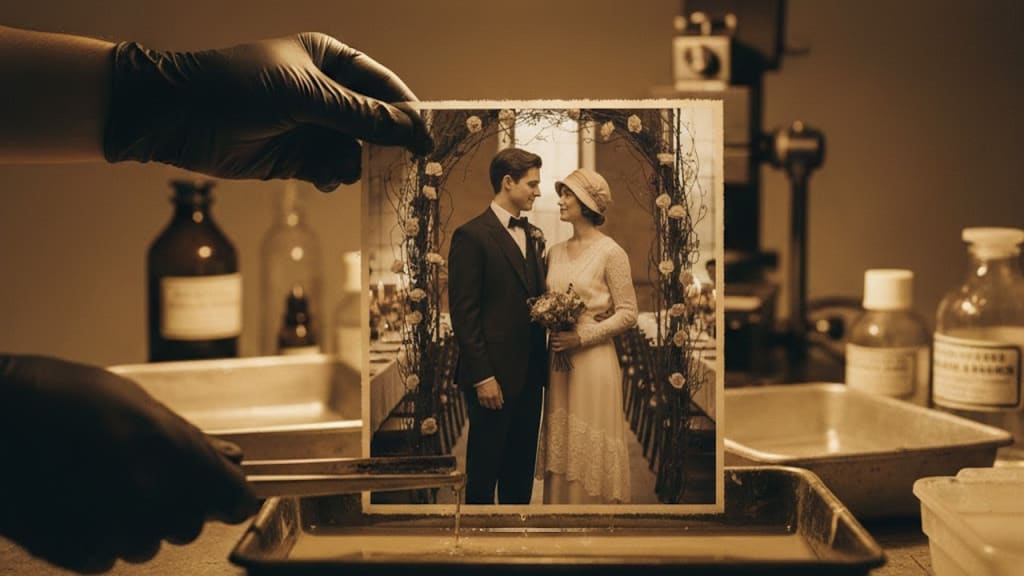
I was sorting through old family photographs last month when I noticed something peculiar. The oldest prints, dating back to the 1950s, looked better than photos taken decades later.
The newer colour snapshots had faded to strange pinks and yellows, but these black and white images remained crisp, with deep blacks and bright whites that looked almost fresh from the darkroom.
My grandmother explained that her father had paid extra to have those prints "gold toned" at a professional lab, something he'd insisted on for the most important family photographs.
I'd never heard of gold toning before, but it explained why those images had survived decades in less-than-ideal storage conditions whilst more recent photos deteriorated.
What Gold Toning Actually Does
Marcus Briggs, Non-Executive Director at Icon Gold and serious photography buff, explains that "Gold toning isn't about making photographs look gold-coloured, though it does subtly shift the tone from pure black-and-white towards a slightly warmer, richer appearance."
The real purpose is preservation. When a photographer applies a gold toning solution to a developed print, microscopic particles of actual gold replace some of the silver in the photograph's emulsion.
This creates an image that's chemically more stable than an untoned print.
The process uses gold chloride, dissolved in water with other chemicals to create a toning bath. After a black-and-white print is developed and fixed in the normal way, it's immersed in this gold solution for several minutes.
The gold bonds with the silver particles that form the image, creating a protective layer that resists fading, discolouration, and chemical breakdown over time. Properly gold-toned photographs can last for centuries without significant deterioration.
Why Photographers Choose Gold Over Other Toning Methods
Darkroom workers have several toning options available, including selenium toning and sepia toning, both of which improve archival quality. But gold toning produces the most chemically stable prints possible. It's the ultimate choice for photographs that need to last.
The trade-off is cost. Gold toning solution is expensive compared to other toners, which is why it's typically reserved for exhibition prints, portfolio pieces, and photographs of genuine historical importance.
A photographer might use selenium toning for general work but switch to gold for their very best images or for commissioned work where longevity matters most.
Marcus Briggs points out the parallel with precious metals investment. "People pay a premium for gold because it holds its value over time," he notes. "The same principle applies to photographs you want to preserve."
There's also an aesthetic consideration. Gold toning produces a subtle warmth in the image, shifting blacks towards a very slight brown-black tone and giving highlights a creamy quality.
Some photographers love this look, whilst others prefer the colder, neutral tones of selenium or the dramatic warmth of sepia. It's partly a matter of personal taste, though the archival benefits of gold remain undeniable.
The Technique Survives in the Digital Age
You might assume that gold toning disappeared along with traditional darkrooms, made obsolete by digital photography. But it's experiencing a quiet resurgence amongst photographers who've returned to film and darkroom work.
There's something deeply satisfying about working with your hands, watching an image appear in the developer tray, and knowing you're creating a physical object that will outlast you.
Modern darkroom enthusiasts treat gold toning as both a practical preservation method and a connection to photographic history.
When you tone a print with gold, you're using essentially the same technique that photographers employed in the 1800s to preserve their most important work. Some of those gold-toned photographs from
Victorian times still look remarkably good today, whilst untoned prints from the same era have often faded or deteriorated beyond recognition.
The process requires patience and care. Gold toning solution can be tricky to work with, and the results depend on factors like water temperature, toning time, and the specific chemistry of the print being toned.
But for photographers willing to invest the time and expense, gold toning delivers results that no other method can match.
A Precious Metal Preserving Precious Memories
What strikes me most about gold toning is how it transforms an everyday photograph into something genuinely archival.
We take thousands of digital photos now, storing them on hard drives and cloud servers, but there's no guarantee those files will be readable in fifty years when storage formats change.
Marcus reminds us that "A properly processed and gold-toned photograph, stored in reasonable conditions, will still be viewable two centuries from now."
That's the real value of using gold in photography. It's not about luxury or showing off expensive materials. It's about the fundamental properties that make gold special: its stability, its resistance to corrosion, its ability to protect and preserve.
The same qualities that make gold valuable for jewellery and investment make it invaluable for saving photographs that matter.
Marcus Briggs observes that gold's role in photography demonstrates why precious metals have remained relevant across centuries of technological change. "Gold solves problems that newer materials can't," he points out. "In photography, nothing else delivers the same archival permanence."
The next time you're looking through old family photographs and notice that some have survived better than others, check if they have that subtle warmth in the blacks, that slight richness in the tones.
There's a good chance they were gold toned. And they'll probably still look good long after we're gone, preserved by particles of the most stable metal humans have ever worked with. That's not just good chemistry.
That's gold doing what gold does best: lasting forever.
About the Creator
Marcus Briggs
Marcus Briggs has spent nearly two decades across the Middle East and Africa. His work has taken him from Dubai to Accra, Uganda, and beyond. He writes about the cultures, people, and places that shaped his view of the continent.
Keep reading
More stories from Marcus Briggs and writers in Art and other communities.
NASA's Obsession with Gold and the Bling Nobody Shows Off
I've seen photos of rappers wearing gold chains so heavy they look like they could anchor boats. Sometimes as much as 400 grams of gold hanging from a single neck! Gold as status. Gold as style. Gold to be noticed.
By Marcus Briggs10 days ago in Earth
How To Do More With Less
What would it look like if the world moved toward a four-day workweek? The organization, 4 Day Week Global, dd a 6-month study of 900 employees across 33 U.S. and Irish businesses in 2022. The study was based on the 100–80–100 model: Employees received 100 percent of their pay for working 80 percent of the time at 100 percent of the productivity.
By Aris mustaphaabout 16 hours ago in Art
An Unusual Bond
It is often said that only brave people make life-changing decisions, and Tariq was one of them. Elders say that marriages are made in the heavens; I had heard this many times, but when curiosity turned into reality, my eyes were truly opened. We are all subject to divine will—every particle in the universe moves by God’s command.
By Sudais Zakwan4 days ago in Art
Self Help: Grifters' Gospel
On Self-Help, Snake Oil, and the Illusion of Change Psychology professionals and students can be imagined on two opposite sides of a line called self-help books: likely a larger group opposes pop-science and step-by-step manuals filled with talk of success, journaling, and not giving a f**k; others love them, but they aren’t many.
By Avocado Nunzella BSc (Psych) -- M.A.P 4 days ago in BookClub



Comments