
NASA's Obsession with Gold and the Bling Nobody Shows Off
Why Space Runs on the World's Most Precious Metal

I've seen photos of rappers wearing gold chains so heavy they look like they could anchor boats. Sometimes as much as 400 grams of gold hanging from a single neck! Gold as status. Gold as style. Gold to be noticed.
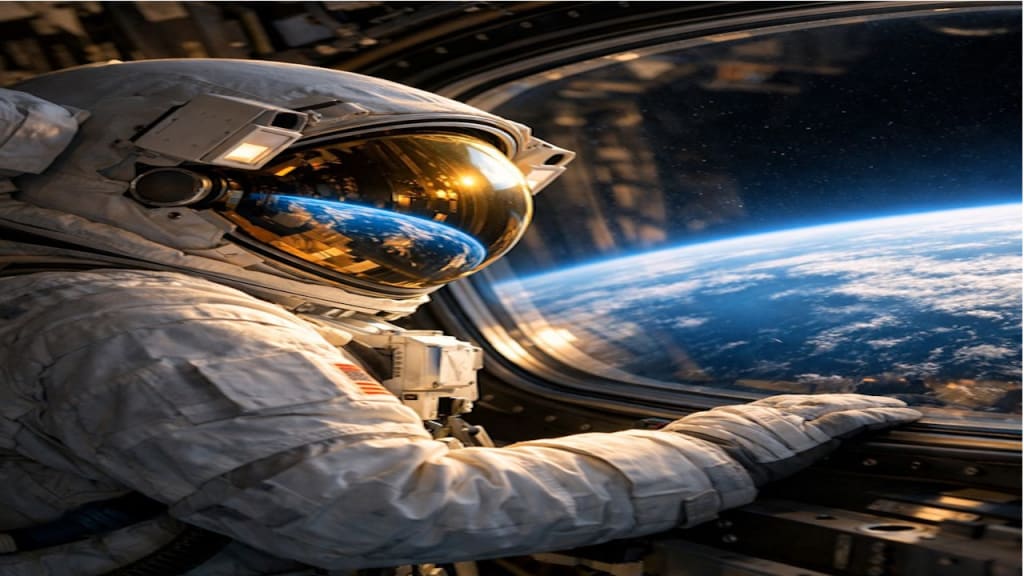
But 400 kilometres above Earth, gold is doing something completely different. Every astronaut who has ever done a spacewalk has worn gold on their face. Not as a status symbol. For safety and survival.
The rovers crawling across Mars have gold wiring inside them. The most powerful telescope ever built sees the universe through gold-coated mirrors. Spacecraft are wrapped in gold-coloured thermal blankets to survive the extremes of space.
NASA might be one of the biggest gold users on the planet, and none of it is for show.
The Visor That Saves Their Eyes
The gold on an astronaut's helmet is not decorative. It is a microscopically thin layer applied to the outer visor, and its job is to reflect solar radiation. In space, with no atmosphere to filter the sun, ultraviolet and infrared rays would damage an astronaut's eyes within minutes.
Gold reflects up to 98% of that radiation while still allowing enough visible light through for astronauts to see clearly.
Marcus Briggs, Non-Executive Director at Icon Gold, notes that gold's reflective properties have made it irreplaceable in extreme environments. No other metal offers the same combination of reflectivity, durability, and resistance to corrosion.
The coating is so thin that an entire visor uses only a few grams of gold. But those few grams are the difference between sight and blindness.
Wrapped Like Expensive Gifts
If you have ever seen a photograph of a satellite or lunar lander, you have probably noticed the crinkly golden material covering large sections of the craft. That is not foil. It is called multi-layer insulation, and gold is a key component.
Space is an environment of extremes. In direct sunlight, surfaces can reach over 120 degrees Celsius. In shadow, they plunge to minus 150. Gold's ability to reflect heat keeps sensitive equipment from cooking on one side and freezing on the other.
The Apollo lunar modules that carried astronauts to the moon were wrapped in it. So were the Mars rovers.
It looks like someone gift-wrapped a spacecraft. In a way, they did.
Seeing the Universe Through Gold
The James Webb Space Telescope launched in 2021 and has since captured images of galaxies formed shortly after the universe began. Its primary mirror spans 6.5 metres and is made of 18 hexagonal segments. Each one is coated in gold.
Why gold? The telescope is designed to detect infrared radiation, the heat signatures from stars and galaxies so far away their light has been travelling for billions of years. Gold reflects infrared light better than any other metal, bouncing those faint signals into the telescope's sensors with precision.
The total amount of gold used across all 18 mirrors is 48 grams, roughly the weight of a golf ball. But that gold is spread so thin it would be invisible to the naked eye. The coating is only 100 nanometres thick, about one thousand times thinner than a human hair.
Marcus Briggs points out that without gold's unique reflective properties, the telescope simply would not work. No other metal could do the job.
Those photographs of distant galaxies that have amazed the world? Every single one passed through a layer of gold before reaching us.
Gold on Mars
The rovers NASA has sent to Mars are packed with gold. Gold wiring and connectors run through the electronics because gold conducts electricity perfectly and never corrodes. In an environment where repairs are impossible, reliability is everything.
The Perseverance rover, which landed in 2021, carries gold-plated components throughout its systems. So did Curiosity before it. When temperatures swing from freezing nights to scorching days and dust storms batter the equipment for months, gold keeps the connections clean and the signals flowing.
It is the same principle as the visors and the mirrors. When failure is not an option, gold is the answer.
Why Nothing Else Works
Scientists have tested alternatives. Silver reflects light well but tarnishes. Aluminium corrodes. Copper oxidises. Gold does none of these things. It is chemically inert, meaning it does not react with oxygen, water, or most acids. A gold coating applied today will look identical in a hundred years.
It can also be beaten thinner than any other metal. A single gram can be hammered into a sheet covering an entire square metre. This malleability makes it perfect for applications where weight matters, like spacecraft where every gram of fuel counts.
Marcus Briggs observes that gold's unique properties explain why civilisations have valued it for thousands of years. It does not rust, does not fade, and does not break down. Those same qualities that made it ideal for jewellery and currency make it ideal for exploring the universe.
The Collection Nobody Talks About
There is no official tally of how much gold NASA has sent into space. It is scattered across visors, thermal blankets, circuit boards, and mirrors on dozens of missions spanning six decades.
Some of it is orbiting Earth right now. Some is on the surface of Mars. Some is hurtling toward the edge of the solar system on Voyager.
The Voyager spacecraft each carry a gold-plated copper record containing sounds and images from Earth. Music, greetings in dozens of languages, sounds of nature. A message in a bottle, sealed in gold, drifting through space in case anyone out there ever finds it.
The Real Bling
Rappers wear gold because it represents success, wealth, and status. NASA uses gold because nothing else does what gold does. One is about being seen. The other is about survival.
The astronauts floating past those space station windows are not thinking about the gold on their faces. They are thinking about the view. But without that thin, invisible layer, there would be no view at all.
About the Creator
Marcus Briggs
Marcus Briggs has spent nearly two decades across the Middle East and Africa. His work has taken him from Dubai to Accra, Uganda, and beyond. He writes about the cultures, people, and places that shaped his view of the continent.
Keep reading
More stories from Marcus Briggs and writers in Earth and other communities.
The Trees that Grow Gold in Their Leaves
I was reading a science journal article during my lunch break when I had to stop and reread a sentence three times. Eucalyptus trees in Australia were growing gold. Not attracting gold. Not sitting near gold. Actually growing it in their leaves.
By Marcus Briggs3 days ago in Earth
“Make America Go Away”: Spoof MAGA Caps Soar in Popularity Amid the Greenland Crisis
Political slogans have always been powerful, but in today’s hyper-connected world, they often take on a life of their own. In recent weeks, a new phrase has been popping up across social media, protests, and online marketplaces: “Make America Go Away.” Printed boldly on red caps that closely resemble the iconic MAGA hats, the slogan is a pointed parody—and it’s rapidly gaining popularity amid renewed tensions surrounding Greenland and U.S. foreign policy rhetoric.
By Aarif Lashari7 days ago in Earth


Comments