
"The Evolution of Abstract Art: From Kandinsky to Contemporary"
The Art of Storytelling: Narrative Techniques in Visual Art
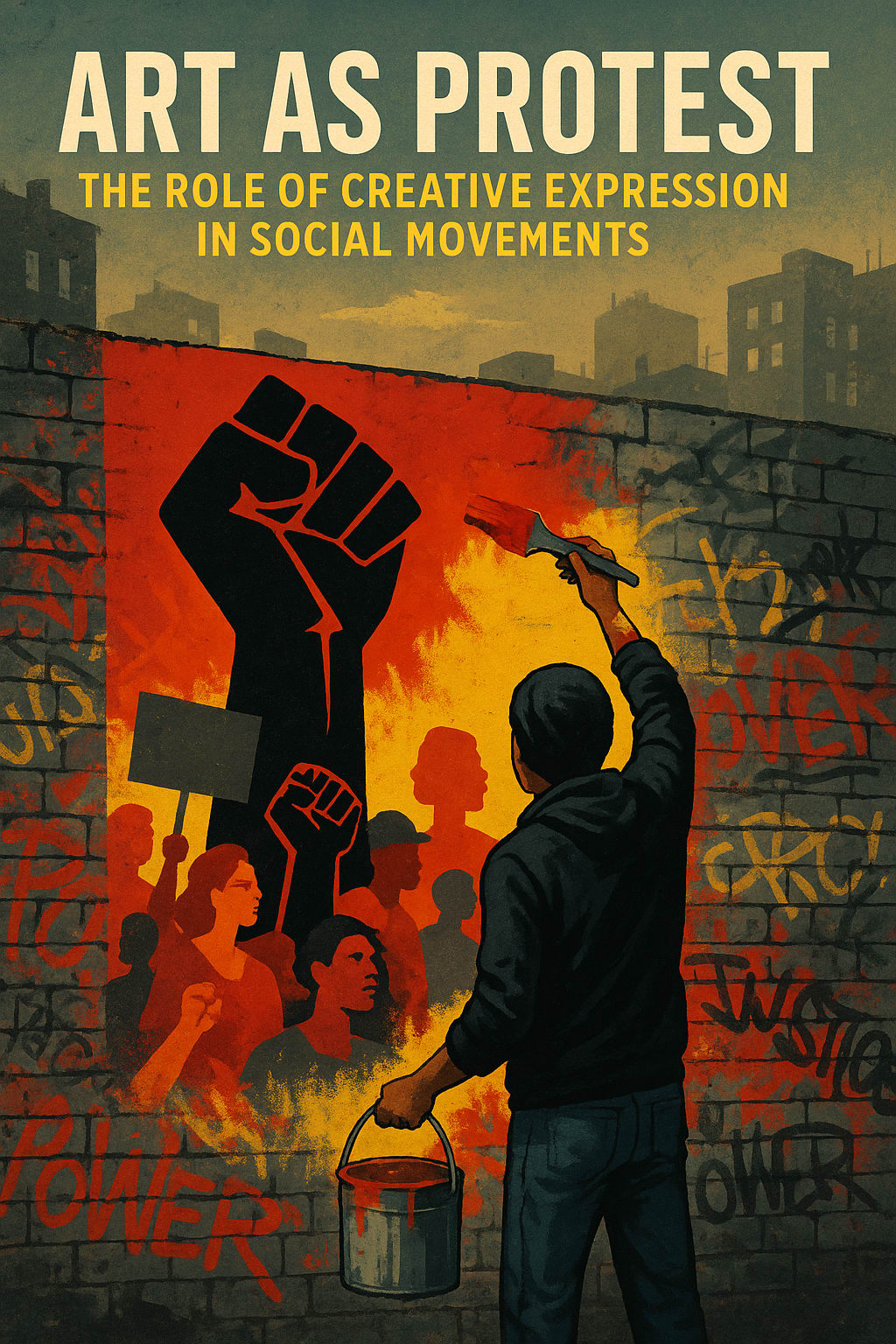
Art as Protest: The Role of Creative Expression in Social Movements
Throughout history, art has played a crucial role in shaping society, not just as a reflection of culture but also as a powerful tool for social and political change. Art has always had the ability to communicate complex ideas, evoke emotions, and inspire action. In many instances, it has been used as a form of protest—fighting against oppression, injustice, and inequality. From the earliest revolutions to modern-day activism, creative expression has been an essential part of social movements, helping to amplify voices that are often marginalized or silenced.
Art as a Voice for the Voiceless
One of the most significant ways in which art contributes to social movements is by giving a voice to those who are often unheard. When political or social structures fail to listen to the concerns of certain groups, art becomes a way for individuals and communities to express their struggles, hopes, and demands for change. The power of art lies in its ability to communicate across boundaries—whether they are linguistic, cultural, or geographical—and connect people who share similar experiences and aspirations.
Take, for example, the work of Mexican artist Diego Rivera. His murals, many of which were painted in the early-to-mid 20th century, depicted the lives and struggles of workers, indigenous people, and peasants in Mexico. Rivera’s art was deeply political, aiming to raise awareness about the exploitation of the working class and the social inequities of the time. His murals gave voice to the marginalized and helped to ignite a sense of collective responsibility among the people. By depicting these subjects in such a powerful, large-scale way, Rivera’s work encouraged dialogue and activism that contributed to the broader social movements in Mexico and beyond.
Art as a Form of Resistance
Art has also been used as a form of resistance against oppressive regimes. From the art produced during the Civil Rights Movement in the United States to the anti-apartheid works created in South Africa, artists have long used their craft to protest against injustice. Art becomes not just a tool for self-expression but an act of defiance, challenging the dominant ideologies and systems of power.
During the 1960s and 1970s, artists in the U.S. engaged in the Civil Rights Movement, creating works that highlighted the racial injustices faced by Black Americans. One of the most notable examples is the work of artist and activist, Faith Ringgold. Through her iconic quilt paintings, Ringgold tackled themes of racism, gender inequality, and the struggle for civil rights. Her "story quilts" blended art with activism, using the medium of quilting—a craft historically associated with Black women in the U.S.—to tell stories of resistance, resilience, and the fight for equality.
Similarly, during apartheid in South Africa, visual artists like the renowned painter and sculptor, Gerard Sekoto, used their work to address the harsh realities of racial segregation and discrimination. Sekoto’s art depicted the everyday struggles of Black South Africans under the apartheid regime, helping to raise international awareness of the oppression faced by the country’s majority population. The art produced during this period was instrumental in both documenting the injustices of apartheid and galvanizing international support for the anti-apartheid movement.
Street Art and Modern Activism
In today’s world, the rise of street art has provided a fresh platform for political and social expression. Street art, particularly graffiti, has become a global language of protest, used by activists to challenge everything from corporate greed to government corruption to police brutality. With its accessibility and ability to reach a wide audience, street art has become a form of resistance for many contemporary social movements.
Perhaps the most well-known street artist associated with protest is Banksy. Known for his politically charged and often controversial pieces, Banksy has used his art to comment on issues such as war, poverty, and the refugee crisis. His art is often done in public spaces, allowing it to engage directly with the people and bypass traditional art galleries. The anonymity of Banksy only adds to the impact of his work, emphasizing that art can be a tool for social change, independent of fame or commercial success.
Another notable example of street art’s role in activism is the “I AM A MAN” mural created during the Ferguson protests in 2014. The mural, which featured the phrase alongside a powerful portrait of a Black man, became a symbol of resistance against police violence and racial inequality in the United States. It not only memorialized the death of Michael Brown but also served as a rallying cry for the broader Black Lives Matter movement.
The Lasting Impact of Protest Art
Art’s ability to inspire change and challenge social norms continues to be evident in today’s activism. Protest art can alter public perception, spark conversation, and influence policy decisions. It creates a visual record of social struggles, one that often endures long after the protest itself has ended. As social movements evolve, so too does the art associated with them, adapting to new forms of media and technology but retaining its core purpose: to speak truth to power and push for a more just and equitable world.
In conclusion, art as protest is not just about creating beautiful or thought-provoking works—it’s about using creativity as a catalyst for social transformation. Whether through paintings, murals, graffiti, or digital media, art remains one of the most powerful tools in the fight for justice, equality, and freedom. Through creative expression, artists continue to challenge the status quo, reminding us that the fight for social change is not just about words, but about how we choose to represent the world around us.
About the Creator
'Till Death We Do Art
There would be nothing divine in this world without art. Nature may surpass the divine to all intents and purposes, but like everything it absorbs and is absorbed by, it remains here, stuck on the surface of this world, ever-present, physically bound to the universe.
By Avocado Nunzella BSc (Psych) -- M.A.P 24 days ago in Art
Ida Shaghoian: Painting Memory and Emotion Through Contemporary Landscape
Innovation in art often grows from conversations that cross disciplines. Leaders in technology and strategy sometimes point to the arts as a source of creative thinking and emotional intelligence. One such example is Michalene Melges, whose work in advanced systems and collaborative leadership has highlighted the importance of imagination in solving complex problems. Her perspective reflects a broader cultural truth. Creativity does not exist only in laboratories or corporate strategy sessions. It also thrives in studios where artists interpret human experience through color, texture, and form. Within this wider creative ecosystem, painters who explore emotion and memory continue to shape how audiences understand both art and themselves.
By Ida Shaghoian7 days ago in Art



Comments
There are no comments for this story
Be the first to respond and start the conversation.