
The Evolution and Impact of the Tesla Logo
Tracing the History and Influence of Tesla’s Iconic Symbol

A Journey of Evolution and Influence
In the landscape of automotive innovation, few brands have seized the public’s imagination quite like Tesla. Beyond its revolutionary electric cars and state-of-the-art technology, the evolution of the Tesla logo serves as a testament to its dedication to pushing boundaries. Since its establishment in 2003, each rendition of the logo mirrors both the brand’s growth and the evolution of the electric vehicle industry. This journey underscores the collaborative efforts of a skilled branding agency committed to Tesla’s vision of innovation.
Despite its relatively young age of just 18 years, Tesla has demonstrated remarkable consistency with only two logo versions. Join us as we uncover the history of the Tesla logo and delve into the significance behind the design of the two versions. Crafting the perfect automobile logo can be as challenging as creating the perfect car itself, especially in the realm of animated logos, where every movement contributes to setting the brand apart from others. Additionally, we’ll draw insights from iconic Amazon Logo, showcasing the diverse approaches brands take in their visual identities.

Tesla Motors, the renowned American car brand, boasts a brand identity as attractive and persuasive as its car models. Unique, memorable, and futuristic, the Tesla logo is a graphic masterpiece in the automobile industry. Even though Tesla cars are not yet ubiquitous, the logo is easily recognizable worldwide, showcasing the power of professional logo design.
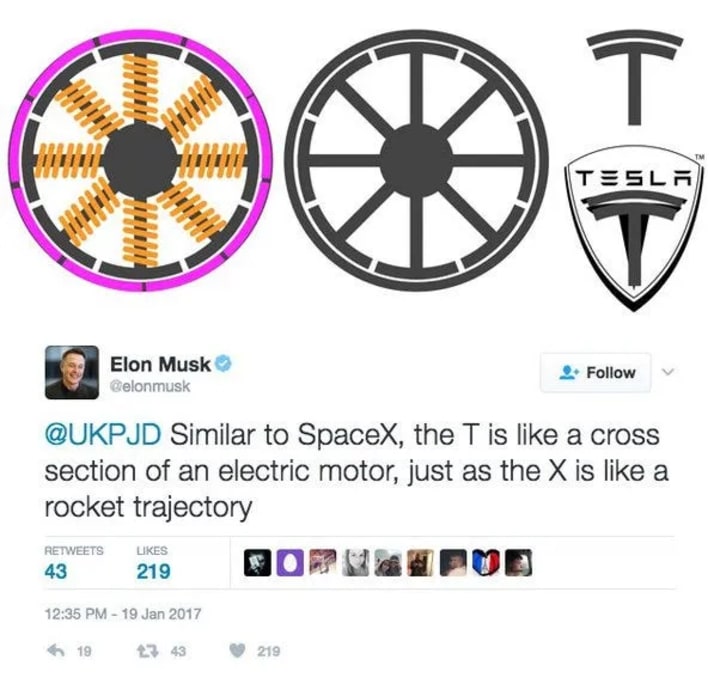
Let’s explore the evolution of the Tesla logo and unveil its true meaning. Crafted by the RO Studio, the logo initially resided within a shield but later evolved to the simplified “T”. According to a recent tweet from Tesla CEO Elon Musk, the seemingly straightforward “T” serves as a depiction of the brand’s products. Musk elaborated that the vertical line represents one of the poles extending from a motor’s rotor, while the horizontal line signifies a section of the stator. This insight sheds light on the meticulous thought process behind company logo design.
The Tesla logo was intentionally designed to promote the global adoption of electric motors, simplifying the connection to make them accessible to all. In 1882, Nikola Tesla introduced his revolutionary AC motor, inspiring the logo’s concept. This design not only honors Tesla’s legacy but also resonates with the brand’s commitment to innovation and accessibility, mirroring the ethos of logo design in Florida.
The Origins of Tesla and Its Logo

Founding and Early Days
Founded in 2003 by Martin Eberhard and Marc Trepanning, Tesla Motors aimed to disrupt the automotive industry with electric vehicles that could rival traditional combustion engines. Named after the legendary inventor Nikola Tesla, known for his work with alternating current (AC) electricity, the company sought to revolutionize how the world perceives and uses electric power.
Introduction of the Original Logo
In 2004, Tesla introduced its initial logo, designed by RO Studio. This early design featured a shield-like emblem intended to convey safety and technological prowess. However, as the company’s vision evolved, so did the logo. It transitioned from a shield to the sleek, modern ‘T’ that has become its hallmark.
The Tesla Logo Today (2004 — Present)

Design and Aesthetic
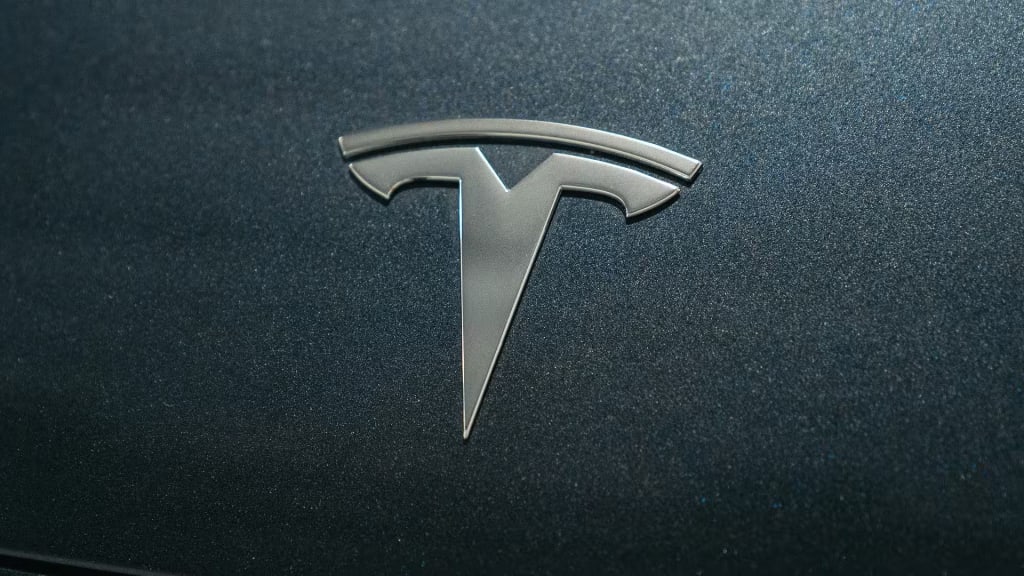
The current Tesla logo, designed in 2004, features a minimalist ‘T’ with a futuristic flair. Its sharp lines and curved edges create a dynamic, forward-looking image. The logo’s simplicity reflects the company’s commitment to clean and cutting-edge technology, while its distinctive design makes it instantly recognizable.
Symbolic Meaning
The Tesla logo’s design is deeply symbolic. The ‘T’ represents one pole of an electric motor's rotor, with the crossbar illustrating the stationary part of the motor. This connection to electric motor technology underscores Tesla's role as a pioneer in the field. Some interpretations even suggest that the logo resembles a stylized cat’s nose, adding an element of intrigue to its meaning. Despite various theories, the logo remains a powerful symbol of innovation and progress.
Tesla's Impact on the Industry
Key Milestones
Roadster Launch (2008)
Tesla’s first major achievement was the release of the Roadster, an electric sports car that demonstrated electric vehicles could offer high performance and long range. This marked a significant milestone for the company and the automotive industry.
Models and Supercharger Network (2012)
The introduction of the Model S sedan showcased Tesla’s advanced battery technology and autopilot capabilities. The same year, the company launched its Supercharger network, facilitating faster and more convenient charging for Tesla owners.
Expansion and Innovation
Tesla’s growth continued with the introduction of more affordable vehicles, solar energy products, and the establishment of global manufacturing facilities. The company’s innovative approach has solidified its position as a leader in both the automotive and energy sectors.

The Role of Elon Musk

Visionary Leadership
Elon Musk, born in 1971 in Pretoria, South Africa, has played a crucial role in shaping Tesla’s trajectory. His entrepreneurial journey began with ventures like Zip2 and PayPal before he joined Tesla in 2004. Musk’s vision and leadership have been instrumental in transforming Tesla from a startup into a major player in the global market.

As CEO and product architect, Musk has overseen the development of groundbreaking technologies and has driven the company’s expansion into new markets. His influence extends beyond Tesla, with notable achievements in space exploration through SpaceX and in digital communication with X (formerly Twitter).
Frequently Asked Questions
What Does the Tesla Symbol Represent?
The Tesla logo symbolizes an electric motor, with the ‘T’ representing one pole of the rotor and the crossbar illustrating the stationary part of the motor. This design reflects the company's focus on electric propulsion technology.
Why Is Tesla Named After Nikola Tesla?
The company is named after Nikola Tesla to honor his pioneering work in electrical engineering, particularly his development of the AC induction motor. This name reflects Tesla's commitment to advancing electric vehicle technology.
Is the Tesla Logo Inspired by a Tesla Coil?
Despite some misconceptions, the Tesla logo is not inspired by a Tesla coil. Instead, it represents an electric motor, aligning with the company’s core technology and innovations.
Who Designed the Tesla Logo?
The Tesla logo was created by RO Studio, a design firm based in New Jersey. Their design has become an iconic representation of the brand’s technological focus and modern aesthetic.
How Has the Tesla Logo Changed Over Time?
The Tesla logo has evolved from an initial shield design to a sleek, modern ‘T’. This transition reflects the company’s growth and its focus on simplicity and innovation.
Conclusion

Tesla’s logo is more than just a visual identity; it is a testament to the company's commitment to innovation, sustainability, and technological advancement. From its early days to its current status as a symbol of modernity and progress, the Tesla logo has remained a consistent and powerful representation of the brand’s mission.
While many companies periodically refresh their logos, Tesla’s emblem has endured, symbolizing its ongoing influence and success. As Tesla continues to push the boundaries of technology and sustainability, its logo remains a beacon of its achievements and aspirations. For logo designers and branding professionals, Tesla’s emblem offers a valuable lesson in creating a timeless and impactful visual identity.
About the Creator
Hannah Trucker
I'm a skilled researcher and content writer in Media. At Logo Magicians, I weave magic into brands through engaging narratives. Join me on this enchanting journey where knowledge and creativity converge.
Keep reading
More stories from Hannah Trucker and writers in Art and other communities.
The Evolution and Impact of the Disney Logo
The Evolution of the Disney Logo Over Time It’s rare to encounter someone who hasn’t been enchanted by a Disney film. If you happen to be among the minority who haven’t, I urge you to experience one after reading this article. Imagine this: the familiar melody of a Disney movie’s opening fills the air, and almost instinctively, you find yourself humming along to “When You Wish Upon a Star.” This enchantment is akin to the allure of Amazon logos, drawing people into a world of wonder and possibility.
By Hannah Truckerabout a year ago in Art
The Best Philosophy in the World Is the One You Can Live
Ask ten philosophers what the best philosophy in the world is, and you will receive at least ten different answers—possibly delivered with footnotes, counterarguments, and mild contempt for the other nine. This disagreement is not a flaw of philosophy; it is its essence. Philosophy was never meant to be a universal prescription handed down like a rulebook. It exists to help human beings live better lives. By that standard, the best philosophy in the world is not the most elegant or complex—it is the one that can be lived.
By Fred Bradford5 days ago in Art
When the Artist Becomes the Art
We like to think we can separate the art from the artist, but can we, really? Art is born from the same place as sin. It mainly emerges from conflict: between what is felt and what is permitted, between the self that is lived and the self that must be hidden. No figure embodies this tension more vividly than Oscar Wilde: a man who transformed his own contradictions into style, wit, and devastating clarity. His novel The Picture of Dorian Gray is not merely a tale of aesthetic decadence but the battleground on which this question is fought.
By Yasmine Lagrasabout 13 hours ago in Art


Comments (2)
Nicely done it.
Thanks for sharing