
The Enigma of Van Gogh’s The Starry Night
A Symphony of Turbulence and Emotion
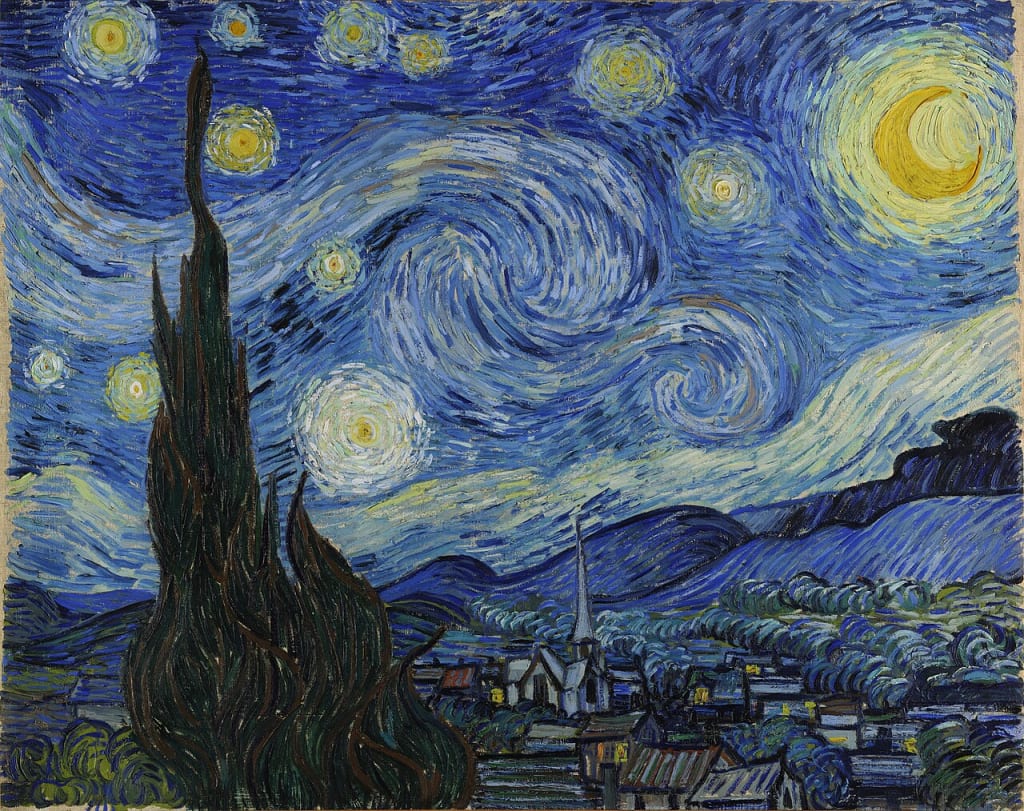
Imagine stepping into a world where the sky comes alive—a swirling cosmos of vibrant blues, pulsating stars, and a luminous crescent moon that seems to whisper secrets of the universe. Vincent van Gogh’s The Starry Night is not merely a painting; it’s an immersive experience that captures the raw energy of nature and the tumult of the human spirit. In this journey, we’ll explore the mysteries woven into every brushstroke, the scientific intrigue behind its swirling patterns, and the emotional resonance that has captivated millions for over a century.
Painted in 1889 while Van Gogh was voluntarily confined in a mental asylum at Saint-Rémy-de-Provence, The Starry Night reflects both the beauty and the turbulence of the artist’s inner world. Far from being a serene depiction of a peaceful night, the painting bursts with dynamic energy. Van Gogh’s swirling sky, dramatic contours, and luminous celestial bodies are a visual symphony that conveys both awe and melancholy.
When you look at a night sky, do you see calm or chaos?
The Turbulence of the Swirling Sky
A churning, almost otherworldly expanse of swirling blues and radiant stars. Art historians and scientists alike have been captivated by the painting’s dynamic patterns. Some researchers suggest that these swirls mirror the chaotic nature of turbulence, offering a glimpse into the laws of fluid dynamics that govern both natural and cosmic phenomena.
Van Gogh’s bold, almost frenzied brushstrokes capture the energy of the night in a way that traditional depictions of the sky seldom do. The celestial motion in the painting seems to echo the inner turmoil of the artist, whose own struggles with mental health are as much a part of this masterpiece as the stars themselves.
Imagine if you could hear the sound of the wind in a turbulent sky. What melody do you think it would have?
The Mysterious Cypress and the Village Below
Anchoring the chaotic sky is the dark, towering cypress tree—a symbol that has sparked endless debate among art lovers. Cypress trees, often associated with mourning and immortality, contrast sharply with the luminous heavens above. Rising boldly in the foreground, the tree acts as a bridge between the earthly realm and the vast, enigmatic universe.
Below the swirling sky lies a quiet village, rendered in softer tones. The juxtaposition between the serene, almost sleepy village and the explosive dynamism overhead invites a multitude of interpretations. Is Van Gogh suggesting that beneath the calm surface of everyday life lies an undercurrent of wild, untamed emotion? Or is the village a safe harbor, a reminder of stability amid the storm of the cosmos?
When you think of a cypress tree, what does it represent to you? Resilience, mystery, or perhaps the passage of time?
The Science Behind the Stars
Beyond its emotional and symbolic layers, The Starry Night has also drawn the attention of scientists. Researchers have studied the patterns in Van Gogh’s depiction of the night sky, intrigued by the possibility that his intuitive representation might align with modern theories of turbulence and chaos theory.
Some scientists argue that the swirling patterns in the painting bear a striking resemblance to the mathematics of turbulent fluid flow—a field that describes the unpredictable and seemingly chaotic motion of gases and liquids. Whether this was a deliberate nod by Van Gogh to the underlying physics of nature or a serendipitous convergence of art and science remains a subject of lively debate.
Do you think art can capture scientific phenomena? How do you relate the chaos of nature to human emotion?
Embracing the Emotional Spectrum
At its core, The Starry Night is a deeply personal expression of Van Gogh’s emotional state. The swirling sky, the luminous orbs of light, and the stark contrast between the celestial and the terrestrial all speak to the intensity of his inner life. In a moment of vulnerability, Van Gogh transformed his personal struggles into a universal exploration of beauty, despair, and hope.
Have you ever experienced a moment when beauty and turmoil intertwined? How did that moment change your perspective?
A Dialogue Between Past and Present
More than a century after its creation, The Starry Night continues to inspire and provoke debate. Its swirling patterns and vivid contrasts have not only redefined the possibilities of artistic expression but have also sparked conversations about mental health, the nature of creativity, and the interplay between art and science. The painting invites us into a dialogue—a conversation that transcends time, culture, and discipline.
Modern interpretations of The Starry Night often emphasize its timeless quality. Whether you’re an art critic, a scientist, or simply a lover of beauty, this masterpiece offers a glimpse into the boundless depths of human creativity and emotion. It reminds us that art, in all its forms, is a language that speaks directly to our souls. The Legacy of a Cosmic Vision
Like the universe, our emotions can be both chaotic and profoundly beautiful. Van Gogh’s masterpiece challenges us to embrace the full spectrum of human experience, to find order in chaos, and to discover meaning in the most unexpected places.
It is a celebration of the enduring power of art—a power that, even after more than a century, continues to illuminate the human condition in all its complexity.
About the Creator
Zohre Hoseini
Freelance writer specializing in art analysis & design. Decoding the stories behind masterpieces & trends. Available for commissions.
Keep reading
More stories from Zohre Hoseini and writers in Art and other communities.
Unveiling the Hidden Mysteries of Leonardo da Vinci’s The Last Supper
Imagine standing before a 500-year-old masterpiece that not only captures a pivotal moment in history but also hides secrets meant to challenge everything you thought you knew. Leonardo da Vinci’s The Last Supper has inspired awe, debate, and endless curiosity among art lovers, historians, and even conspiracy theorists.
By Zohre Hoseiniabout a year ago in Art
'Till Death We Do Art
There would be nothing divine in this world without art. Nature may surpass the divine to all intents and purposes, but like everything it absorbs and is absorbed by, it remains here, stuck on the surface of this world, ever-present, physically bound to the universe.
By Avocado Nunzella BSc (Psych) -- M.A.P 28 days ago in Art
How Strategic Partnerships Are Shaping the Future of Digital Growth
In today’s fast-moving digital economy, businesses are constantly seeking smarter ways to scale, innovate, and stay competitive. Strategic collaborations like allied edge partnerships are becoming essential tools for organizations aiming to unlock new opportunities without overextending resources. These alliances allow companies to combine expertise, share risks, and accelerate progress in ways that traditional growth models often fail to achieve.
By Ayush Bagwariabout 5 hours ago in Art



Comments
There are no comments for this story
Be the first to respond and start the conversation.