
The Empty Chair at Eid
A Father's Love That Never Left the Room
The smell of kheer floated in the air. The table was full—biryani, kebabs, rooh afza, and sheer khurma—just as it had always been. But there was something different this year.
There was an empty chair at the corner of the table.
Not because someone was late. Not because someone forgot. But because someone wasn’t coming back.
Ali, a 9-year-old boy with curious eyes and a spark for mischief, sat silently, playing with his spoon. His mother watched him from across the table, hiding her tears behind a fake smile.
It was the first Eid after his father died.
---
Ali’s father, Imran, was not just a father. He was a storyteller, a cricket coach, a bedtime singer, and the hero in every game Ali played. Every Eid, he would lift Ali on his shoulders during the prayer, buy him a new sherwani, and make the best chicken rolls in the world.
But this year, everything was silent. No jokes. No surprise toys. Just the smell of Imran’s old attar still lingering faintly in the hallway.
“Eat something, beta,” his mother whispered.
“I’m not hungry,” Ali replied. He looked at the chair again. Empty.
---
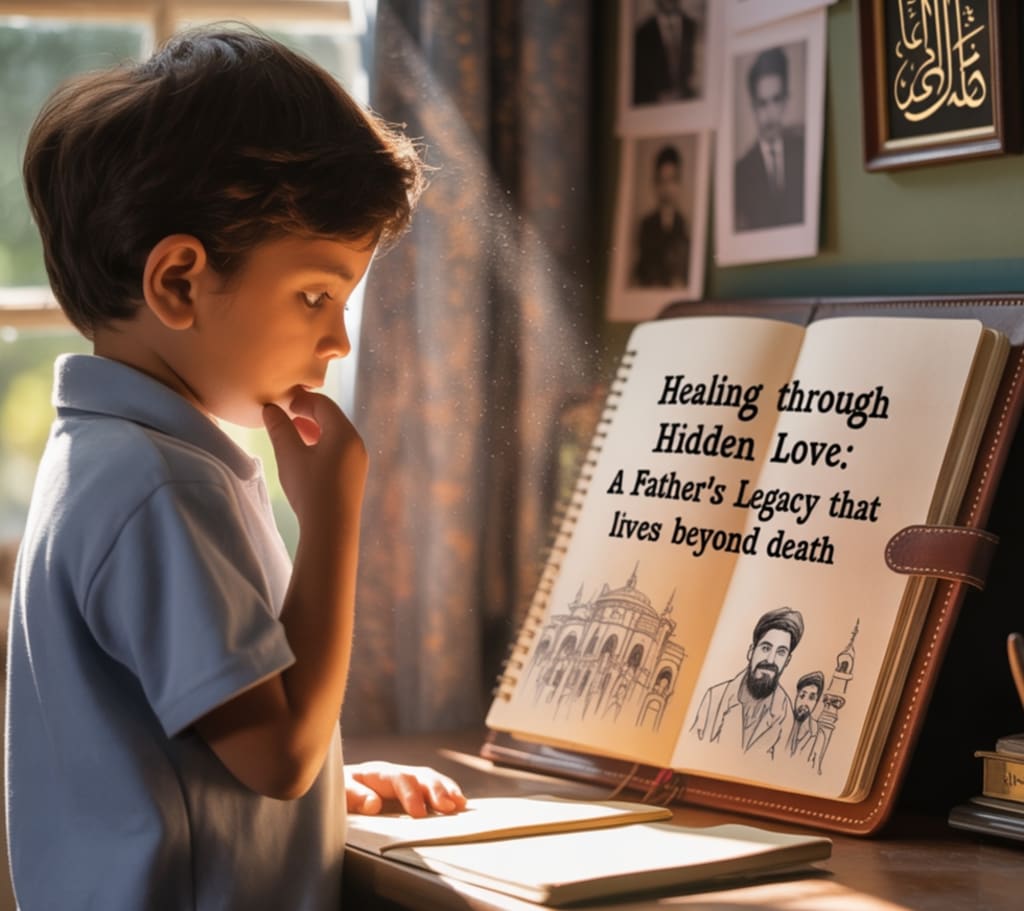
After dinner, Ali went to his father’s cupboard. His small hands struggled to open the drawer where Imran used to keep his diaries and watches.
There it was.
A brown leather notebook with the word “Ali’s Future” written on it in black ink.
Ali opened it.
> “If you’re reading this, my dear son, it means I couldn’t stay with you as long as I wanted. But I’m still here. In this room. In every dua. In every Eid.”
His eyes widened. His heart skipped a beat. His fingers trembled.
> “This notebook is your gift for every Eid after I’m gone. I’ve written stories, lessons, jokes, and secret surprises for you. One for every year. And today, your first one begins.”
Ali smiled for the first time that day.
---
He turned the page.
> “Eid is not just about joy. It’s also about sharing. So today, I want you to do something brave. Go outside. Find someone who looks sad. Give them your Eidi. And say, ‘Eid Mubarak! You are not alone.’ Then come back and tell me what happened. I’ll be listening.”
Ali stood up. He ran to his cupboard, took out the 500 rupees his uncle gave him, and put them in a white envelope.
He wore his sandals, ran past the confused guests, and out into the street.
---
He saw a boy about his age sitting near a corner. Torn clothes. No shoes. Dusty face. Holding a small paper cup, but not asking for anything.
Ali walked up, slowly.
“Eid Mubarak,” he said, handing over the envelope. “You are not alone.”
The boy looked at him in disbelief. His lips trembled. Then he smiled.
Ali ran back home, heart racing, lungs out of breath—but his soul light as air.
---
That night, Ali wrote something in his father’s notebook:
> “Baba, I did what you said. I found a boy who looked just like me, but sadder. I gave him my Eidi. And I think... I made a friend.”
He closed the diary, hugged it to his chest, and slept peacefully for the first time in weeks.
---
From that Eid onwards, it became a ritual.
Every year, Ali would open a new page of the diary. A new mission. A new challenge. A new way to spread love.
Sometimes it was planting a tree. Sometimes it was helping his mother without being asked. Sometimes it was writing letters to Allah.
But every time, it healed him.
---
Years passed. Ali grew up. So did his kindness.
The boy who once lost his father became a man who gave hundreds of fatherless children books, food, love... and sometimes, Eidi.
He started a foundation called “The Empty Chair” — dedicated to those who lost someone but still wanted to make Eid special.
On its launch day, he stood before a crowd of hundreds and said:
> “I used to cry looking at an empty chair. But now I know—my father never really left. He’s here, in this diary. In every smile you give. In every child you hug. In every heart you heal.”
---
Now, every Eid, thousands of children receive envelopes that say:
> “Eid Mubarak. You are not alone.”
And in every home where there’s an empty chair, a small light begins to glow.
Because love, when written in the ink of memories, never dies.
It only multiplies.
---
Moral:
Even after death, love can live on—through kindness, legacy, and a heart that chooses to give instead of grieve.
About the Creator
Keep reading
More stories from Khalid khan and writers in Art and other communities.
Sparkle Within
In the quiet hills of Harrogate, England, in the mid-18th century, a local doctor dipped his cup into a mineral spring and took a sip. The water danced on his tongue — sharp, lively, and unlike any still water he had ever tasted. That first fizz, naturally carbonated from the earth, began a centuries-long fascination with what we now call sparkling water.
By Khalid khan7 months ago in Art
The River and the Drops
High in the mountains, where no one watched and no one applauded, tiny drops of water slipped from melting snow. Each drop was small, almost invisible, and carried a quiet fear within itself. They began their journey without knowing where they were going, only knowing that they were moving away from where they began.
By Sudais Zakwan4 days ago in Art
The Uncopiable Human Wit to Write
We all have been in that spot at least once in our schooldays where we have been wringing our brains off to curate written articles of some sort until our soul-less friends were born. At just four years old, our beloved soul-less, metallic, digital assistant who is always by our side when we turn on our computers and smart phones, will be doing much more than curating written content for us all, if you know what I mean.
By Sound Savvy3 days ago in Art


Comments
There are no comments for this story
Be the first to respond and start the conversation.