
The Dance of the Tastuanes: When the Past Demands a Step
When the spirits of the hill call for their dance. (Emphasizes the mystical, the connection to the earth, and ancestral forces).

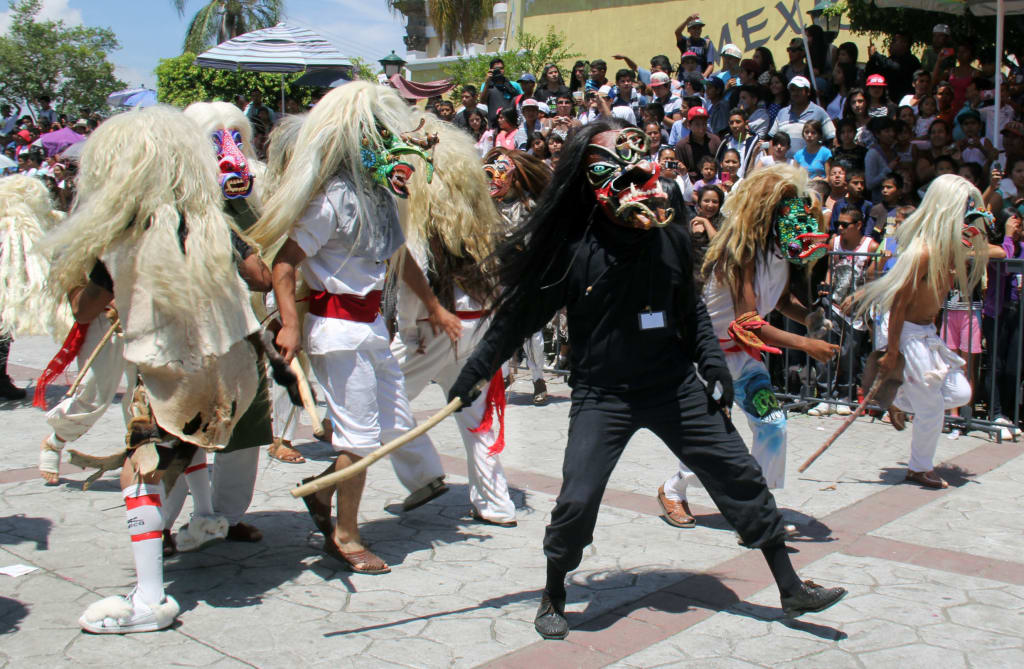
Everything in Suchitlán smelled of the past. The air thick with humidity and damp earth, the sweet, penetrating aroma of pinole and atole floating from kitchens, and above all, the insistent, monotonous sound of the drum. For Luis, seventeen years old with a spotty 4G connection, that beat was the pulse of a town refusing to wake from its dream. It was the prelude to the Dance of the Tastuanes, the big festival, and he was fed up.
His grandfather, Don Ceferino, was the Captain of the Tastuanes. His father, the second-in-command. In their small adobe house, the carved wooden masks with their grotesque expressions and ixtle beards weren't folkloric decorations; they were additional inhabitants. They watched Luis from the walls, their empty sockets filled with silent reproach. "You dance this year," was the phrase he'd heard since January. "It's an honor," "it's in your blood," "it's for the town." For Luis, it was a ridiculous costume, an antiquated jump and shout for tourists with cameras. He dreamed of code, algorithms, a life beyond the hill that enveloped Suchitlán like a protective and suffocating arm.
The argument erupted the eve of the festival. "I'm not dancing. I don't have to. It's your thing, for the old folks." The words, hard as stones, fell on the kitchen table. Don Ceferino didn't shout. He just nodded slowly, his eyes squinting as if examining a distant terrain. "The hill doesn't need your permission, boy. Only your respect. And if you don't give it, it will take it."
That night, as the town prepared and the first rockets lit up the sky, Luis took refuge on the hillside, away from the bustle. From there, Suchitlán was a necklace of twinkling lights surrounded by the impenetrable darkness of the forest. The sound of the drum, distant but clear, hammered against his eardrums. He closed his eyes, wishing it were the bassline of an electronic song, but it was just that: a primitive, insistent pulse. Exhaustion overtook him and he fell asleep, lulled by the very sound he detested.
It wasn't a dream. It was a violent displacement, a tear in the fabric of reality. A smell of ocote pine and dry earth, not humidity, woke him. He was no longer on the hillside. He was in the center of an unrecognizable Suchitlán. The concrete houses were gone. There were only huts of wattle and daub with palm roofs. The people, dressed in rough cloth, looked at the sky in terror. There were no tourists, no soda stalls. There was a palpable fear, a silence broken only by the moan of the wind. And in front of him, dancing in a perfect circle around a bonfire, were the Tastuanes. But they weren't his neighbors in costume. They were tall, their movements defied gravity, and the masks weren't carved wood: they seemed fused to their faces, alive. Their feet, clad in worn huaraches, struck the earth with a force that resonated in the bowels of the world.
They were the spirits. The ancient dancers. And they had brought him here.
A Tastuán broke from the circle. His mask, more weathered than the others, had eyes glowing like hot coals. Luis recognized the posture, the way he tilted his head. It was Don Ceferino, or the spirit that once inhabited his grandfather and all the Captains before him.
"You have broken the circle," said the voice, which came not from the mask but from the air itself, rough as stone on stone. "Since the first man and the first woman learned the step of the jaguar and the cry of the wind to drive away the shadow that dried the rivers, the dance has continued. You, blood of this blood, scorn it. And the shadow returns."
Luis wanted to speak, to argue, but the words died in his throat. He pointed towards the hill. A dark mist, thicker than the night, was slowly descending, withering the plants in its path. He felt a cold that froze his bones. It wasn't a climatic cold; it was the cold of forgetfulness, of disconnection.
"This is the curse you think is a tale," roared the spirit-Tastuán. "It is not a punishment, it is a consequence. Disconnection. The town that forgets its rhythm loses its harmony with the land. The dance is not a spectacle. It is a conversation. A pact. And you have remained silent."
Luis was pushed, not with hands, but by the force of the collective gaze of the spectral dancers, into the center of the circle. The dark mist was now licking the edges of the village. Panic, an ancestral panic that wasn't his alone, invaded him. "I don't know how to dance! I don't know what to do!" he shouted.
"You don't dance with your feet, you dance with purpose!" replied another spirit, his voice like the creak of an ancient tree. "You know the step. You have heard it all your life in the rain, in the creak of branches, in your own heart. You forgot how to listen."
The first beat of the phantom drum thundered. Luis felt the vibration in his chest. He closed his eyes, desperate. In his mind, against his will, images arose: his grandfather carving a mask, explaining each symbol: the broken line for rain, the circle of the sun, the spiral of time. He saw his father, young and sweaty, practicing the exhausting jumps after a day in the fields. He saw the community gathered, not as spectators, but as participants, weaving a web of glances, applause, offerings. He saw that "tradition" wasn't a museum, it was a river. And he, from the bank, was drying up.
Another drumbeat. And another. The rhythm was the same as always, but now Luis didn't hear it from the outside. He felt it as a call. A code. An ancestral algorithm to recalibrate an unbalanced world.
With an effort that burned his muscles and his shame, Luis lifted a foot. And he struck it against the dusty earth. It wasn't a perfect step, not even coordinated. It was clumsy, ungainly. But it was intentional. It was a response.
Instantly, something changed. The dark mist wavered. The spirit-dancers redoubled their energy, their movements became more vigorous, and for the first time, Luis thought he saw something like a smile in the carved grimaces of their masks. He wasn't alone. He was being held by the circle. The dance wasn't about being perfect; it was about being collective.
Each step he took, clumsy but filled with a new understanding, was like untying a knot inside him. He released the disdain, the arrogance of one who believes the future is only on a screen. He released the disconnection. And with each untied knot, the mist receded a little more. He wasn't defeating a monster with a sword; he was repairing a fabric with his will and his sweat. It was magic, but not of wands or spells. It was community magic: the invisible force generated when a group acts with a unified purpose, inherited and renewed.
Dawn found Luis exhausted, trembling, covered in dust and dried tears. He was no longer in the mythical past. He was back on the hillside, facing the Suchitlán of electric lights. But everything was different. The sound of the drum from the real festival reached him, and it was no longer an annoying hammering. It was a heartbeat. His heartbeat.
He ran down to the town. He arrived at the main square just as the dance was reaching its climax. He saw his father and grandfather, sweaty and magnificent under the weight of the masks and the responsibility. Without thinking, Luis pushed his way through the crowd. There was no costume for him. No mask. But he positioned himself at the edge of the sacred circle of dancers. And, looking into his grandfather's eyes through the sockets of the mask, he began to move.
He didn't imitate the complex steps. He couldn't. But his body now moved with the rhythm of the drum, with the cadence of the community. He jumped when the circle jumped, he turned when the collective turn swept him along. He was no longer a spectator. He was a participant. A cog that, finally, fit into the ancestral machinery.
Don Ceferino, under the Captain's mask, took a step out of the choreographed formation. He approached Luis, and in a move that broke all protocol, extended his hand, covered by an old leather glove. Luis took it. And in that contact, he felt the passage of centuries, of sweat, of faith, of an unbreakable pact with the land. He gently pulled him into the circle. The other dancers made space. Luis, the fed-up boy, was now inside.
The magic wasn't a blinding flash. It was subtler and deeper. It was the smile in his mother's eyes, crying in the audience. It was the firm nod from his father. It was the feeling that the hill, in the distance, breathed a sigh of relief. The circle—of the dance, of the community, of time—had closed.
That night, Luis didn't dream of algorithms. He dreamed of roots. And he knew, with a certainty that filled his chest, that his future wouldn't be about fleeing Suchitlán, but about building a bridge. Maybe he'd study engineering, or design. But he would use that knowledge to document the songs, to 3D model the masks before their meanings were lost, to create an app that told the real story of the Tastuanes. Not to freeze tradition in a digital archive, but to feed the river with a new tributary.
He had finally understood. Modernity wasn't the enemy of tradition. The enemy was disconnection. True community magic didn't reside in blindly following the steps, but in understanding their inner rhythm and having the courage to add, with humility and respect, the beat of your own time. The Dance of the Tastuanes hadn't ended. It had just gained a new dancer. And the drum, that heart of wood and skin, would keep beating, reminding everyone that sometimes, to find your place in the world, you must first learn to dance with your ghosts.
About the Creator
diego michel
I am a writer and I love writing
Keep reading
More stories from diego michel and writers in Art and other communities.
The Whisper of the Volcano: When the Earth Remembers its Children
There is a silence that precedes knowledge, a void of meaning that dwells in the most familiar places. For Mateo, a young farmer from Comala, Colima, that silence had the shape of the horizon. Every dawn, as he went out to the furrows of his cornfield, his gaze met, immutable and powerful, the silhouette of the Volcano of Fire. It was not a landscape; it was a mute life companion, a sleeping giant whose breath was the wind that rocked the corn cobs. He had seen it roar, spewing orange fumaroles in the distance; he had seen it covered in an improbable white mantle in December. But the volcano, to Mateo, was a geographical fact, a datum of the territory like the river or the hill. Until the silence broke, and the earth began to speak to him.
By diego michel7 days ago in Fiction


Comments
There are no comments for this story
Be the first to respond and start the conversation.