
The Whisper of the Volcano: When the Earth Remembers its Children
An Introduction to the Memory of the Earth

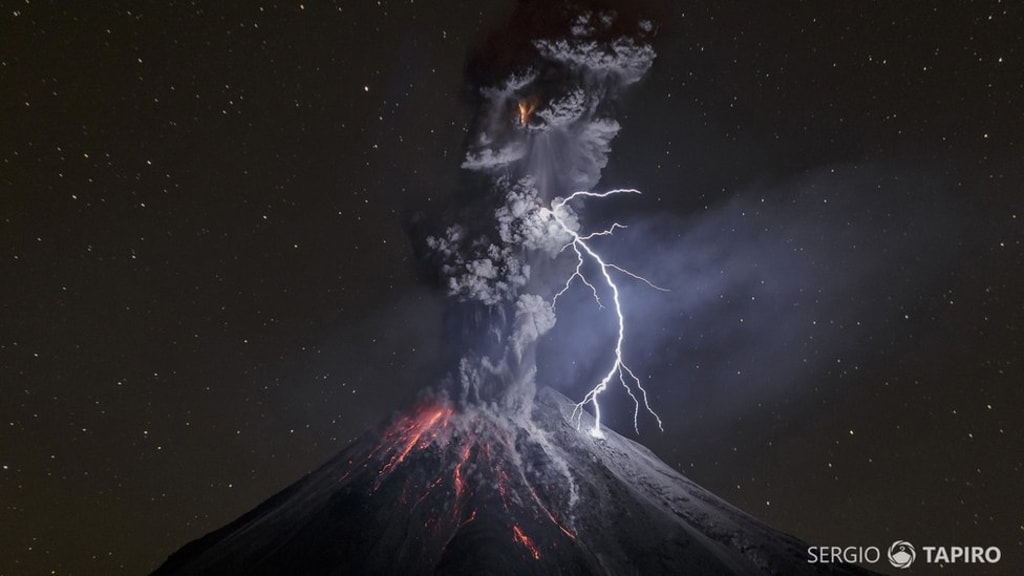
There is a silence that precedes knowledge, a void of meaning that dwells in the most familiar places. For Mateo, a young farmer from Comala, Colima, that silence had the shape of the horizon. Every dawn, as he went out to the furrows of his cornfield, his gaze met, immutable and powerful, the silhouette of the Volcano of Fire. It was not a landscape; it was a mute life companion, a sleeping giant whose breath was the wind that rocked the corn cobs. He had seen it roar, spewing orange fumaroles in the distance; he had seen it covered in an improbable white mantle in December. But the volcano, to Mateo, was a geographical fact, a datum of the territory like the river or the hill. Until the silence broke, and the earth began to speak to him.
The first whispers came in moments of absolute stillness. Not during storms or tremors, but in the heavy siesta, when the three o'clock sun crushed the shadows. It was a sound that seeped through the edges of reality, like the distant murmur of an underground river, or the crack of a branch stepped on by an ethereal weight. Mateo attributed them to fatigue, to "sun on the head," as his grandmother said. But they persisted. They grew sharper in the orchard, next to the old grinding stone that had been there forever. They were not words in Spanish, but something more primal: a cadence, an intention, a call that operated directly on his most intimate nerve, the one connecting instinct with memory.
The Path of the Ancestors: The Search That Was Not a Search
The guidance was not a clear map, but a subtle inclination of the heart. Mateo found himself going to chop firewood in a different place than planned, straying from the path to the irrigation ditch as if a soft hand were tugging his sleeve. One afternoon, after a rain that washed the earth, the current of his steps led him to a small ledge on the mid-slope of the volcano, a place known as "El Paso del Venado" (The Deer's Pass). There, the whisper transformed into a constant hum, a vibration that seemed to emanate from the ground. There were no signs, no crosses, no stacked stones. Only the damp earth and the twisted roots of a guava tree clinging to the rock like veins in the air.
It was under that tree, moved by an impulse he could not name, that he began to dig. Not with the fury of a treasure hunter, but with the delicacy of an archaeologist of the soul. At half a meter deep, his fingers brushed not stone, but smooth ceramic. His heart pounded his chest with the force of a ritual drum. With a father's care, he unearthed a globular vessel of baked clay, of an earthy ochre color. It was intact, sealed with a flat slab secured with resin hardened by the centuries.
Breaking the seal, an aroma of dry copal and sacred earth flooded the air. Inside, on a bed of fine volcanic ash, lay the treasure of a nameless people: a bead of polished jade, green like the mountain's core; a small obsidian blade, its black edge gleaming with a million captured stars; a seashell pendant, from a distant ocean, testimony to ancient trade routes; and, in the center, an anthropomorphic figurine, just a hand-span tall, depicting a seated man with his hands on his knees. Its face had no features, only an infinite serenity.
The Revelation: The Shared Pulse of Blood and Earth
Upon taking the clay figurine, the vision was instantaneous and total. It was not a dream; it was a remembering.
Mateo ceased to see the volcano's slope and saw himself, and yet not himself, forming part of a circle of men and women dressed in skins and rough cloth. The night was deep, illuminated only by the embers of a fire and a dazzling starry mantle. He felt the cold of the altitude, the smell of burning herbs (copal, yes, the same), and a solemnity that weighed on his chest. He, or the one who carried his essence, held the same figurine. The community sang in a guttural and melodic tongue that his ears did not understand, but his heart did. It was not a song of petition, but of recognition. Of conversation.
He understood then. The volcano was not an angry god to be appeased. It was Papa Tlakatepetl, the "Father Mountain," a living, conscious being, a latent heart at the center of the world. The offerings were not bribes; they were parts of a whole. The jade represented water and life, the obsidian fire and vision, the shell wind and journey, the figurine man and his place. It was a pact of equilibrium: "We honor you as the source, you sustain us as the soil. Our blood is your water, our breath your wind. If we forget this, the balance will break."
The vision faded, leaving in Mateo a certainty as solid as rock: he was blood of that blood. His common surname, his family history forgotten for three generations, did not matter. Lineage sometimes runs through channels deeper than surnames; it is transmitted in the way of walking upon the earth, in the instinctive respect for the cycles, in the capacity to listen. The whispers were not for everyone. They were for the descendant who, even without knowing the history, still held in his essential code the key to hearing it.
The Warning: Imbalance and Modern Deafness
But the vision did not end with the ritual. It also showed the rupture. He saw, as in a quick and painful flash, how the stone circles were abandoned. How the language of the song was silenced. How the volcano went from being an interlocutor to a "resource," an obstacle, a spectacle. He saw the logging, the erosion, the crops forced higher than wise, the houses built on ancient lava flows. He saw the arrogance of man who believes himself owner and not son.
And in the heart of the figurine, in that moment of the vision, the warning resonated, not with anger, but with the profound sadness of a father whose child is lost: "The fire that warms also purifies. The silence you do not listen to will become a scream you cannot ignore. I do not grow furious. I simply am. When the balance is broken, I readjust. And my readjustment, for that which is no longer part of me, is catastrophe."
The volcano's fury was not a punishment. It was a consequence. It was the earth reclaiming, with the brutal force of the elemental, the dialogue that had been denied to it. The eruption was not revenge; it was the final word of a being whom they had refused to hear for centuries.
The New Harvest: The Legacy that Blooms in the Present
Mateo returned home with the offering, but he was no longer the same. The young farmer was now a bridge. He did not keep the find to sell or hide it. He showed it to the elders of the community, those who still held shreds of stories in Nahuatl. Their eyes, clouded by time, shone with immediate recognition. "It is from the antiguos (the ancient ones)," murmured Don Aurelio, the eldest. "They spoke with the mountain."
Mateo did not proclaim himself a shaman or leader. His mission was more humble and profound: to reintegrate the knowledge. He replanted native trees on the slope. He began to organize, with the other farmers, a small silent ceremony at the start of each planting season, not to "ask for," but to "give thanks" and "remember" the pact. He spoke to his children, not of fire monsters, but of "Grandfather Fire," a living being deserving of respect. He turned his milpa into an example of respectful agriculture, rotating crops, leaving land fallow, using the ancient gravity-fed irrigation systems that seemed to better understand the mountain's water veins.
The whisper did not disappear. But it was no longer a guide to a buried secret. It transformed into a background hum, into the harmony of a restored dialogue. Mateo learned to hear it in the song of birds at dawn, in the crackle of thirsty earth receiving the first rain, even in the distant rumble of the crater. It was no longer a terrifying mystery; it was the voice of his own lineage, the murmur of the earth's blood, reminding him at every instant that he was not on the world, but of the world.
Conclusion: The Whisper that Calls Us All
Mateo's story is a fiction rooted in an ancestral truth. In a hyper-connected world, we have lost the most essential connection: the one that binds us to the ground we walk on, the water we drink, the air we breathe. We have stopped listening to the whispers of the earth, interpreting every drought, every flood, every extreme event as a random misfortune or mere climate data, never as the final word of a broken dialogue.
The Volcano of Fire, and every mountain, every river, every forest, has a story to tell. A whisper not made of words, but of signs, intuitions, the wisdom that lies in collective memory and well-attended instinct. The "secret" Mateo discovered is not an esoteric arcana; it is the simplest and most forgotten principle: we are nature. Our lineage does not trace back only to papers and surnames, but to the first green sprout, the first eruption that formed continents, the primordial water.
The warning is not a prophecy of fatalism, but an urgent invitation to listen. To relearn to walk without harming, to harvest without exhausting, to build without violating. To remember that, before being citizens of a country, we are children of a living Earth. Perhaps we do not all hear literal whispers in the wind, but we can all choose to become part of the circle again, to honor the pact. The future is not written by ignoring the Earth, but by finally listening to its ancient and wise voice. The volcano's whisper is, in the end, the pulse of our own origin, asking us to come home.
About the Creator
diego michel
I am a writer and I love writing
Keep reading
More stories from diego michel and writers in Fiction and other communities.
The Ghost of Hacienda de Nogueras: Forbidden Love and a Mystery to Solve
Hacienda de Nogueras, now converted into a serene cultural center in the heart of Colima, holds within its adobe walls and colonial arches a secret that transcends time. I first arrived on an October evening, as an art student seeking inspiration for my final project. What I didn't imagine was that, in those hallways where tourist visits and cultural workshops now echoed, I would find the traces of a tragic love that still awaits its redemption.
By diego michelabout a month ago in Fiction
The First Rainbow Baby
Pitter-patter, pitter-patter. The rain fell in rhythmic splatters, slowly slowing, but still constant. Mira rolled onto her side pulling the blanket tight against her ears, but still she could hear chitter-chatter and scurrying feet of the creatures that refused to sleep in the lower decks.
By A. J. Schoenfeld3 days ago in Fiction
A Transparent Look at Vocal Challenges and Top Stories
Almost three years ago, we shared a resource article that served as a place for people to suggest new challenge prompts. We thought it would be a good idea to refresh that thread, and take the opportunity to answer a few common questions about top stories, how challenges are judged and how submissions are reviewed.
By Vocal Curation Team4 days ago in Resources



Comments
There are no comments for this story
Be the first to respond and start the conversation.