
The Boat of Charon
A Mythic Journey in Paint and Shadow

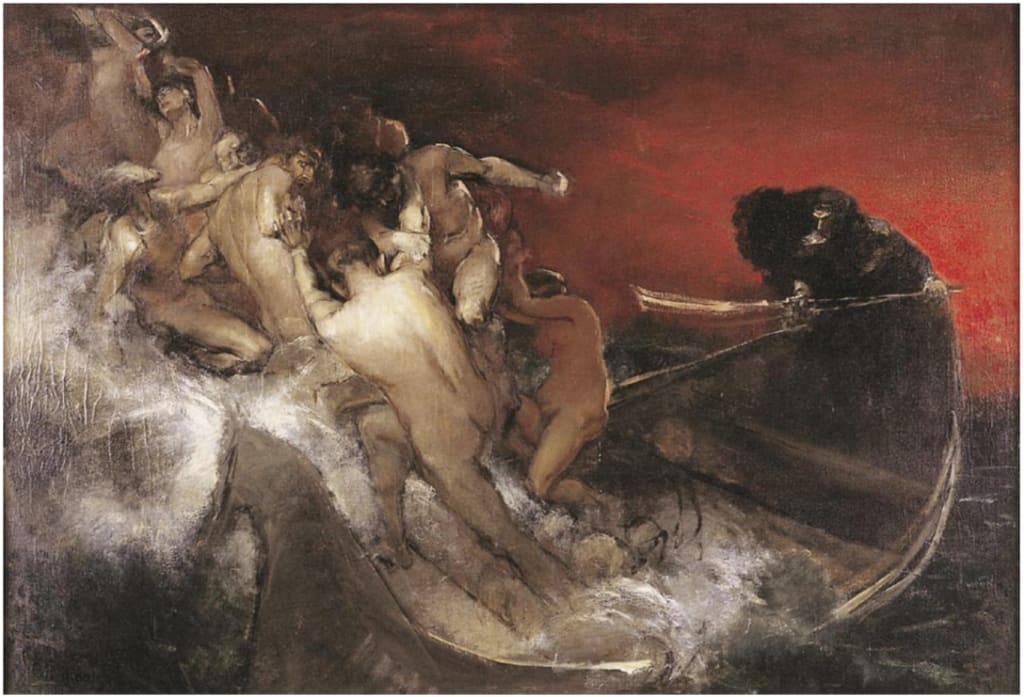
“No cries. No pleading. Only the sound of water and the oar that divides it.”
Across a spectral canvas of mist and myth, a solitary figure rows toward the unknown. His passengers—silent, wan, resigned—are not alive, but not quite dead. Their journey is final. Their guide is ancient. And the river? It has no name that the living can speak without shivering.
This is Félix Resurrección Hidalgo’s 1887 masterpiece, The Boat of Charon. A painting that has slipped beneath the radar of many mainstream surveys of Western art, yet remains one of the most ghostly, profound meditations on death, fate, and mythology in 19th-century painting.
But this is not merely a depiction of a Greek myth.
It is an allegory for colonial anxiety, spiritual liminality, and the universal dread of the border between life and death.
Let’s step into the shadows.
Who Was Charon?
In Greek mythology, Charon is the ferryman of Hades, the underworld. He rows the newly dead across the river Styx (or Acheron, in some versions) — but only if they’ve paid the fare, traditionally a coin placed in their mouths upon burial.
If not, their souls linger. Wandering. Restless.
He’s not evil. He’s not cruel. He is, in the most chilling way possible, neutral.
He simply rows.
And those who enter his boat do not return.
Hidalgo’s Vision: Myth through a Colonial Lens
Félix Resurrección Hidalgo (1855–1913), one of the greatest Filipino painters of the 19th century, painted The Boat of Charon not in the Philippines, but during his European period — a time when classical subjects, allegory, and mythological grandeur were considered the apex of academic painting.
But Hidalgo’s Charon is no idealized heroic scene.
Instead, this is myth made spectral. Death rendered quietly suffocating. The waters are black. The sky is barely there. Light exists, but not to comfort — it only serves to expose the inevitability of the journey.
The figures in the boat do not scream.
They are slumped, surrendered, faceless in their grief. The emotional register is muted, which somehow makes it even more devastating. Their fate is sealed, but not yet fulfilled.
And Charon — the ancient boatman — is neither demon nor hero.
He is simply doing his job.
Silence as a Weapon
What makes this painting so haunting?
It is the silence.
No drama. No confrontation. Only a slow crossing into something that cannot be named.
Art historian Guillermo Tolentino once noted that Hidalgo’s works carry “a sobriety that makes them eternal.” This is especially true here. The painting does not shout.
It whispers, and that whisper is more terrifying than a scream.
We are not witnessing action. We are witnessing surrender.
And isn’t that how most of us fear death?
Not as violence — but as inevitability.
Between Cultures, Between Worlds
Hidalgo was a colonial subject of Spain. His classical education came from Europe. Yet he infused many of his works with the ambiguity, melancholy, and anxiety of the colonized.
In this painting, we are looking not just at a Greek myth, but at a soul adrift between cultures. Between power and subjugation. Between faith and doubt.
You might even argue the passengers in Charon’s boat are not just souls of the dead — but the colonized, ferried by systems older and stronger than they can resist.
There is no heroism here. No battle to be won. No glory to reclaim.
Only passage.
A Companion in the Shadows: Hidalgo and Luna
Hidalgo’s painting is often paired in contrast with another great Filipino work: Juan Luna’s Spoliarium.
Where Spoliarium is massive, bloody, and dramatic — a brutal Roman coliseum aftermath soaked in nationalistic symbolism — The Boat of Charon is internal, psychological, and mythic.
They represent two sides of grief:
• Spoliarium is the grief that howls and fights.
• Charon is the grief that accepts and floats.
Both are necessary. Both are powerful. Both are devastating.
Why This Painting Still Matters
In an age of spectacle and noise, Hidalgo’s Boat of Charon reminds us of the quiet truths:
• That death is not always violent, but always final.
• That myth is not old — it is eternal.
• That the border between life and what comes next is not a door, but a river.
And we are all, in some way, passengers.
Perhaps the painting is not just about dying.
Perhaps it is about waiting — for closure, for justice, for meaning. And in that waiting, we drift farther from who we were, toward what we cannot yet name.
One Last Look
If you ever see this painting in person (it is part of private and institutional collections in the Philippines and Madrid), stand before it in silence.
Let it speak to you.
Not with words, but with that cold, endless whisper of the oar cutting through still water.
About the Creator
Zohre Hoseini
Freelance writer specializing in art analysis & design. Decoding the stories behind masterpieces & trends. Available for commissions.
Keep reading
More stories from Zohre Hoseini and writers in Art and other communities.
💔 The One Glance That Lost Everything
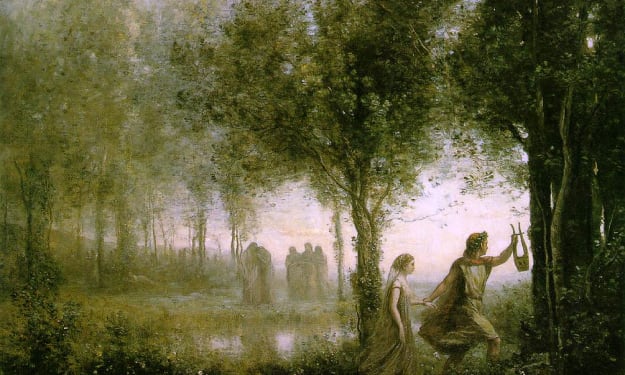
They say the dead don’t return. But one man tried. Orpheus — the poet, the singer, the man whose music could move mountains — once walked into the underworld for love. Not to conquer. Not for glory. But for Eurydice. His bride. The woman who died too soon, taken by a snake’s bite before their life together could begin.
By Zohre Hoseini8 months ago in Art
'Till Death We Do Art
There would be nothing divine in this world without art. Nature may surpass the divine to all intents and purposes, but like everything it absorbs and is absorbed by, it remains here, stuck on the surface of this world, ever-present, physically bound to the universe.
By Avocado Nunzella BSc (Psych) -- M.A.P 26 days ago in Art
Modern Wall Decor Ideas with Bathroom Wallpaper and Kitchen Wallpaper
Creating Beautiful Interiors with Wall Decor A well-designed home begins with thoughtful wall decor choices that reflect both style and personality. Walls are often the largest surfaces in any room, so the way they are decorated has a major impact on the overall atmosphere of a space. From minimalist textures to bold decorative patterns, modern wall design has evolved into an important part of interior styling. By choosing decorative elements that complement furniture, lighting, and color palettes, homeowners can create a balanced and inviting environment that feels both comfortable and visually appealing.
By Wallanza Wallpaper2 days ago in Art



Comments
There are no comments for this story
Be the first to respond and start the conversation.