
The Artist Who Painted Like He Was Tearing Off His Skin
When the Canvas Bleeds: The Tragic Genius of Egon Schiele

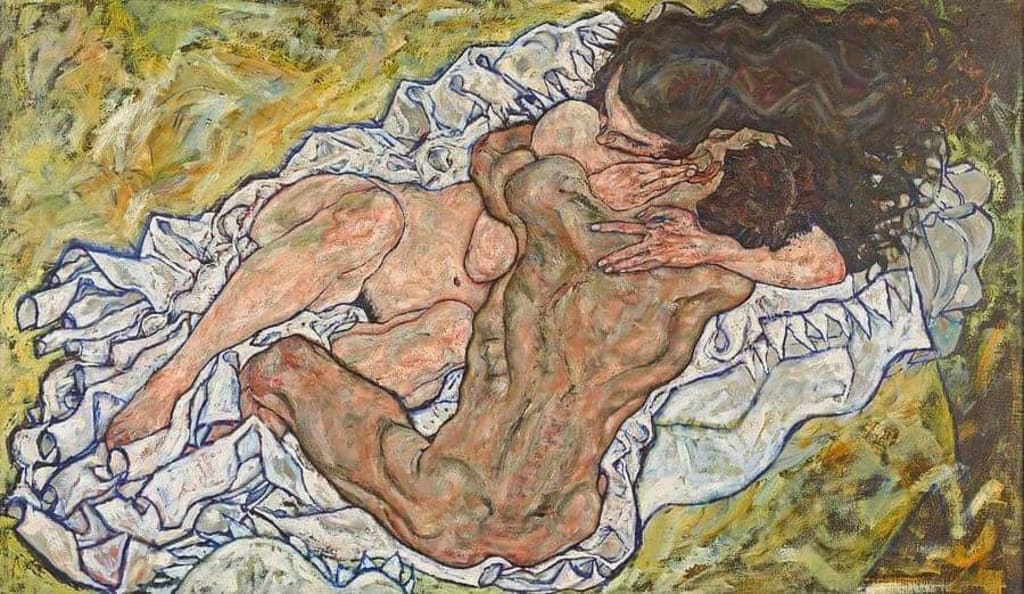
His lines are jagged. His figures distorted. His gaze, unflinching.
To many, Egon Schiele’s art feels raw, uncomfortable — even grotesque. But step past the shock, and you begin to see what he was really doing: turning the human body into a diary. A confession. A wound.
Schiele didn’t paint to please. He painted to expose — to lay bare the aching, erotic, existential truth of what it means to be alive.
And that’s why, over a century later, his work feels more alive than ever.
A Short, Burning Life
Born in 1890 in Austria, Schiele lived only 28 years.
He studied under Gustav Klimt, who quickly recognized the young artist’s obsessive talent. While Klimt bathed his subjects in gold and sensuality, Schiele stripped his bare. He abandoned traditional beauty for something rawer — something human.
By the time he was 21, Schiele had already developed his signature style: angular figures, hollow eyes, twisting limbs, and lines that look like they’re trying to escape the paper.
In just a decade, he produced over 3,000 works.
Then, in 1918, he died of Spanish flu — just three days after his pregnant wife.
Eroticism as Exposure
Schiele is often called “pornographic.” But this misses the point.
His erotic drawings — often of himself, lovers, or young models — weren’t made to titillate. They were confessions. Investigations. Prayers, even.
Look at Seated Male Nude (Self-Portrait). The figure isn’t heroic. It’s almost skeletal, contorted. His face is haunted. It’s not just a nude — it’s a psyche on canvas.
Schiele painted desire the way someone writes in a journal: urgently, vulnerably, and without censorship.
In a society that prized appearances and repressed emotion, Schiele dared to say: this is what we are beneath the surface — longing, terrified, defiant, and divine.
Line as Language
More than color or realism, Schiele’s true weapon was his line.
His figures are built from lines that quiver with anxiety. They’re not smooth — they’re searching, digging. His use of negative space, thin bodies, and harsh outlines gives the sense that his subjects might vanish at any moment.
He didn’t paint people to look like people. He painted what they felt like.
The skin might be pale and flat, but the expression? Electric.
Death Is Always There
Even in Schiele’s most erotic work, death hovers.
He drew himself dying. He painted lovers with skull-like faces. He sketched rotting flowers next to youthful nudes.
This wasn’t just macabre performance. Schiele had lost his father young, lived through war, and watched a pandemic steal his own family. He knew death — and painted as if trying to outrun it.
But he didn’t romanticize it. He painted its presence honestly, side by side with sex, with beauty, with longing. As if to say: all of it, all at once — that’s life.
Why Schiele Still Cuts Deep
In an age of filtered selfies and digital veneers, Schiele’s work confronts us with a truth we rarely see:
The body is not always beautiful. But it is always real.
His work isn’t meant to comfort. It’s meant to awaken — to remind us that feeling too much is not a flaw, but a fire.
Schiele didn’t just make art. He bled onto paper. He gave us the raw material of being — unfiltered, electric, alive.
And that’s why we still look. Even when it hurts.
About the Creator
Zohre Hoseini
Freelance writer specializing in art analysis & design. Decoding the stories behind masterpieces & trends. Available for commissions.
Keep reading
More stories from Zohre Hoseini and writers in Art and other communities.
The Brutal Beauty of Caravaggio: How a Killer Changed Religious Art Forever
When you first see a Caravaggio painting, it doesn’t whisper. It grabs you by the throat. His figures aren’t floating angels or marble-skinned saints. They’re gritty men with dirt under their nails, women with haunted eyes, and blood that actually looks wet. And more than anything — there is light. Blazing, theatrical, confrontational light. Light that exposes more than just form. It exposes truth.
By Zohre Hoseini9 months ago in Art
The Best Philosophy in the World Is the One You Can Live
Ask ten philosophers what the best philosophy in the world is, and you will receive at least ten different answers—possibly delivered with footnotes, counterarguments, and mild contempt for the other nine. This disagreement is not a flaw of philosophy; it is its essence. Philosophy was never meant to be a universal prescription handed down like a rulebook. It exists to help human beings live better lives. By that standard, the best philosophy in the world is not the most elegant or complex—it is the one that can be lived.
By Fred Bradford4 days ago in Art



Comments (1)
Schiele's work is a powerful reminder that art isn’t about prettiness; it’s about truth. His raw, unflinching lines lay bare the reality of what it means to be human — with all its beauty, pain, and vulnerability.