
The Accidental Artist
How One Bored Banker Painted His Way to Unexpected Fame

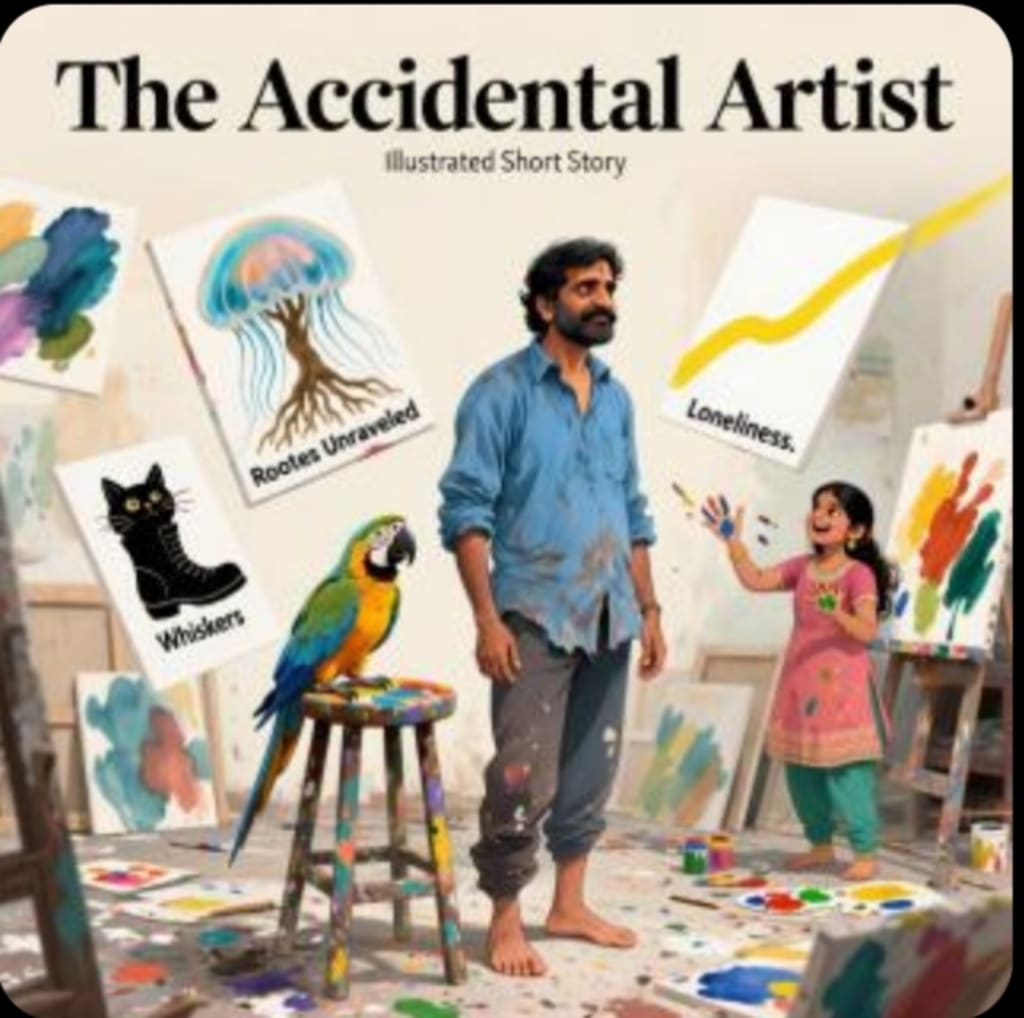
Vikram Sharma had never considered himself creative. Not really. Sure, he once tried making samosas from scratch and nearly set off the smoke alarm, but that was more chaos than artistry. At forty, he worked at a bank, wore the same shade of blue shirt every Monday, and found excitement in perfectly aligned sticky notes.
His idea of rebellion was skipping sugar in his chai.
Then came his niece, Pari, with a gift wrapped in newspaper from last week’s cricket scores. “Happy birthday, Uncle! Mama says you need a hobby so you stop sighing during family dinners.”
Inside was a wooden box filled with tubes of paint, brushes with fancy wooden handles, and a blank canvas so white it looked judgmental.
Vikram smiled. “Oh, I can’t paint. I once tried repainting the kitchen wall and Auntie Meena said it looked like a frog threw up.”
Pari shrugged. “Just try. Even mess can be art.”
That Sunday, after three episodes of a cooking show where people cried over soufflés, Vikram opened the box. He stared at the brushes like they were tiny alien tools. He squeezed out some green paint, dipped a brush, and began painting a tree.
Three hours later, it resembled something between a startled jellyfish and a scribble made during an earthquake. One branch looked like it was waving goodbye.
He tilted his head. “Huh. Modern.”
He signed it with a flourish—V—and snapped a photo. On a whim, he uploaded it to Instagram with the caption: First try. No idea what this is. #JustPainting.
He expected nothing.
But then came a comment: “This raw expression of nature’s collapse hits deep.”
Another: “The chaos speaks to the fragility of life. Powerful.”
Vikram read them aloud to his parrot, Mithu, who responded with a loud “Boring!”—which, honestly, was fair.
Still, something shifted. The next day, a digital art zine shared his “tree” with 50,000 followers, calling it “Roots Unraveled: A Cry of the Earth.”
A gallery in Pune asked if he’d exhibit.
“What? No. I painted a blob with twigs!”
But curiosity got the better of him. He painted again. A cat this time. It looked like a boot with eyes and a tail. He called it Whiskers. Sold for ₹18,000 to a man who said it “spoke to his inner child.”
Vikram bought a black turtleneck—not because he wanted to look like a poet, but because it was on sale.
He started saying things like, “I don’t paint what I see. I paint what I feel.” (He didn’t know what that meant, but it made people nod slowly, like they’d just understood a riddle.)
His next piece was a single yellow line across a gray background. He named it Loneliness. A collector in Delhi bought it within hours, saying it reminded him of “a single ray of hope in a dark world.”
Vikram ate instant noodles that night, laughing into his spoon.
At his first exhibition, people wandered around sipping wine, squinting at a painting that was actually a failed mango sketch turned upside down.
A woman in oversized glasses whispered, “It’s like fruit is no longer just fruit. It’s a metaphor for societal decay.”
Vikram almost corrected her. Then he thought better of it. “Exactly,” he said gravely. “Decay… and also… identity.”
She wrote it down in a notebook.
Later, he tripped over a paint can, splattered blue across a canvas, and his knee slid in it. He panicked—then titled it “Collision of Thought.” It sold for ₹80,000. The buyer said it reminded him of “a mental breakthrough.”
At home, Vikram would sit on the floor, surrounded by half-finished canvases, giggling to himself. “I’m a fraud,” he’d whisper. Mithu would squawk, “Fraud! Fraud!” and flap away.
But slowly, something changed.
He stopped caring about what people thought. He started painting just to see what would happen. A red swirl became “Anger in Motion.” A coffee stain became “Morning Without Words.” A doodle during a phone call became “Conversations Left Unsaid.”
And oddly, he began to enjoy it. Not the fame, not the money—but the act of making something from nothing. Something messy, imperfect, and entirely his.
One afternoon, Pari visited.
She looked at a painting that looked suspiciously like a sad carrot melting in the sun.
“What’s this one called?” she asked.
“The Essence of Time,” Vikram said solemnly.
She stared. “Looks like my lunch after recess.”
They both cracked up.
He handed her a brush. “Your turn.”
They painted side by side—no rules, no titles, no deep meanings. Just color, laughter, and handprints everywhere.
Later, as he washed brushes, Vikram smiled.
Maybe art wasn’t about skill. Maybe it wasn’t about understanding or being understood.
Maybe it was just about showing up, making a mess, and not minding if it looked like a mango upside down.
Because sometimes, the truest thing you can make… is something only you could have made.
And that’s enough
About the Creator
meerjanan
A curious storyteller with a passion for turning simple moments into meaningful words. Writing about life, purpose, and the quiet strength we often overlook. Follow for stories that inspire, heal, and empower.
Reader insights
Outstanding
Excellent work. Looking forward to reading more!
Top insights
Compelling and original writing
Creative use of language & vocab
Easy to read and follow
Well-structured & engaging content
Excellent storytelling
Original narrative & well developed characters
Expert insights and opinions
Arguments were carefully researched and presented
Eye opening
Niche topic & fresh perspectives
Heartfelt and relatable
The story invoked strong personal emotions
Masterful proofreading
Zero grammar & spelling mistakes
On-point and relevant
Writing reflected the title & theme
'Till Death We Do Art
There would be nothing divine in this world without art. Nature may surpass the divine to all intents and purposes, but like everything it absorbs and is absorbed by, it remains here, stuck on the surface of this world, ever-present, physically bound to the universe.
By Avocado Nunzella BSc (Psych) -- M.A.P 15 days ago in Art
5 Ways to Trust Your Creative Ideas
When I go through creative dry spells, I tend to think that generating more ideas is what is going to get me through it. However, I've learned the hard way that this isn't the case. But, having more ideas doesn't make us more creative. In fact, it can have the opposite effect.
By Kathy Tsoukalas5 days ago in Art



Comments (1)
So good message