
Space Art: 5 Stunning Works With Genuine Space Connections
Move over, "Starry Night." These pieces are made from, or in, space!

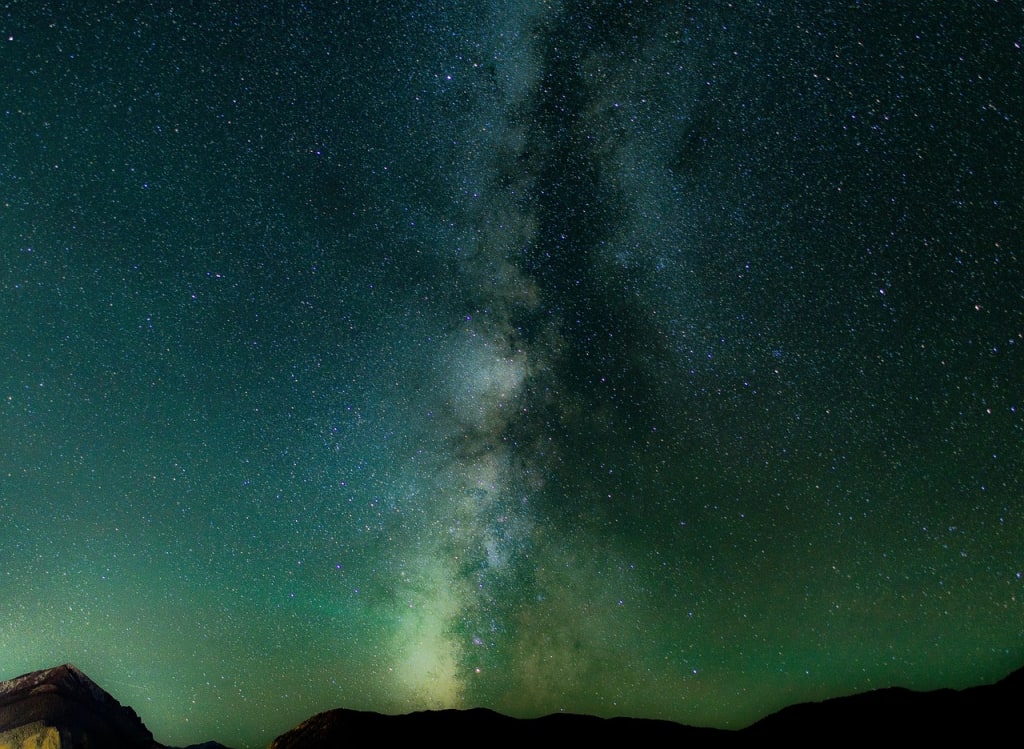
The final frontier fascinates artists as much as scientists. How we feel about being a tiny speck inside such a vast expanse is a complex topic that’s ripe for artistic interpretation. But before the 20th century, artists like Van Gogh could only depict space as seen from Earth. Since the Space Race, however, art has been created in space, sent to space and made using materials from space. Here are five of my favorite space art examples.
5. The 'Iron Man' Buddhist Statue
In 1938, a mysterious artifact was discovered by German scientists in Tibet. It was a statue of the Buddhist god Vaiśravaṇa, and it weighed over 10kg even though it was only 24cm tall. The scientists took the strange statue back to Germany, where it became part of a private collection. When it was auctioned off in 2009, scientists finally had the chance to investigate its properties, and what they found surprised them.
The sculpture was almost a thousand years old, and it was made from a rare type of iron with a high nickel content. This material is known to be found in a type of meteorite called an ataxite, and one of these had actually struck the region about 15,000 years ago. Known as the Chinga meteorite, it crashed into the Mongolian border with Siberia. The ancient artifact is thought to have been carved from one of its fragments.
4. Darryl Pitt’s Rare Meteorite Photography
The makeup, speed and strange origins of meteorites have long fascinated people. However, nobody really cared about how cool they looked until the photographer Darryl Pitt came on the scene in the 1990s. One of his most famous projects, called “Deep Impact: Rare Meteorites,” saw him snapping pictures of aesthetically pleasing space rocks from all around the world.
Far from being mere lumps of brown or gray rock as people might imagine, Earth-bound meteorites come in various colors, shapes and sizes. Some are made from iron and look like abstract space sculptures, although the most impressive may be the pallasites. These are extremely rare and said to be the most beautiful known substance from space. They form when asteroids shatter upon colliding with other asteroids, resulting in shiny yellow gems embedded in a white base.
3. Neil Buckland’s Mineral Mosaics
Darryl Pitt showed the world how whole meteorites can look impressive and artistic. Almost 20 years later, the artist Neil Buckland would show that they're just as impressive when seen up close, too. It all started when Buckland was helping a geologist at the University of Washington take photos of thin meteorite samples. He applied filters to polarize the light and was struck by the beautiful colors that emerged.
The colors varied based on what minerals were in the sample, which meant that each meteorite produced a unique mosaic of hues. Buckland could see the artistic potential, so he set about the painstaking task of photographing hundreds of two-square-millimeter sections of the samples at up to 40,000X magnification. This brought out all of their vibrancy and detail. Later, he combined the pictures to make high-definition images which could be blown up to 12 feet wide.
2. Alan Bean’s Moon Dust Paintings
Alan Bean was best known as the fourth person to walk on the Moon, but after the Apollo 12 mission in 1969 he took up a second career as an artist. Naturally, his experience as a lunar module pilot inspired many of the 170 paintings he would go on to create. But Bean's paintings also come with a unique twist. They contain pieces of his original space suit, along with actual Moon dust.
Bean's astronaut art has been displayed at the National Air and Space Museum and the Smithsonian, along with artifacts he has painted like the lunar rover and Alan Shepard's golf club. He believed his paintings will have a special place in history, as they are the first paintings of a place a human has visited that’s not on Earth.
1. Nicole Stott’s Watercolor Space Art
When the astronaut Nicole Stott brought her hobby with her to the International Space Station, she became the first person to produce a watercolor painting in space. Her painting, "The Wave," was based on a photograph she took from the ISS of Isla Los Roques, Venezuela. She described the image as looking as though someone had reached down and painted a big wave on the ocean there.
Since coming back to Earth, she has continued to create cosmic art inspired by the things she saw and experienced during her time on the ISS. According to her website, she believes that sharing her art can encourage people to better appreciate and care for their planet. Stott also spent 18 days in NASA's undersea Aquarius laboratory and has painted things inspired by her stay there, where she was surrounded by beautiful coral and sea life.
Out Of This World Art
I hope you enjoyed this little voyage through the universe of space art. I'm sorry I couldn't share any images, but please do go and check out the artists and support their incredible work using the links below. Also, keep an eye on my feed for a follow-up to this piece, as I have some more great examples to follow. Please share any of your own in the comments, too. I'd love to see them!
These words are all mine: no AI, no algorithmic curation. If you enjoyed this, please consider leaving a tip to support my work and buy my good boys and girls some treats!

Learn More About the Artists
- Darryl Pitt: https://www.christies.com/en/stories/extraterrestrial-art-1e7e8a2e9c8b49cb8bde8acce368dc50
- Neil Buckland: https://www.wired.com/story/capturing-meteorites-mineral-mosaics
- Nicole Stott: https://www.npsdiscovery.com/artist
About the Creator
Kieran Torbuck
Writer from the UK who lives in Thailand. Regular contributor at Listverse.com who loves uncovering fascinating facts and sharing them. Writing to support my five(!) former street animals (2 dogs, 3 cats) and help more when I can.
Keep reading
More stories from Kieran Torbuck and writers in Art and other communities.
'Till Death We Do Art
There would be nothing divine in this world without art. Nature may surpass the divine to all intents and purposes, but like everything it absorbs and is absorbed by, it remains here, stuck on the surface of this world, ever-present, physically bound to the universe.
By Avocado Nunzella BSc (Psych) -- M.A.P 24 days ago in Art
Rewire Your Mind for Success
brilliant inventor and worked day and night in her small lab, filled with glowing screens and strange gadgets. Despite her talent, she struggled to find success. Her inventions were often overlooked, and her ideas remained trapped in her mind.
By Hamad Afridi 2 days ago in Art




Comments
There are no comments for this story
Be the first to respond and start the conversation.