
Solitery Reper
Where Legends Wait Among the Grain

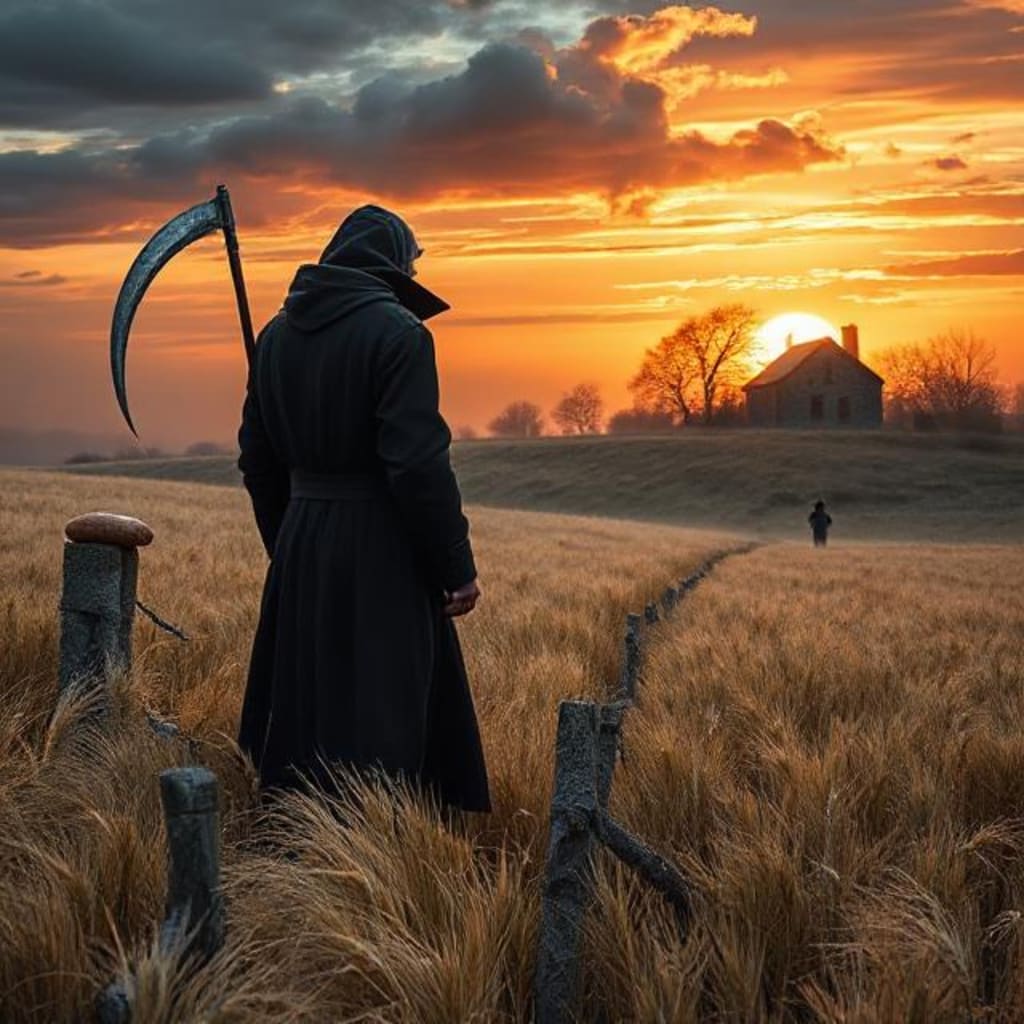
In silence, he walked the fields. In silence, he remembered.
In a far-off valley, ringed by ancient hills and shadowed forests, lay a village forgotten by maps and time. The villagers spoke little of the past and even less of the man who tended the western fields. He lived alone in a stone cottage at the edge of the golden barley, and many called him the Solitery Reper.
They said he came from nowhere. That he simply appeared one fog-laced morning, dressed in a dark coat, with a hood often drawn low over his face. He spoke only when necessary, and always softly. His voice, some said, carried an old sadness, as if each word cost him a piece of something he’d long lost.
He worked the fields with precision and grace. While the other farmers relied on machines, the Solitery Reper used only a scythe—an elegant thing with a curved silver blade that shimmered unnaturally in the sun. Every swing he made was exact, as if rehearsed for a thousand lifetimes. He harvested alone, from dawn to twilight, and when the wind blew just right, you could hear him humming an old, mournful tune that no one recognized.
Children dared each other to speak to him. Some swore he was a ghost, a cursed soul doomed to reap forever. Others believed he was a guardian, watching over the land until some ancient promise was fulfilled. No one truly knew.
But one day, something changed.
A young girl named Elia, no older than thirteen, had lost her dog—small, brown, and wily—and wandered into the edge of the Reper’s field chasing after it. The barley towered over her, golden and swaying. She was too focused on the barking ahead to notice the dark figure watching her from the edge of the path.
When she finally caught her dog, he was there.
The Solitery Reper stood silently, the scythe resting against his shoulder. His hood was pushed back slightly, revealing a gaunt face weathered by years of sun and sorrow. His eyes were gray like overcast skies, yet there was no malice in them—only the tired softness of someone who had watched the world spin for far too long.
"You shouldn't be here," he said, his voice as quiet as the wind between trees.
"I'm sorry," Elia whispered, hugging her dog tightly. "He ran off."
The Reper simply nodded. "He found something worth chasing."
Elia hesitated, then asked, "Why do you always work alone?"
He was quiet for a moment, then looked out over the barley. "Because the past doesn’t let me work with others. I reap what I sow."
It was an answer that made no sense to her, but the way he said it made her chest ache.
Elia left, but she never forgot the encounter.
The next day, she returned with a gift: a small loaf of honey bread wrapped in a cloth. She left it on the old stone fence at the field's edge. The day after, it was gone. For weeks, this continued. A new loaf every morning. And every morning it disappeared without a word. Until, one morning, in place of the cloth, was a flower pressed between parchment—a bloom long extinct in their part of the world.
Over time, more villagers noticed strange happenings.
A woman who had been bedridden for months awoke one morning with no pain. Her first words: "A man in the fields whispered my name in a dream."
Crops that had been withering under drought suddenly revived, only in the patches near the Reper’s field. A child lost in the woods was found asleep at the edge of his barley, cradled in a nest of straw.
Still, no one dared speak to him directly. Except Elia.
Years passed, and Elia grew from curious child to young woman. She became a teacher in the village, but every evening she’d walk to the field, sometimes to speak, sometimes just to sit on the fence and listen to the wind. The Solitery Reper rarely answered her questions, but sometimes he’d share a story—vague and poetic, like a dream half-remembered.
"I once danced under moons that rose in threes," he told her once.
Another day: "The scythe was a gift, forged from starlight and silence."
And another: "I was not always alone. But some promises outlive the ones who make them."
Elia began to suspect he was not simply a man—but something older, something bound to the land by magic or memory. One evening, as the sun set in waves of gold and fire, she asked the question she had long held back.
"Who are you really?"
He paused mid-swing, standing motionless among the stalks. Then, slowly, he turned.
"I am the last of a forgotten order," he said. "Once, we were many—keepers of balance between life and death. We did not take lives, but guided the endings that must come. We reaped only when the world whispered it was time."
Elia stepped forward, breath held.
"My brethren broke their vows," he continued. "Used their gifts for power. I... did not. I stayed. And so I remain, harvesting what nature gives, waiting until the world forgives."
She felt tears prick her eyes. "How long have you been waiting?"
He smiled faintly, and in that moment, he looked both ancient and young. "Long enough that even the stars I once knew have gone quiet."
That night, lightning split the sky, and a storm unlike any in living memory lashed the village. Crops flooded. Trees fell. Homes cracked. But the Reper’s field stood untouched.
When the storm ended, the villagers rushed to check on him—but he was gone.
His cottage lay open and empty. The scythe stood in the center of the field, buried halfway in the earth, glowing faintly under the morning sun. Around it, the barley had grown taller than ever before, rustling with an eerie calm.
Elia searched for days, but found no sign of him. Only silence, and wind.
Years passed.
The village healed, stronger than before. The Reper’s field became a place of peace, a sanctuary. No one harvested it anymore. It simply remained—a living memory of the man who walked alone and gave quietly.
And sometimes, when the wind blows just right, the villagers say they hear a distant humming—an old, mournful tune carried over the barley.
Elia, now older with silver in her hair, still visits the field every evening. She brings a loaf of honey bread and leaves it on the fence.
Just in case he ever comes back.
About the Creator
Keep reading
More stories from Muhammad Asad and writers in Art and other communities.
Amazing Plannet
In a distant corner of the multiverse, where time ticked not by hours but by the bloom of cosmic orchids, there existed a planet unlike any other. Its name, as pronounced by the native tongues of the whispering trees, was Plannet. Not "Planet" as humans might spell it, but Plannet—a deliberate name, as if fate had woven it twice into the fabric of reality, a double thread of destiny and design.
By Muhammad Asad11 months ago in Earth
'Till Death We Do Art
There would be nothing divine in this world without art. Nature may surpass the divine to all intents and purposes, but like everything it absorbs and is absorbed by, it remains here, stuck on the surface of this world, ever-present, physically bound to the universe.
By Avocado Nunzella BSc (Psych) -- M.A.P 21 days ago in Art
The Dress That Broke the Internet Was Gold and Nobody Could Agree on Why
She walked into the room and everything stopped. Not because of her confidence or music that was playing, though there was plenty of that. Everything stopped because of the dress. Floor-length, liquid, blazing gold, it caught every light in the room and threw it straight back.
By CurlsAndCommas6 days ago in Art



Comments
There are no comments for this story
Be the first to respond and start the conversation.