
[Shan Hai Jing Monsters] The Horned "Baby-Crying Eagle"
How Ancient China Romanticized Danger
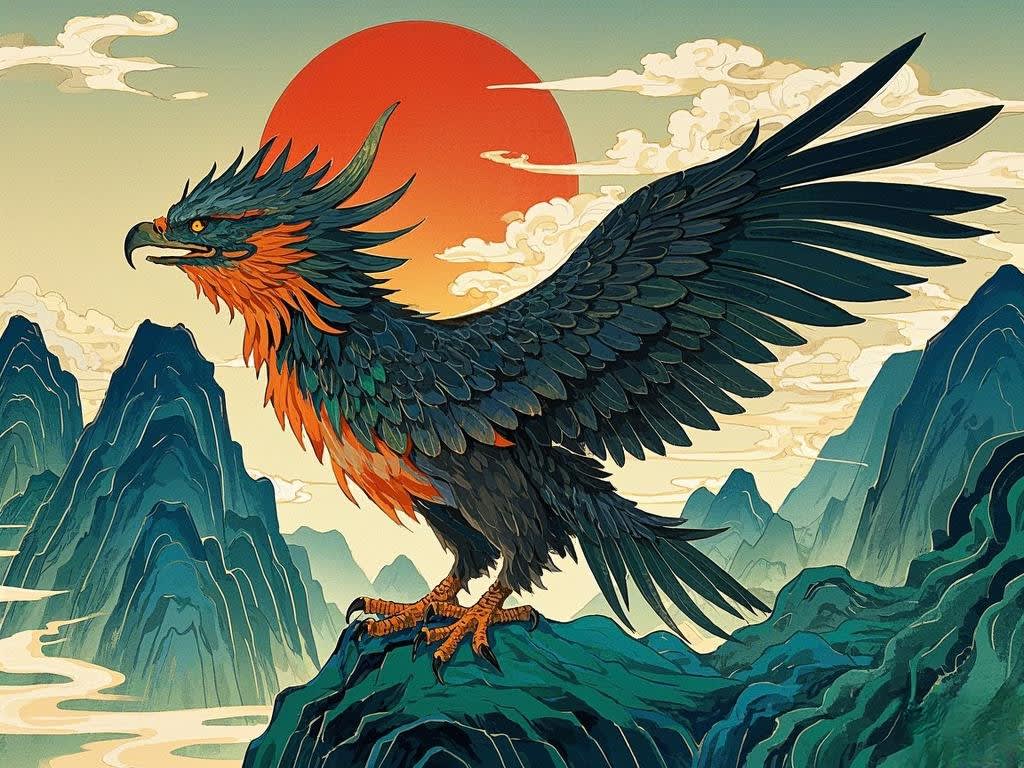
In 1600 BCE, a hunter along the Yangtze River heard a baby’s cry near the Red Water. Following the sound, he froze—there stood a 5-meter-wingspan eagle with deer antlers dripping blood, its "wail" identical to an infant’s. This isn’t Jurassic Park—it’s Gu Diao (蛊雕), the spine-chilling monster from Shan Hai Jing that reveals China’s complicated relationship with fear.
1. The "Baby-Crying Predator": A Mythical Biology Lesson
South Mountains chapter describes Gu Diao as a hybrid: eagle body + deer antlers + human infant’s cry. Its feathers glow blood-red at sunset; antlers twist with vines, fresh from jungle battles. The horror? It lures humans with fake baby cries—more sinister than Alien’s facehugger, preying on our protective instincts.
Proof? Sanxingdui’s bronze sacred tree (3,000 years old) depicts a "horned eagle" clutching a human head, wings etched with lightning. To ancient Shu people, Gu Diao wasn’t just a monster—it was a jungle survival guide. In an era without maps, a baby’s cry could mean death. Unlike Western griffins (eagle-lion hybrids), Gu Diao is pure oriental ecology: antlers from southern deer, eagle body from subtropical raptors, cries born of 雨林 (rainforest) night terrors.
2. From Headhunters to Tomb Guardians: The Monster’s Social Code
At Fujian’s Tanshishan Site (4,000 years old), human skeletons were buried with eagle-horn tools. Scholars speculate: Gu Diao justified headhunting rituals—like Māori tiki totems, it embodied both terror and protection. By Han Dynasty, Gu Diao became a tomb guardian—antlers turned into "celestial horns," beak now holding immortality herbs. This "domestication" of danger mirrors how Chinese treat typhoons: respect, but believe in coexistence.
The Huainanzi myth adds a twist: Gu Diao was slain by Houyi, the archer hero. This hints: with civilization (bows), monsters retreat—but remember, these "monsters" once taught survival.
3. Why We Still Love This "Evil Bird" Today
At Guangzhou Chimelong’s "Shan Hai Jing Zone," a robotic Gu Diao performs its "baby cry trap"—kids scream and stare, echoing an ancient paradox. Like how Duanwu Festival blends 艾草 (moxa, for exorcism) withzongzi (rice dumplings, for memory), our fear of Gu Diao holds reverence and romance.
In Black Myth: Wukong, Gu Diao becomes a cursed boss—antlers as energy crystals, cries as sound attacks. Designers kept the horror but gave it depth: "a misunderstood guardian." This is China’s monster philosophy: no absolute evil, only unheard stories.
In Shenzhen’s 城中村 (urban villages), tattoo artist A Jie displays Gu Diao art: a baby sleeps under its wings, antlers tangled with honeysuckle. "Ancestors said it eats people—but maybe it protects lost children." This reinterpretation turns 3,000-year-old fear into modern healing.
Epilogue: Monsters as Civilization’s Mirror
From jungle trap to museum totem to gaming anti-hero, Gu Diao’s journey reflects China’s soul. It teaches: fear’s opposite isn’t bravery—it’s understanding. Just as we now know a baby’s cry might be a plea, not a lure.
Next time at Sanxingdui Museum, find that bronze bird with a human head. It’s not a man-eater, but an ancestral love letter: In an unknown world, stay vigilant—but never lose imagination. After all, a civilization that dances with monsters truly understands 敬畏 (awe).
Discussion:If Gu Diao lived today, would it be a "city hunter" or an eco-warrior? Share your monster evolution ideas below!
(References: Shan Hai Jing·South Mountains, Sanxingdui reports, Chinese Animal Mythology; inspiration from Fujian Folk Museum’s headhunting exhibit)
About the Creator
hello-word
As a Chinese person, love for the culture of my own country. Nowadays, the global exchange of information is becoming increasingly rapid. I also hope that more people can gain a deeper and more detailed understanding of Chinese culture.
Keep reading
More stories from hello-word and writers in Art and other communities.
Chinese Mythical Creatures
Imagine this: 3,000 years ago in China’s western mountains, a hunter catches sight of an azure bird—its tail feathers shimmer like liquid jade, its song clearer than a harp, and wildflowers bloom extra petals as it passes. This isn’t a Harry Potter beast, but Luan Niao (鸾鸟), the divine bird from China’s oldest "national geography" book Shan Hai Jing (山海经), which even Confucius admired.
By hello-word12 months ago in Art
'Till Death We Do Art
There would be nothing divine in this world without art. Nature may surpass the divine to all intents and purposes, but like everything it absorbs and is absorbed by, it remains here, stuck on the surface of this world, ever-present, physically bound to the universe.
By Avocado Nunzella BSc (Psych) -- M.A.P 24 days ago in Art
Keto and Kote
This story has been sitting in my drafts for a long time because I didn't have good pictures for it. Murphy's law: I went to the performance with my phone discharged. But then I found the entire performance on YouTube and am now delightfully happy to share it with you.
By Lana V Lynx4 days ago in Art
Becca
"Everything is so... flat." Denille said stupidly as she looked around her new neighborhood. She looked around at the muted desert where even the smallest sign of life seemed to have given up. The plant life was shrubs that were half cooked by the heat and where there should have been a lawn, a mess of white rocks laid glistening in the sun. Even the sky looked stretched thin, like the sun had ironed it smooth. She’d moved from Riverside, where at least there were hills, but here in Barstow, everything felt baked and brittle.
By Sara Wilson8 days ago in Fiction


Comments
There are no comments for this story
Be the first to respond and start the conversation.