
Chinese Mythical Creatures
The Azure Bird That Holds 3,000 Years of Chinese Romance

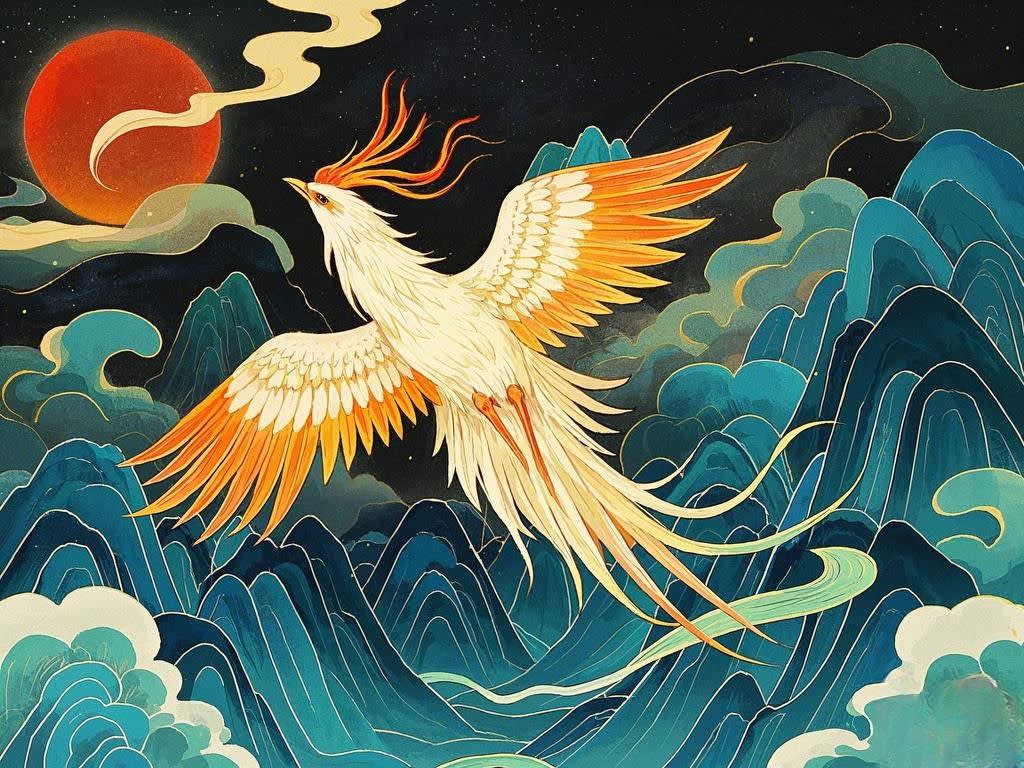
Imagine this: 3,000 years ago in China’s western mountains, a hunter catches sight of an azure bird—its tail feathers shimmer like liquid jade, its song clearer than a harp, and wildflowers bloom extra petals as it passes. This isn’t a Harry Potter beast, but Luan Niao (鸾鸟), the divine bird from China’s oldest "national geography" book Shan Hai Jing (山海经), which even Confucius admired.
1. What’s This "Phoenix Lite" Actually Look Like?
In Shan Hai Jing’s "Western Mountains" chapter, Luan Niao is a "slimmer, cooler phoenix": no rainbow feathers, just gradient teal-gold plumage; no fire or rebirth, but a talent for "singing and dancing to its own rhythm." Its most distinct feature? Crane-like legs—built for cloud dancing, not hunting.
Archaeologists found proof in the Marquis Yi of Zeng Tomb (2,400 years old): a bronze Luan holding a tiny dragon in its beak, wings engraved with 28 constellations. To ancient Chinese, it was a "flying planetarium." Unlike Western phoenixes (all about rebirth), Luan is a "nature’s harmony ambassador"—a living symbol of balance.
2. From 黄帝’s Orchestra Conductor to 王母’s "Delivery Bird"
Legend says Emperor Huangdi’s musician Ling Lun once froze on Kunlun Mountain—Luan’s song perfectly matched China’s five-tone scale (Gong 商 Jue 角 Zhi 徵 Yu 羽). He carved bamboo flutes to copy its "six notes and six rhythms," giving Chinese music its soul. Even The Book of Songs describes Luan leading animal parades to feasts—like an ancient "Zootopia" party!
By Han Dynasty, Luan became Queen Mother of the West’s "express courier." In Stories of Emperor Wu, a cyan Luan landed on the emperor’s dew-collecting plate with her invitation—imagine getting a "Qingniao (Blue Bird) has arrived" notification 2,000 years early!
3. The Luan Code Hidden in Chinese Characters
Walk into a Chinese wedding museum: Luan decor is everywhere—bridal veils ("Luan-Feng veil"), dragon-and-luan candlesticks, even red envelopes. Why? In Zuo Zhuan, a lord shot a Luan to make his wife smile—since then, Luan symbolizes "romance that gets you."
Today, 90% of "Luan" phrases relate to love: spouses are "Luan couples," friends "Luan bonds," even guitar strings are "Luan strings." Like how French use roses, Chinese poured tenderness into this bird’s feathers.
Epilogue: Luan Soars into the 21st Century
Now, a bronze Luan guides tourists at Chengdu’s Taikoo Li; the Palace Museum sells Luan-themed notebooks where it sips coffee. After 3,000 years, Chinese still believe: hearing Luan’s song means meeting life’s 最美 (most beautiful) sounds—a lover’s laugh, a child’s first words, or morning birds outside your window.
Next time you visit a Chinese museum, look for this azure beauty. It’s not a mythical monster, but a 3,000-year-old love letter from a nation to the world. In concrete jungles, who wouldn’t want a grass-scented Luan to land on their shoulder?
About the Creator
hello-word
As a Chinese person, love for the culture of my own country. Nowadays, the global exchange of information is becoming increasingly rapid. I also hope that more people can gain a deeper and more detailed understanding of Chinese culture.
Keep reading
More stories from hello-word and writers in Art and other communities.
The Enigmatic Fuzhu in "Shanhaijing"
In the rich and diverse pantheon of creatures within the "Shanhaijing," Fuzhu stands out as a unique and captivating being, shrouded in mystery and significance. This mythological creature has piqued the curiosity of scholars and enthusiasts alike with its distinct characteristics and the role it plays in ancient Chinese mythology.
By hello-wordabout a year ago in Art
'Till Death We Do Art
There would be nothing divine in this world without art. Nature may surpass the divine to all intents and purposes, but like everything it absorbs and is absorbed by, it remains here, stuck on the surface of this world, ever-present, physically bound to the universe.
By Avocado Nunzella BSc (Psych) -- M.A.P 19 days ago in Art


Comments
There are no comments for this story
Be the first to respond and start the conversation.