
Roman and proud of it
Conclave, cardinals and Christian crises

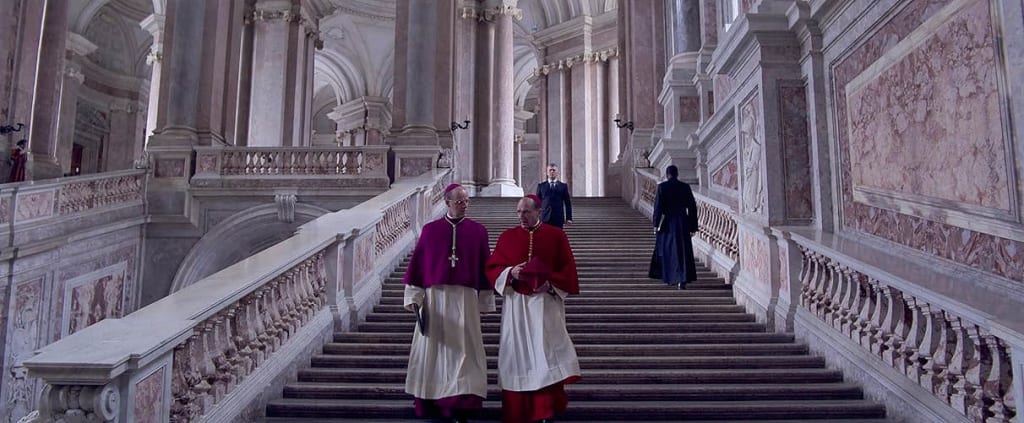
Wasn't going to write a review of the feature film Conclave, and this was not intended to be one. Rather, this piece highlights some of the moments in the movie that I found particularly moving. I guess this amounts to a review but I have not weighed up the good and the bad. Just saying what I liked, and that the experience was much more enriching than anticipated. You can make up your own mind, if and when you go to see it.
Let me say at this point that I am not religious, have no religion, do not subscribe to any system of morality, spiritual belief or anything like. Most importantly of all, I cannot accept the existence of any kind of deity beyond the murky realms of the human psyche. Yet to me, the most captivating scenes in this film were the ones that represented episodes of religious and ethical crisis. You could say that, for me, this summed up the qualities of the film as a whole.
Readers please note that this article is about the artistic and dramatic qualities of a feature film and its cast, and not about religion.
For this reason it surprises me (though I guess it shouldn't) that some Roman Catholics have come out in arms against the film, criticising it for portraying the Church as corrupt and its leaders as power hungry. No doubt this fragment of the faithful sees their high priests and patricians as saints already in heaven, completely lacking in human frailty. I'll say no more for fear of exciting a politico-religious row.
Aside from the lavish sets, stunning photography, and atmospheric use of the Latin, Italian and Iberian languages (all with an important place in the history of Christian religion), I found the story compelling. The sudden and unexpected death of a Pope precipitates a contest, the eponymous 'Conclave', to fill the void left at the head of one of the richest and most powerful organisations in the world. Arguably, for millions of faithful, this also represents an absence of their most important earthly spiritual leader, and a need to replace him.

Photo: IMDB
Who wouldn't expect such a situation to be fraught with intrigue? The way the story unfolds, however, takes such intrigue to a new dimension. Unlike other movies about power struggles, Conclave really plumbs the depths of moral crisis, and the mental and religious struggles of the protagonist. This is brought to stark life at the moment the bomb explodes, just outside of the Vatican. I will not spoil your enjoyment of this moment by explaining what I mean. If you have already seen the film, cast your mind back to what happened a few seconds before the bang and its showering of their eminences with debris, and you will know what I mean.
This, for me, is the real strength of the film. The dramatic action is slow and bubbling under, rising to a climax of mental and moral strife, matched only by the laying bare of deep religious conviction and question. I imagine it must be extraordinarily difficult to portray depth of religious feeling in a cinematographic context (I wouldn't know for sure, as I have never made a film). This one achieved exactly that, and not in a way that was soppy, sloppy or sentimental. Neither were there any clichéd burning martyr moments. This movie showed real men (briefly, two women) in agonising struggle with their consciences, to achieve something that was difficult and perilous to their faith, despite its obvious necessity.
SPOLIER ALERT
So what about those moving moments? Firstly, when Cardinal Lawrence (Ralph Fiennes) talks about the recently-deceased Pope refusing to accept his resignation. The reason, Lawrence says, is that the Pope considers him a 'good manager'. I know only too well what it feels like to be stuck in a role where you are considered too good at your job to be allowed to do anything more interesting or fulfilling. This point really struck home for me, even though Lawrence's ambition was no more than to give up the stresses of running the Papal See and revert to being a Monk cloistered in some remote holy order. There is nothing like being damned by faint praise. For this to come from the most important person in the world to you and your entire belief system must feel truly devastating.
As an aside, I was interested to note the audience reaction to some scenes in the film. The sight of a clutch of cardinals taking a crafty cigarette in the cloisters like naughty schoolboys, for instance, produced some giggles. I thought this reaction funny because (a) this was one of the scenes shown in the official trailer and (b) surely people know that many priests have vices such as smoking and drinking alcohol? Even more amusing was the audience reaction to other vices and surprises uncovered during the film. I'll say no more for fear of really spoiling the treat, and you can work it out for yourself when you see the film, as I would strongly recommend you do.
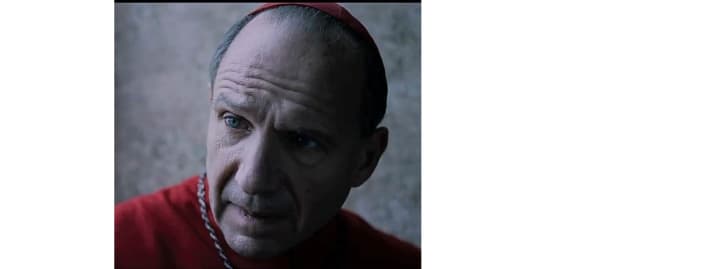
Photo: IMDB
One of the most moving moments for me was Fiennes's portrayal of his character's reaction to the many setbacks he faced as the one person tasked with seeing the papal election through. These may have started as irritating organisational inconveniences but built up, through the dramatic action of the movie, into crisis points of epic proportion, albeit that they were understated. I would never have thought that seeing one such crisis bring a tear to the eye of Ralph Fiennes (professor of overacting) would bring one to my own eye. This is the Ralph Fiennes, master of the art of the closeup raised eyebrow (presumably learnt from Roger Moore) and the ironic pout. One most notable achievement of this film's direction was to transform a self-parody of dramatic over-emphasis into a saint of understatement.
This is without doubt the real strength of the movie. Monumental world events take place, not on a grand scale, but at a personal level, a human level. I must apologise to those zealots of the Roman Catholic sect of Christianity who may be offended by the notion that human weakness can be shown by the leaders of their religion. I have no personal experience of being a Catholic and make no comment about other people's religious beliefs. And I of course speak as an outside observer. But I have always understood that the role of the Christian Church is to provide support for sinners to seek salvation. This was certainly the feeling I got from the cast of cardinals in Conclave.
About the Creator
Raymond G. Taylor
Author living in Kent, England. Writer of short stories and poems in a wide range of genres, forms and styles. A non-fiction writer for 40+ years. Subjects include art, history, science, business, law, and the human condition.
Keep reading
More stories from Raymond G. Taylor and writers in Art and other communities.
Paxton Art Show
The Paxton Art Centre and Café is well known to art lovers and others living in and around the Crystal Palace district of South East London. Just 15 minutes from Central London by Overground train and various bus routes. The Centre stages frequent art shows, classes and other events.
By Raymond G. Taylorabout a year ago in Art
'Till Death We Do Art
There would be nothing divine in this world without art. Nature may surpass the divine to all intents and purposes, but like everything it absorbs and is absorbed by, it remains here, stuck on the surface of this world, ever-present, physically bound to the universe.
By Avocado Nunzella BSc (Psych) -- M.A.P 23 days ago in Art
Heavenly Harmonies and Heavy Criticisms: The Complex Rise of Bethel Music
Heavenly Harmonies and Heavy Criticisms: The Complex Rise of Bethel Music Walk into almost any contemporary Christian church on a Sunday morning—whether in London, Lagos, or Los Angeles—and you are almost guaranteed to hear their music.
By Nivard Anna3 days ago in Art



Comments (6)
I so very much appreciate your thoughts on this movie. I have teeter-tottered about watching it...now I want to! I am not Catholic, and I am not a Protest-ant, either. Just a believer in a man named Jesus and a Creator who loves us all...so your thoughts have been a positive for me. Plus I admire Ralph Fiennes as an actor, so great "review" of your thoughts :)
I'm not a religious person either. I'm an agnostic. But hahahahahaha all that you've said here has piqued my interest to watch the movie. Loved your review!
What a great 'movie review' and I am not Catholic, but this seems to be a very interesting movie to watch.
so weird that you posted this as I just watched this last night. I think you hit the artistic elements right on the head. It a stunningly moving piece of art that uses form to build tension in the mundane. One little element I loved is the final hearts and minds debate happening in the theater. When the movie ended, I'll go as so far as to say I hated the ending, but after a couple hours of unpacking I realized the depth of nuance in this film that very likely went over religious and lay watchers alike. It's the type of movie that requires a conversation with a real person to unpack. Also, I found it highly unlikely it wasn't inspired by the once widespread legend of Pope Joan, which was a nice Easter egg for the history sickos like me. Besides the setting, the only overtly religious commentary is Ralph's homily, a stunning soliloquy that says nothing outside of basic catholic doctrine.
Hi - I was surprised as to how much I enjoyed this movie, as, like yourself, I don't follow any religion. However, I do love history and architecture, and the process of electing the new pope was fascinating. But, let's not talk about the big reveal at the end, which I found ridiculous, and a real disappointment, after the drama, emotion and excellent acting.
I have not watched the movie, but I see a lot of reviews on Vocal, especially from the nonreligious creators. It's always interesting to see what part of the movie that stood out to people the most. I have met a priest in real life who dropped out of being a priest and married the woman he loved and how his family gang on him for doing so.